Carmen

“Love is a rebellious bird that no one can tame… And if I love you, watch out !”

Act I ─ Carmen

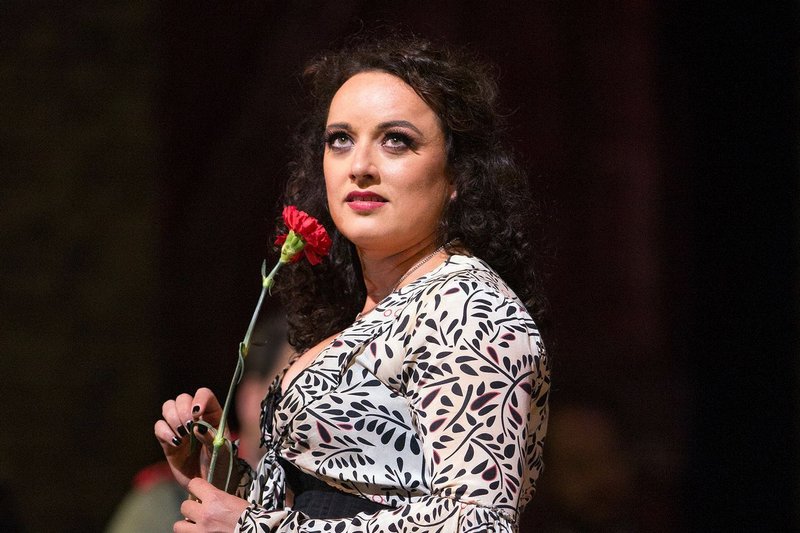
Opera’s most notorious femme fatale finally sashayed her way into the theater after keeping me waiting for years. Truthfully, I have longed to see Carmen for two reasons. First, the bouncing music, which is both tuneful as well as recognizable, is an alluring draw to Bizet’s landmark opera. And then there’s Carmen herself, a meaty role for any mezzo-soprano. Clémentine Margaine, French by birth, slipped into the black dress for this Live in HD performance.

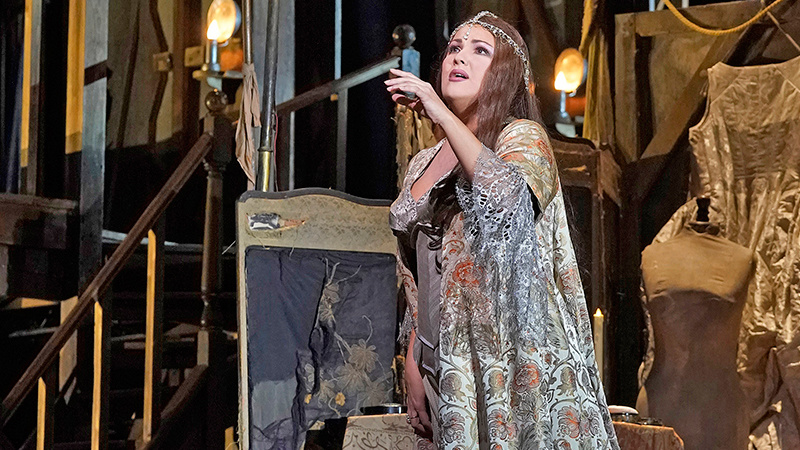
Clémentine Margaine as Carmen / Metropolitan Opera

Gritty, but perfumed, Clémentine Margaine balance crude manners with beguiling charm. Watching her sent my mind into vacillations of resolve as to who she really was: a woman who looked attractive at first glance, but on further inspection was nothing more than a broad wearing lipstick and eyeliner. There was a hardness about her ─ an earthiness ─ that befit the role of the tempestuous gypsy well. This baseness was especially noticeable when compared to the sweet and singular Micaëla, played by Polish soprano, Aleksandra Kurzak, who also happens to be the real life wife of Roberto Alagna, the opera’s Don José !

Aleksandra Kurzak as Micaëla and Roberto Alagna as Don José in Carmen / Metropolitan Opera

While the songs were as exciting as I hoped they would be, I wouldn’t say that Carmen ranks as one of my favorite operas. It’s too long for a story that feels humdrum and predictable. From a personal standpoint, Bizet’s earlier work, Les Pêcheurs de Perles, was much more intriguing in terms of plot and outcome. Nevertheless, I was happy to be able to check Carmen off my list of must-see operas.

A scene from Carmen / Metropolitan Opera

Just as the singer who plays Carmen often relishes the chance to live vicariously through the role, so I also wanted to step into the clicking heels of a Spanish gypsy through my portrayal. Although Richard Eyre’s production is set in Seville during the 1930’s, I felt many of the costumes seemed pertinent to the present day and so I decided to model my look after the dancing ensemble worn by Carmen in Act II.

A scene from Act II of Carmen / Metropolitan Opera

A voluminous bell sleeve blouse and lace skirt swings in time to the rousing Gypsy Song while a black corset exemplifies Carmen’s signature seduction. Planning my version of the outfit was easy, especially when I thought of the coral colored crinkle skirt in my mother’s closet that would be perfect for the part. Marking the tiers with rows of beads, it was destined for bohemian couture. Two yards of Raschel lace, which I bought for a bargain during a Black Friday sale, were draped and pinned on the outside of the skirt like a sarong.
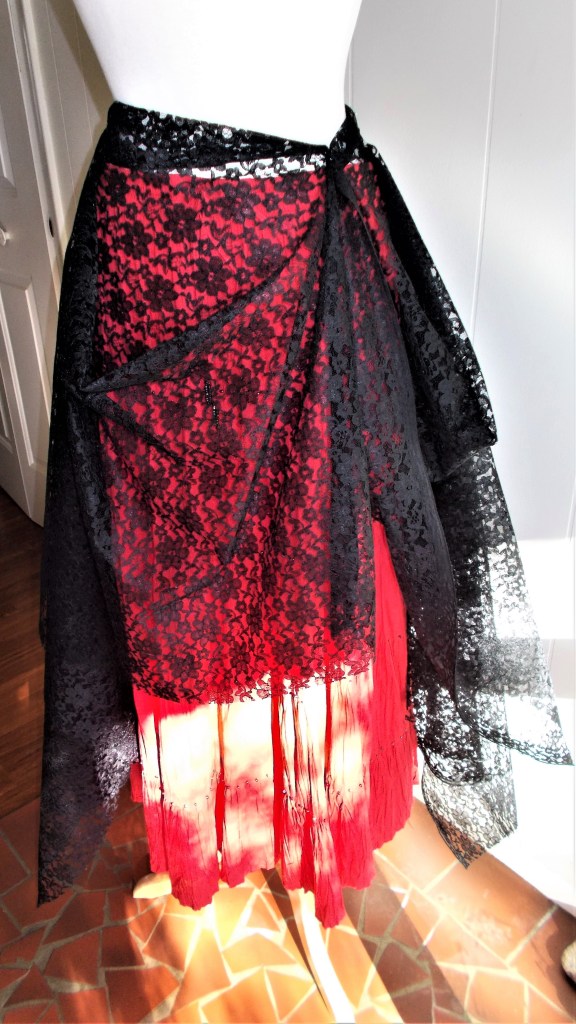
The lower half of the outfit complete, I moved onto the fun parts ─ the corset and the blouse !

Yes, I made a corset. It was easy with the patterns and instructions from the Corset Academy, which I use often when making structured garments. Shaping my figure, the corset was mostly hidden beneath the flouncy tie bottom blouse I sewed using the free wrap blouse pattern from Anke Herrmann’s website for Flamenco Dressmaking. Her advice and support were valuable as I altered the style slightly to suit my needs. Once I found a festive dot crepe fabric on closeout online, I was ready to sew my blouse.
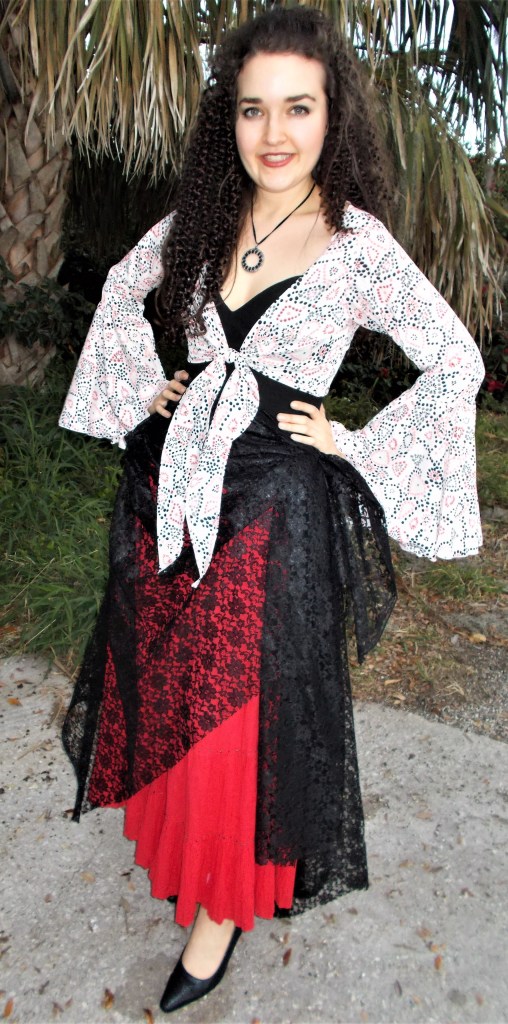
Making the bell sleeves was not as difficult as I anticipated, especially using a circle skirt cutting layout. And I loved using the rolled hem setting on my BabyLock serger ! It made the edges of my bell sleeves frilly and polished.

“But what about your hair ? Is it real ?” Yes and no. Looking over past Met performance pictures, I knew I needed tightly curled locks to match that of the character’s and so I related my plight to my mother (also known as my hairstylist) whereupon she gauged that trying to curl my naturally soft and wavy hair was a futile effort. Ultimately, she suggested I find some hairpieces. Well, I did, but the entirety of that story is not fit for publication. It involved a shady shop on the wrong side of town and a man who tried to convince me that he bore an uncanny resemblance to Che Guevara. Fearful for my life ? Just a smidge.
Doing her best, my mother mingled my hair with the newly bought hairpieces to capture the Spanish vibe I was seeking.

Steeped in Sevillian style, I thoroughly delighted in playing opera’s most infamous gypsy, especially when twirling around in the theater on the way back to my seat. Olé !

Toi, Toi, Toi,

Mary Martha

Casts and Credits:

Carmen ─ Georges Bizet (1875)
Live in HD air date: February 2, 2019

Cast:
Carmen ─ Clémentine Margaine
Don José ─ Roberto Alagna
Micaëla ─ Aleksandra Kurzak
Escamillo ─ Alexander Vinogradov

Credits:
Conductor ─ Louis Langrée
Production ─ Sir Richard Eyre
Set and Costume Designer ─ Rob Howell
Lighting Designer ─ Peter Mumford
Choreographer ─ Christopher Wheeldon
Live in HD Director ─ Gary Halvorson
Host ─ Ailyn Pérez
Madama Butterfly (2016)

Tragedies have always attracted me. Fully aware that the ending will be sad and the experience will most likely cause some degree of physical and emotional depletion, I still find myself being drawn to the most dramatic literary form like a batty moth to a glaring light. And when one of opera’s most famous tragedies is set to some of the most beautiful, heart-soaring music, the call to attend is heeded without question.

Intriguingly, Madama Butterfly could have been my first opera: glancing over the 2015-2016 Live in HD schedule, I thought it would be a perfect “first-timer” opera since its title is readily on the lips of laymen. But other decisions were made and now stepping into the theater in early April 2016, my opera attendances had now totaled beyond what could be counted on one hand.

The opening pantomime from Madama Butterfly / Metropolitan Opera

So what did I think of Madama Butterfly ? I loved it ! The music was thematic and stunning while the costumes were colorful and imaginative. Also appropriately mimicking the clean, Japanese aesthetic were the sets designed by the late director, Anthony Minghella.
Of course, there was heartbreak, but the unwavering balance created by the supporting characters of Suzuki and Sharpless added stability to an otherwise distressing story.

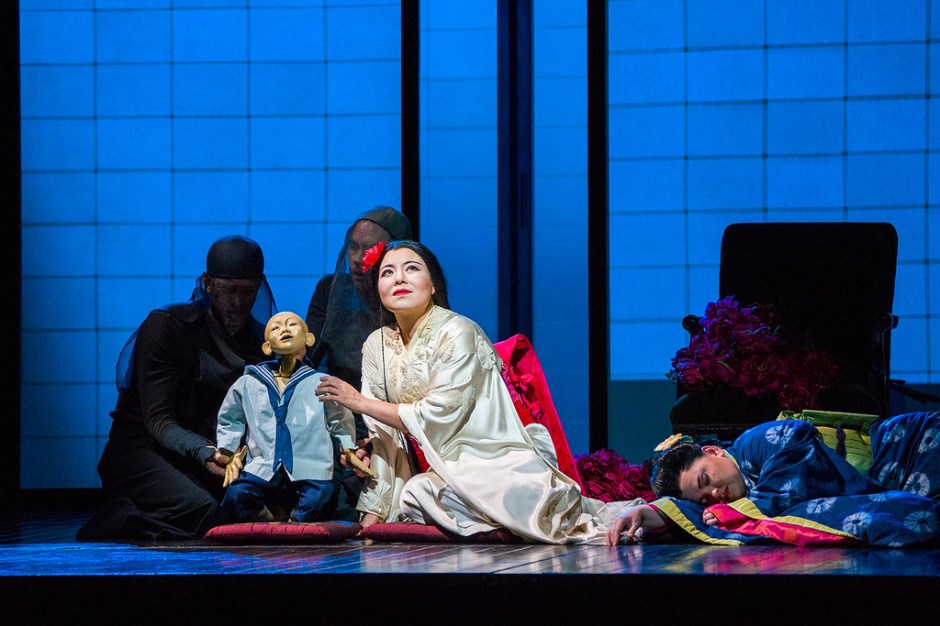
Kristine Opolais as Cio-Cio-San and Maria Zifchak as Suzuki / Metropolitan Opera

However, my winner of the day goes to Kristine Opolais, who sang Butterfly. What a sublime actress ! Her ability to convey both tenderness and frustration as the unfortunate geisha was unmatched, even though her voice sounds a bit too “hollow” for my liking. If only she and Roberto Alagna (Pinkerton) could have swapped heights… Too many times did I notice Opolais purposefully stooping as she pattered on stage in order to diminish the deficit between her head and that of her leading man’s.

Kristine Opolais and Roberto Alagna in Madama Butterfly / Metropolitan Opera

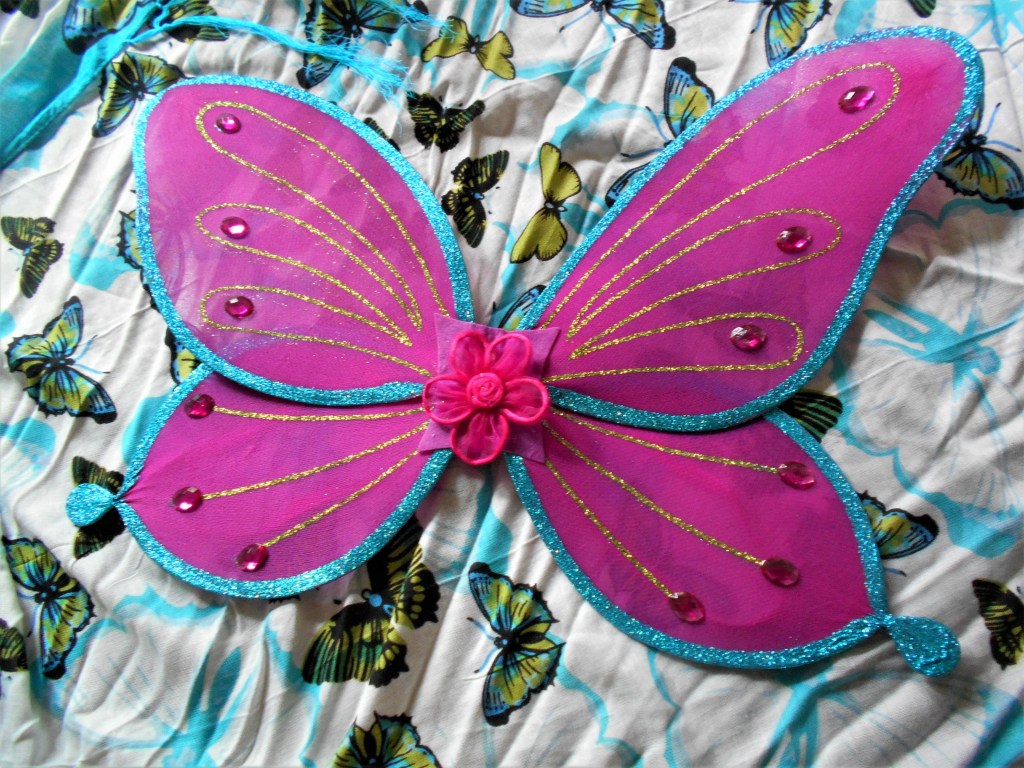
“Now, what to wear…?” Hitherto, I had been able to furnish themed costumes out of accessories in my closets with limited issues. Butterfly was a different story. Not knowing anything about the opera beforehand, I first toyed with the idea of draping a long skirt in a scarf printed with bright butterflies and donning a pair of child’s dress-up butterfly wings… Just as Pinkerton abandoned Butterfly, so I also jettisoned that silly notion.

Madame Butterfly ? Not quite…

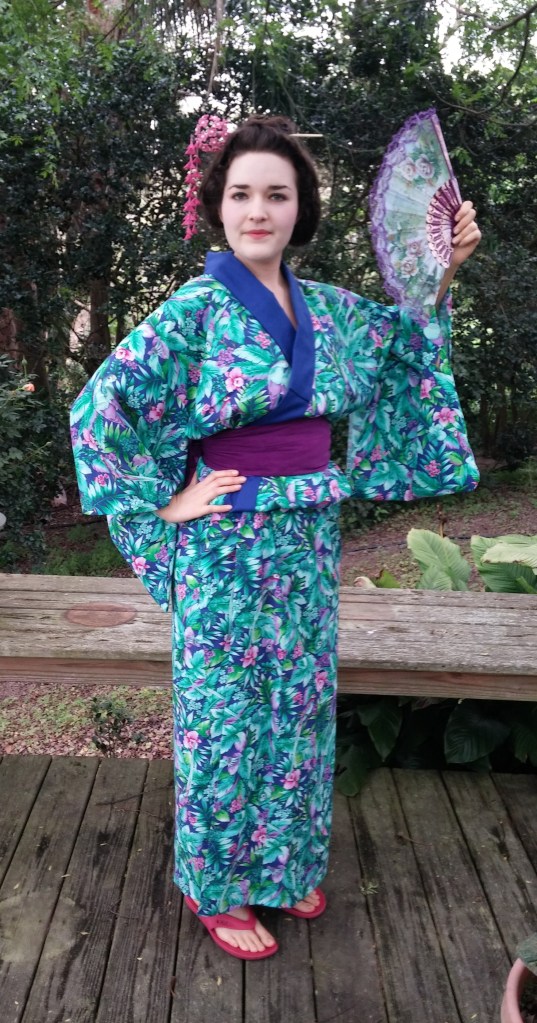
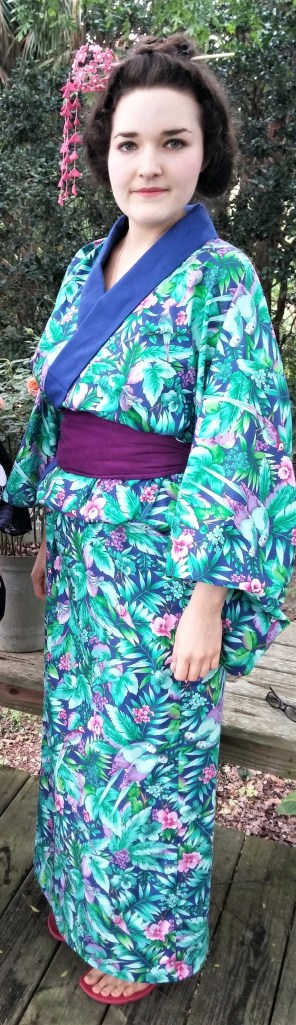
Desperate for a solution japonaise, I realized I had no other option but to make my own kimono. But where to begin ?! I didn’t even know how to operate a sewing machine ! Determination, however, was stronger than Doubt. Unearthing the old Singer sewing machine, sheathed in dust, from under my mother’s bed, I sat on the floor of my bedroom trying to understand how the machine worked. Turning the hand wheel and observing how and where the needle fell was a fascinating procedure, but I wasn’t gaining ground on my endeavour. Thank goodness for online articles and YouTube ! After many failed attempts at propelling the needle on its journey, something finally clicked and I sewed my first line of stitches. Eureka ! Now to begin the staggering challenge of sewing a yukata…

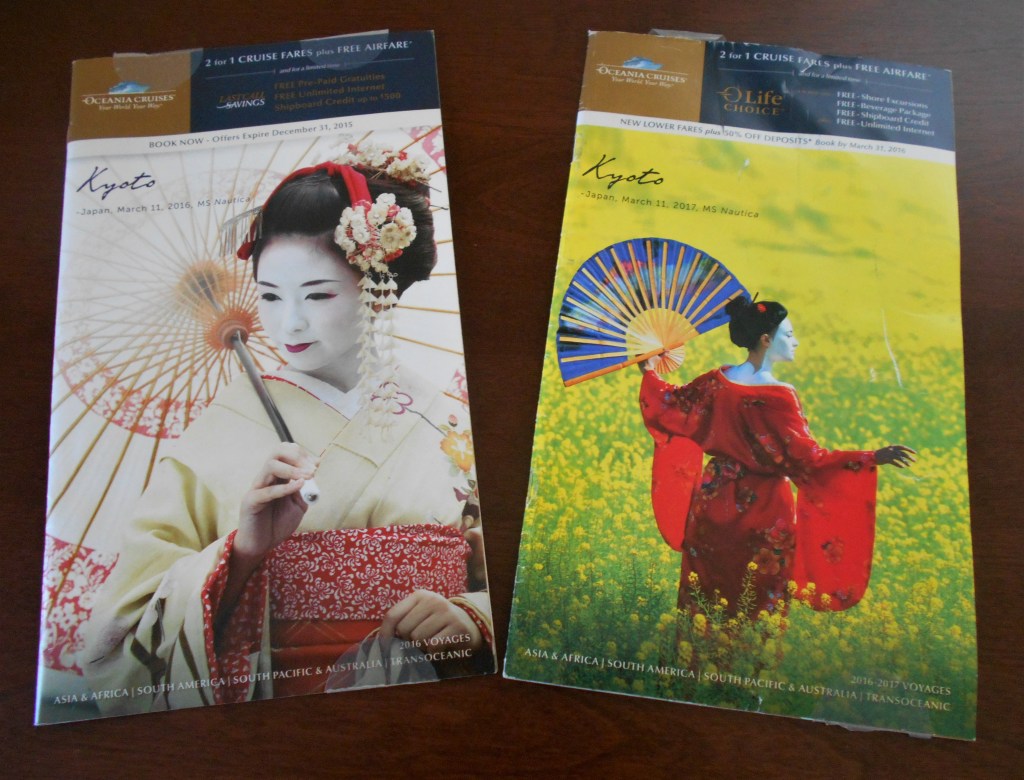
Inspiration while working on my yukata: cruise line travel brochures !

Keeping my project a secret, I worked late hours in my bedroom following the instructions for a homemade yukata. Astoundingly, I learned and retained more information about kimonos, yukatas, and Japanese geisha culture than I ever imagined. One of the greatest benefits of sewing costumes is the amount of research needed to facilitate an authentic look and therefore, the knowledge gained in the process. Differentiating the method from textbook learning is the hands-on approach that ensures greater retention even after the project is complete. Even now, I can name off all the parts of a kimono and some of the little intricacies of geisha manners.

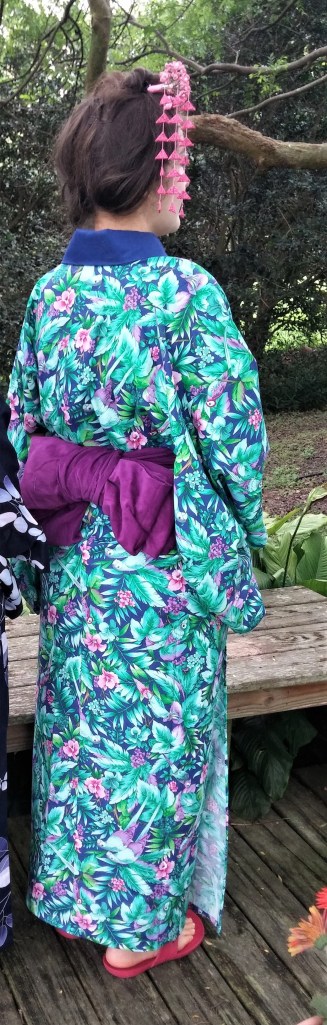
Nearly all the design aspects of my cotton yukata are traditional (except the contrasting bachi eri, but that’s only because I ran out of the main fabric !). From the ohashori (pouched fabric beneath the obi) to the left-over-right okumi panels (NEVER right-over-left ─ that’s for corpses only !!!!), my yukata was fit for a Japanese festival. I even made a matching kanzashi chopstick hairpiece to tie into the tropical print of the yukata.

Kanzashi hairpiece and obi tied into a bow

Overall, I was proud of my very first sewing project─ wearing my creation to the theater made me feel as if I had conquered an unimaginable feat !
With Madama Butterfly, my taste for tragedy was well satiated. In matters of sewing, my palate had just been whetted.

Toi, Toi, Toi,

Mary Martha

Cast and Credits:

Madama Butterfly ─ Giacomo Puccini (1904)
Live in HD air date: April 2, 2016

Cast:
Cio-Cio-San ─ Kristine Opolais
Pinkerton ─ Roberto Alagna
Suzuki ─ Maria Zifchak
Sharpless ─ Dwayne Croft

Credits:
Conductor ─ Karel Mark Chichon
Production ─ Anthony Minghella
Director and Choreographer ─ Carolyn Choa
Set Designer ─ Michael Levine
Costume Designer ─ Han Feng
Lighting Director ─ Peter Mumford
Puppetry ─ Blind Summit Theatre
Live in HD Director ─ Gary Halvorson
Host ─ Deborah Voigt*

*Matthew Polenzani originally scheduled to host broadcast.

Die Walküre

I couldn’t have asked for a better opera for my first outing of Wagner: from Bugs Bunny to WWE wrestler walk-up music, Die Walküre‘s fame and legacy permeates all realms of music and culture. Who hasn’t heard the irresistibly iconic “Ride of the Valkyries” or been amused by the warrior women with braids and Viking helmets ?

Part of an epic tetralogy know formally as “Der Ring des Nibelungen”, Die Walküre explodes with mythological drama and some of the most involving music ever written. Ever since I began attending operas, I’ve always heard mentions of Wagner’s “engrossing” music and how spectators loose track of time while taking in a performance, despite the harrowing length of most of Wagner’s works. Knowing this, I was a little apprehensive about how I would fare at my first Ring opera.

Jamie Barton as Fricka, Greer Grimsley as Wotan, and Christine Goerke as Brünnhilde in Die Walküre / Metropolitan Opera

I shouldn’t have been worried ─ I loved Die Walküre and was hooked on the Ring Cycle ! While the layered story dipped into several previous arcs that occurred in Das Rhinegold (the first opera in the tetralogy), I found I was able to keep pace with the action and inevitably slipped into that intoxicating Wagner “trance”. Brutish warriors and incestuous twins aside, there were greatly tender moments as well. The final farewell between Wotan, the flawed God of Valhalla, and his disobedient Valkyrie daughter, Brünnhilde, nearly sent my mascara running !

Greer Grimsley as Wotan and Christine Goerke as Brünnhilde in Die Walküre / Metropolitan Opera

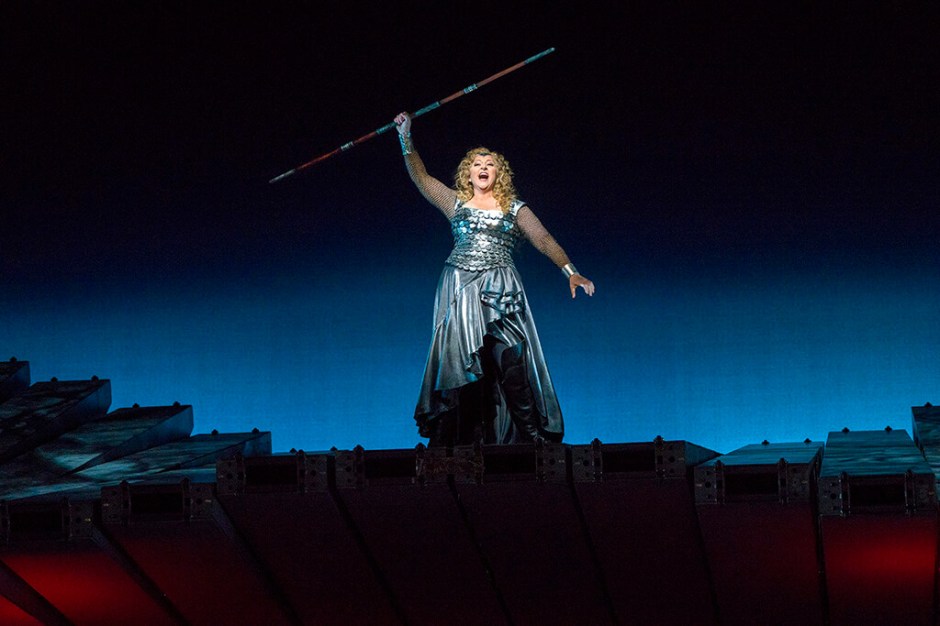
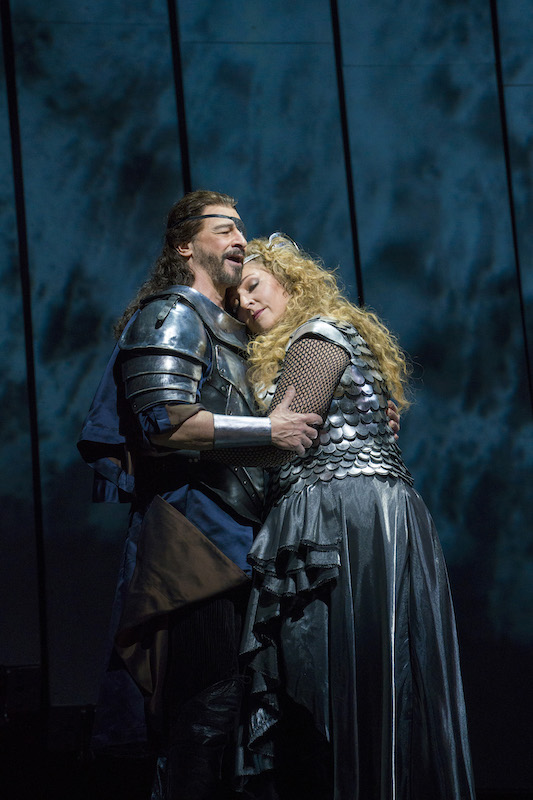
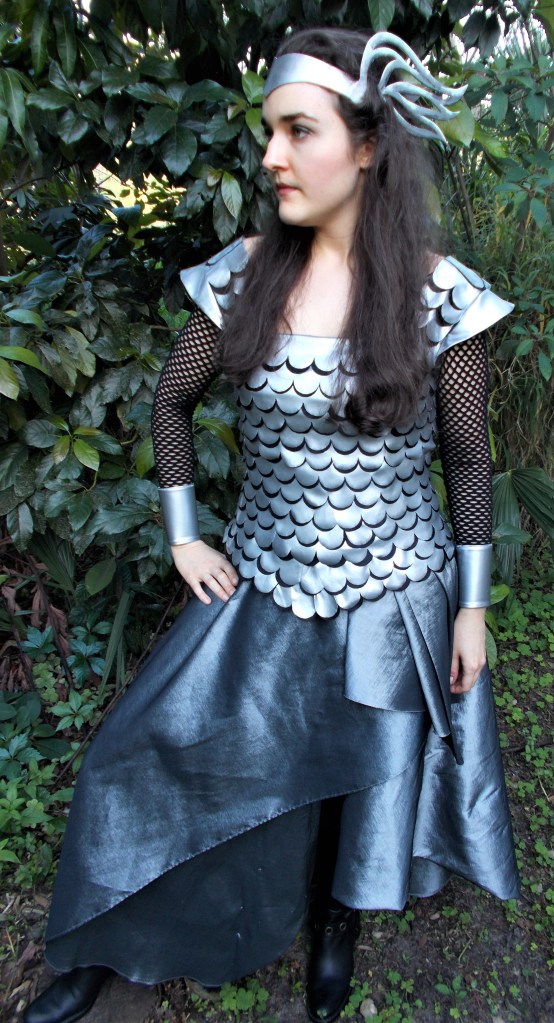
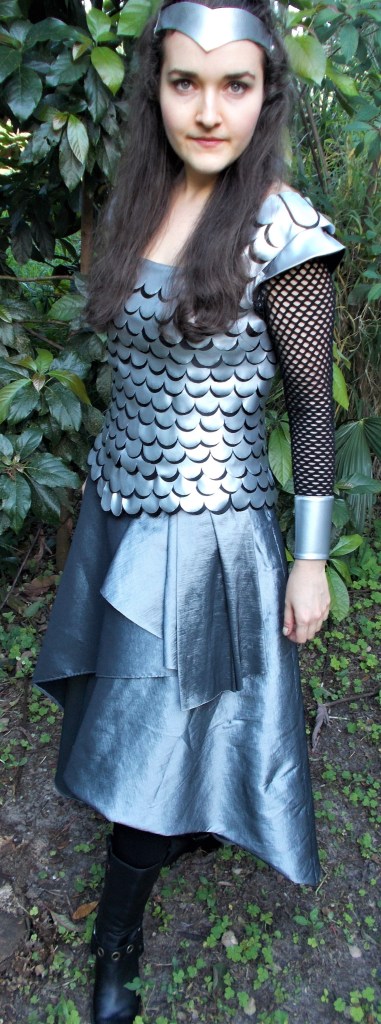
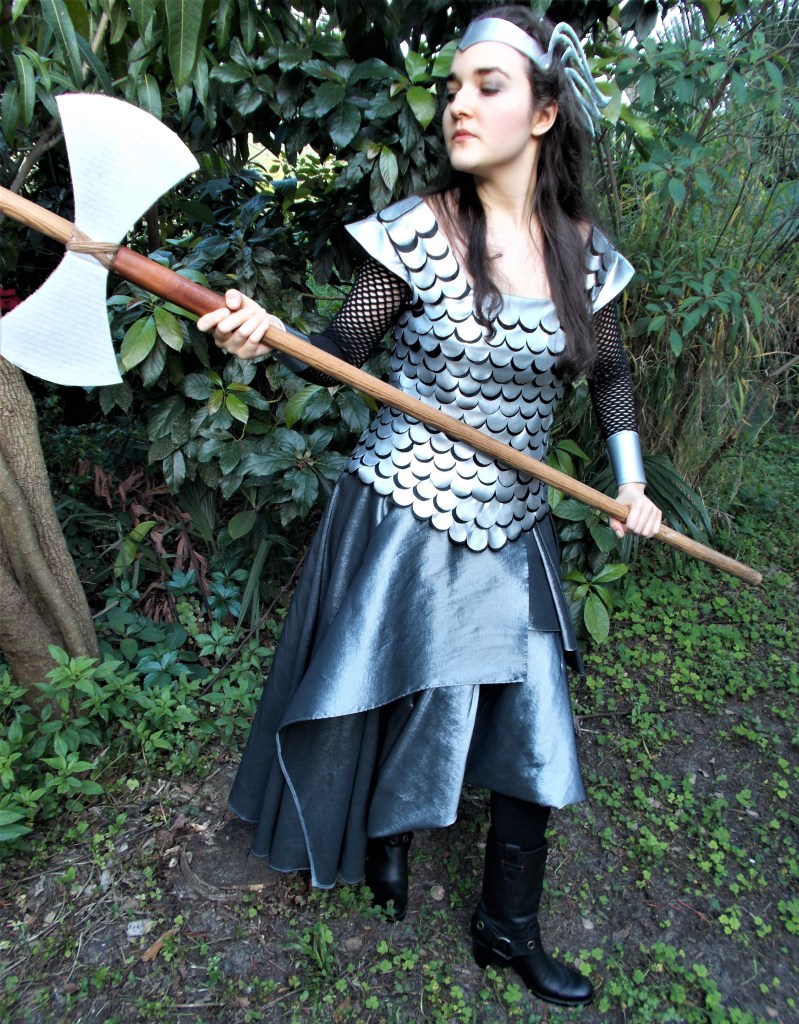
What is a ‘Valkyrie’ anyway ? In reading up on Norse mythology, I learned how Valkyries were immortal female fighters who aided in the battles among men on earth and safely carried the fallen heroes to Valhalla where they would live and serve Wotan in happiness. Although generally styled as Viking women with horned helmets and long braided pigtails, the Met’s Robert Lepage production has altered the women’s accoutrements to have filigreed chrome wings mounted to diadems and textured skirts of a metallic mylar material. As a costume that would unmistakably smack of cosplay, I set out to replicate the shiny scaled armor bodices and flashy skirts of the Met’s fearless Valkyries.

A scene with the Valkyries: Christine Goerke as Brünnhilde and Eva-Maria Westbroek as the Wälsung, Sieglinde / Metropolitan Opera

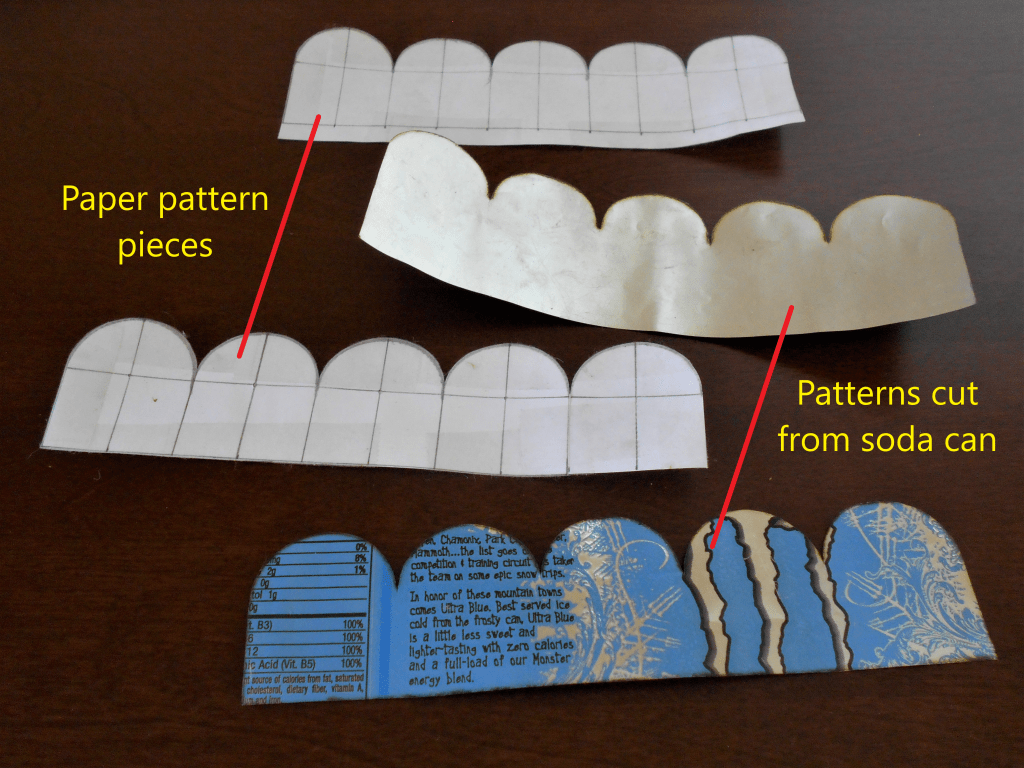
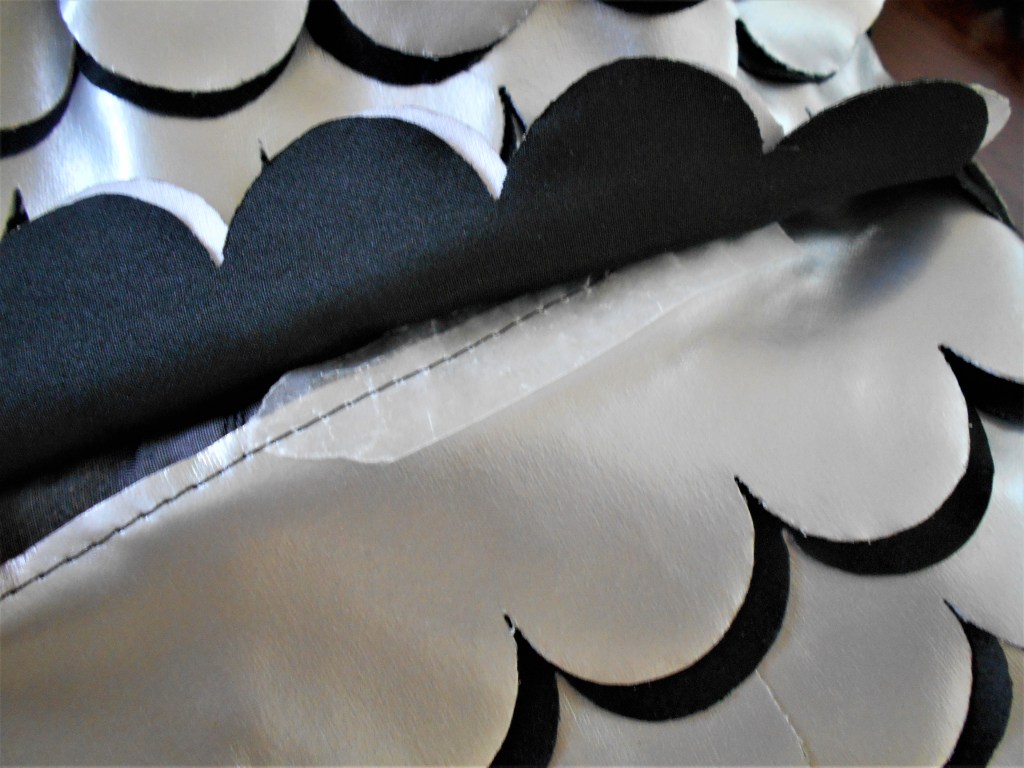
Sourcing the materials was the first step. Initially, I thought of using a spangle sequin fabric for the chain mail bodice, but decided against it in favor of hand cutting my “scales” out of versatile silver pleather for a more authentic look. In order to use my hot knife on the pleather, I needed a stencil and a sturdy one at that ! A branding pen devours paper like the flames of Brünnhilde’s bridal fire ─ I transferred my paper patterns onto an empty soda can and burned both pleather and black matte satin using their forms.

With long lengths of scalloped scales simultaneously cut and sealed, I sewed them alternately onto a princess bodice I drafted to fit my figure using patterns from the Corset Academy. Wax paper was the saving grace while stitching sticky, scrunching pleather…

Wax paper stitched on top of the pleather

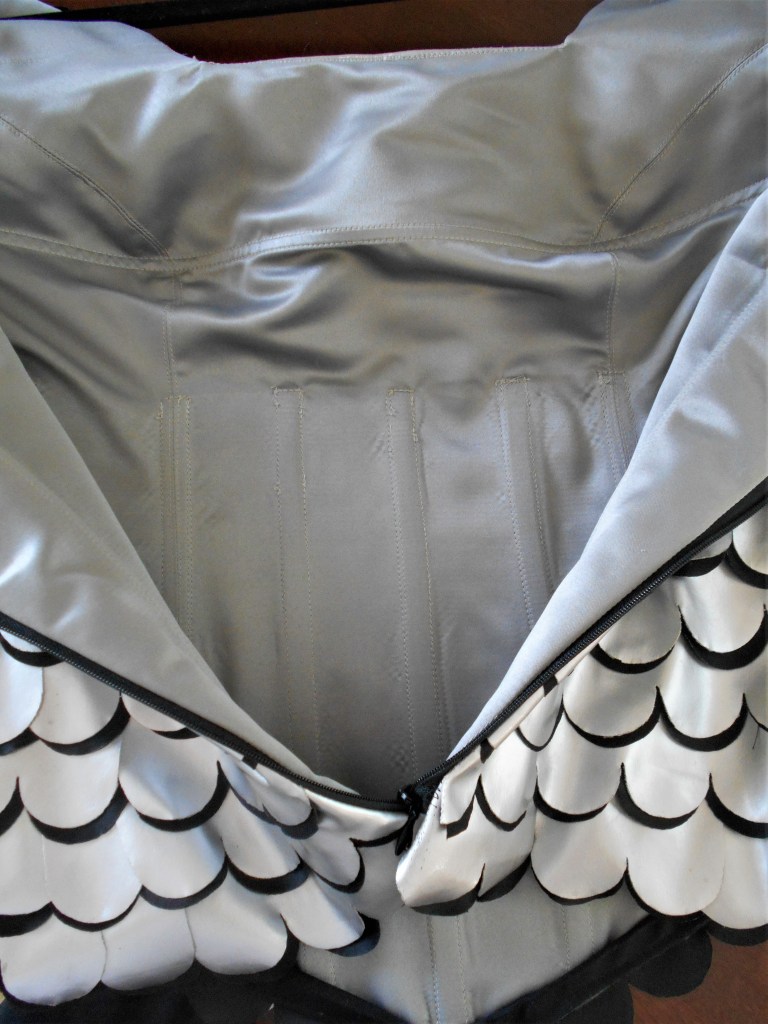
Just a note─ I don’t suggest making a lining out of heavy polyester satin, especially if you live in hot and humid climates like I do. While I could quell my mascara from running down my cheek, the sweat down my spine I could not. The bodice was a polyester sauna !

Bodice lined, boned, and topstitched along seams

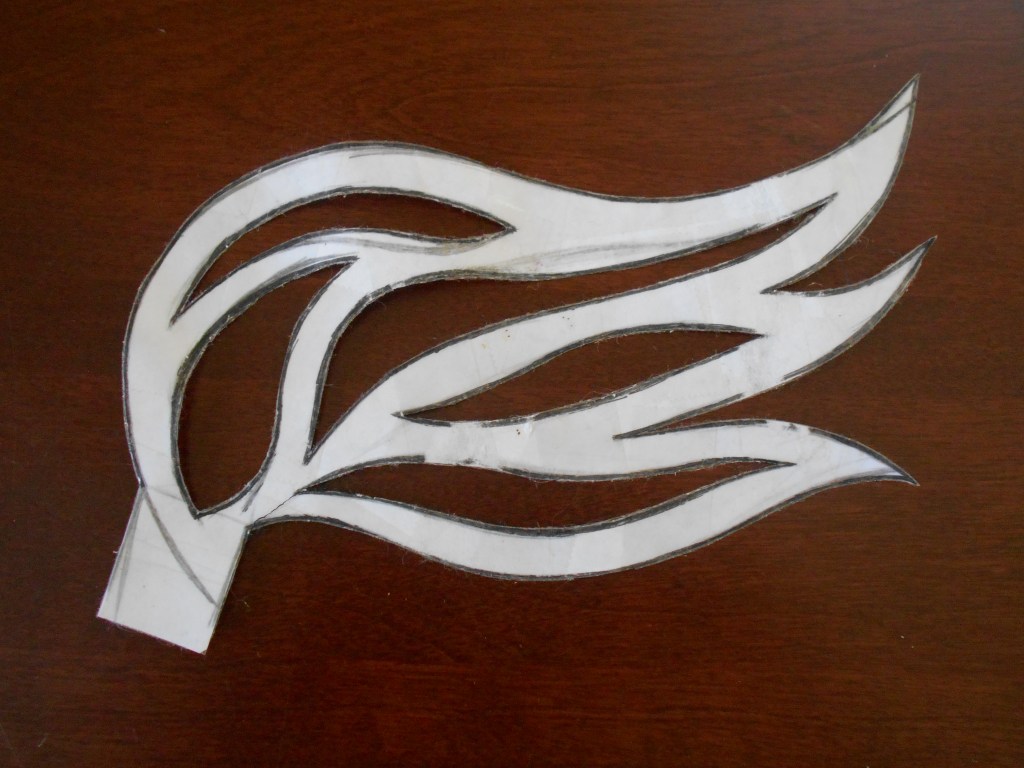
One of the most distinguishing features of the costume was the lofty pair of wings, glinting in the flashes of battle. Using pictorial resources available on the web (particularly, Deborah Voigt’s portrayal), I drew a freehand version of the openwork wing on paper and transferred it onto a thin cardboard cereal box to be spray painted later.

Deborah Voigt as Brünnhilde / Metropolitan Opera
The paper wing stencil

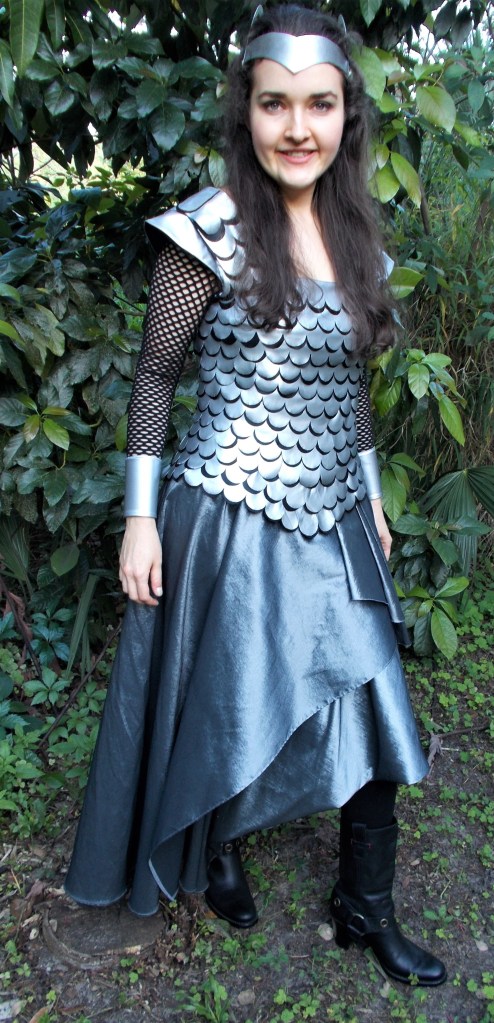
Once the wings were painted, they were affixed to a pleather covered foam diadem. Wrist cuffs out of the same foam/pleather combination anchored the tapered ends of the fishnet mesh sleeves. All that remained was the skirt, which was created from steely stretch taffeta by a series of angled half circles formed into a wrap style. The costume was finished and I was ready to take flight as a Valkyrie !

In spite of the poor choice of lining material, wearing this costume was a thrill ! After all, how many people can claim that they’ve been a Valkyrie ? This outfit also doubled as my Halloween costume for the year and just as at the theater, it sparked otherworldly interest.

“Hojotoho !”

Toi, Toi, Toi,

Mary Martha

Cast and Credits:

Die Walküre ─ Richard Wagner (1870)
Live in HD air date: March 30, 2019

Cast:
Brünnhilde ─ Christine Goerke
Sieglinde ─ Eva-Maria Westbroek
Fricka ─ Jamie Barton
Siegmund ─ Stuart Skelton
Wotan ─ Greer Grimsley
Hunding ─ Günter Groissböck

Credits:
Conductor ─ Philippe Jordan
Production ─ Robert Lepage
Associate Director ─ Neilson Vignola
Set Designer ─ Carl Fillion
Costume Designer ─ François St-Aubin
Lighting Designer ─ Etienne Boucher
Video Image Artist ─ Boris Firquet
Live in HD Director ─ Gary Halvorson
Host ─ Deborah Voigt

Madama Butterfly (2019)

Arguably the most heartbreaking of all operas, Madama Butterfly fully represents one of the key reasons why I love opera so much: it unearths emotions in me that I rarely feel otherwise. One cannot help but be mortally affected by the tragedy of the teenaged geisha as she bestows complete faith in a foreigner she has never laid eyes upon to be her wedded husband. Characteristically of Puccini, the score sweeps with valor and brings forth some of opera’s most emblazoned moments, culminating in the painfully hopeful aria “Un bel dì”, which nearly brings tears to my eyes.

Hui He singing an excerpt from “Un bel dì” / Metropolitan Opera

Although I had seen this same Anthony Minghella production in 2016, I couldn’t resist going back a second time when it returned to theaters. In a dramatic twist, a relatively unknown tenor, Bruce Sledge, jumped into the leading role of Pinkerton with just 2 days notice and stunned ─ at least, vocally. His acting was heinous, but it was to be expected with hardly any rehearsal time. I would love to see him again when he has more time to prepare. His potential was tremendous !

Bruce Sledge as Lieutenant B.F. Pinkerton in Madama Butterfly / Metropolitan Opera

One of the fundamentals of the much-adored Minghella production is the use of traditional Japanese Bunraku puppets, most notably as Butterfly’s 3-year-old son. While it’s mesmerizing to watch three veiled men in the shadows maneuver the head, hands, and feet of the wooden child, I felt that some of the attention to detail in regards to the physicality of the puppet had diminished since seeing the 2016 performance: the child toddled not as often as before and relied more frequently on being held by his mother.

Hui He as Cio-Cio-San in Madama Butterfly / Metropolitan Opera

This was just one detail that aided in the feeling of something being amiss. Although I can’t quite put my finger on it, this particular performance lacked a chemistry and fire that is so needed for a convincing Butterfly. Still, I enjoyed the opera ─ and the visually stunning production ─ nonetheless. It is Puccini, after all.

A scene from Madama Butterfly / Metropolitan Opera

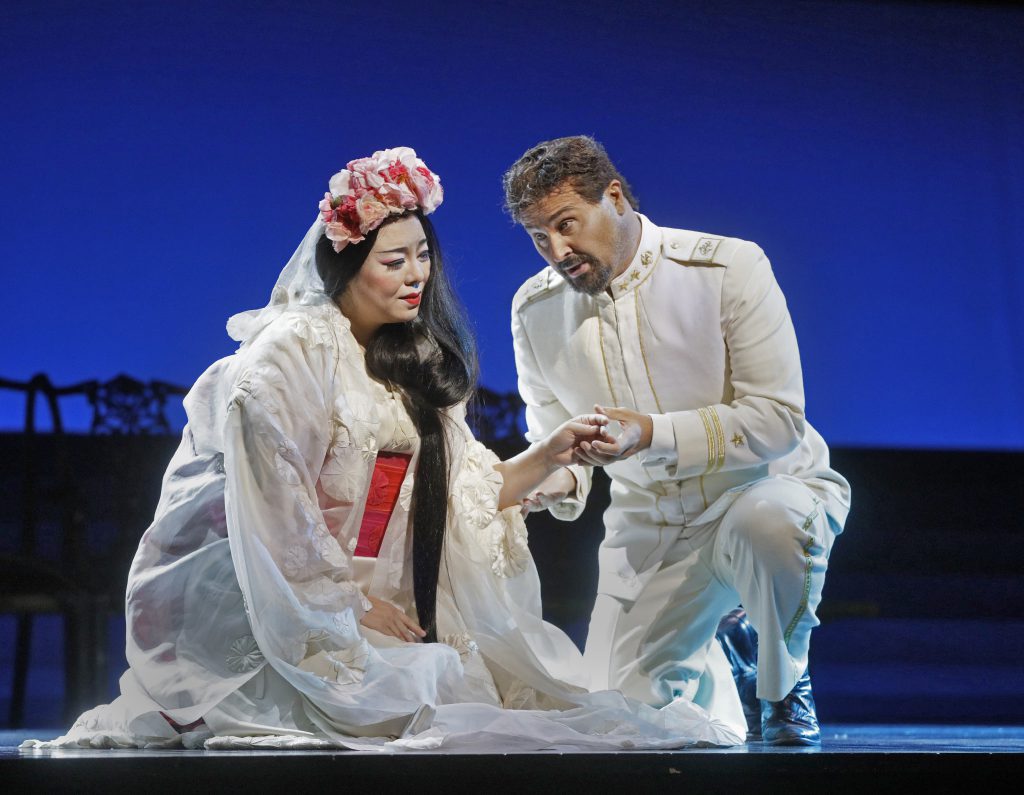
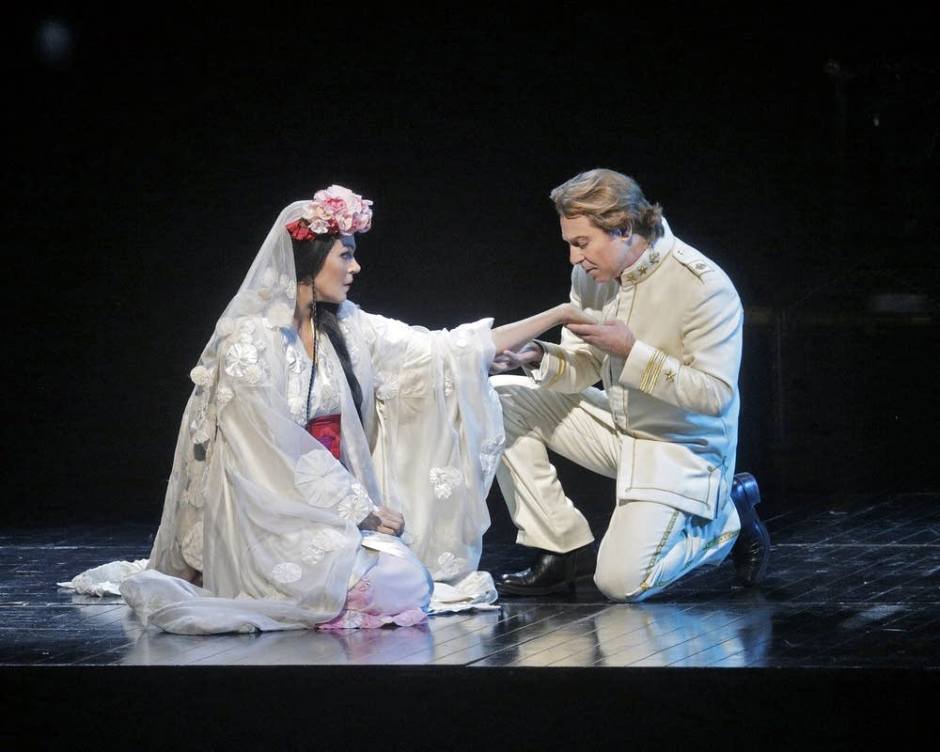
She’s a geisha, yes. But more significantly, Cio-Cio-San is Madame Butterfly─ as in, a married woman. The centrifugal moment of the opera, which triggers all the dominoes to fall, is the marriage ceremony between Butterfly and Pinkerton. Climbing up the glossy stage while accompanied by her wedding party in bright regalia and corrugated fans, the silken white figure of Cio-Cio-San is a breathtaking sight to behold. This was exactly the look I wished to emulate with my costume.

Hui He as Madame Butterfly (seen here with Roberto Armonica) / Metropolitan Opera

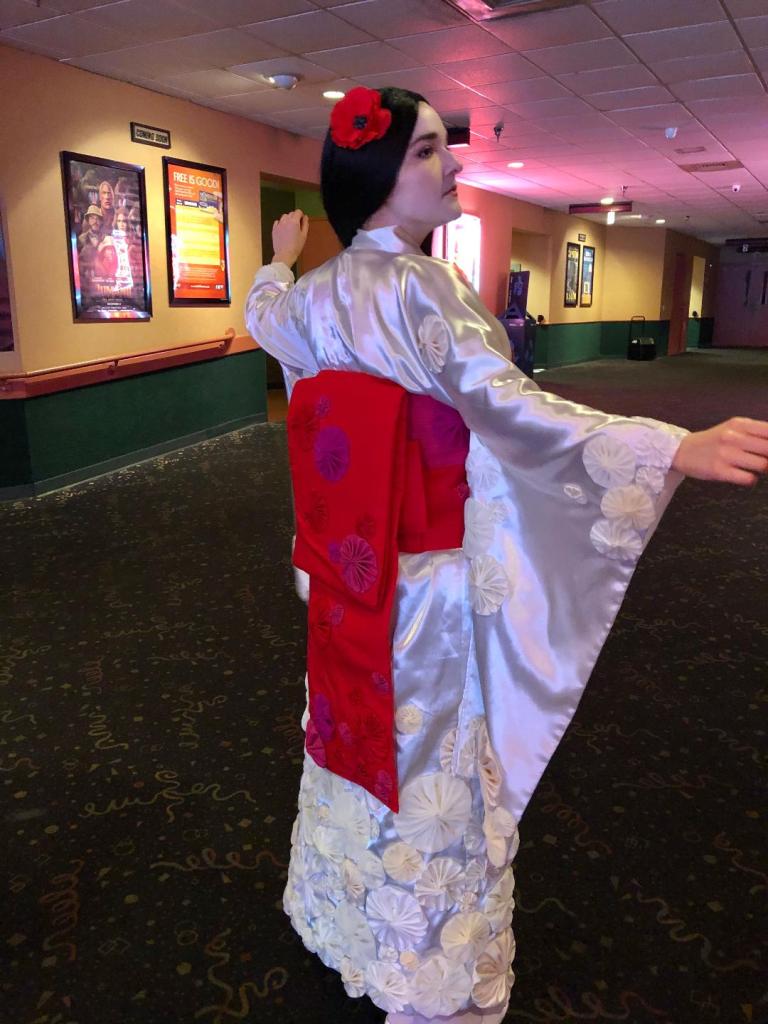
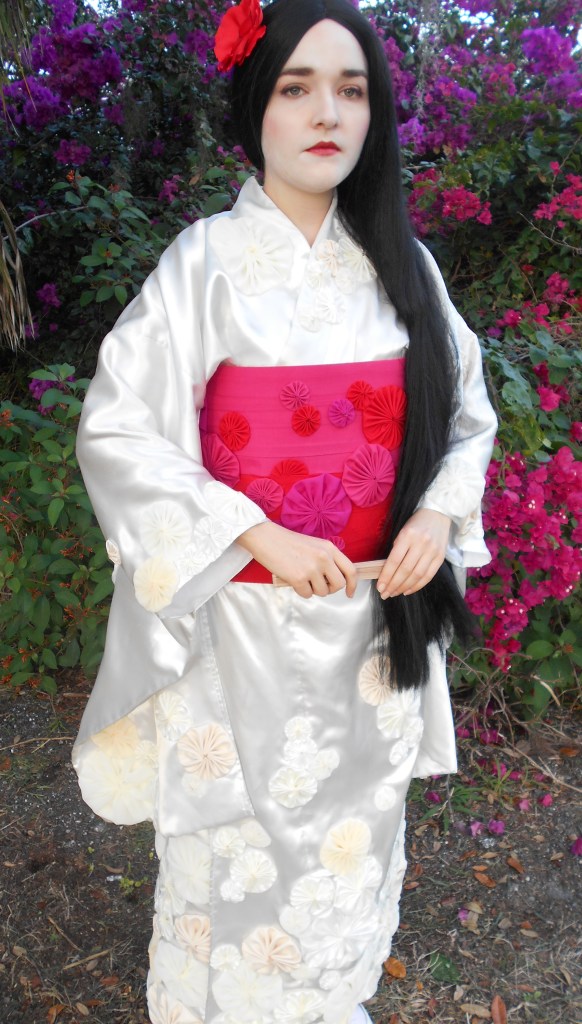
With exactly a month before the opera, I commenced work on a replica kimono that I hoped would give credence to the character. An abounding bevy of varying satin “yo-yos” were cut and hand sewn together as the key ornamentation of the robe, which was quite comfortable since it was lined in a thin cotton voile. The logistical challenge of creating the obi (sash) and faux drum knot was another story, but for now we’ll just say it was adequate for its brief stint at the theater. My lovely friend, Judy, captured a photo of the back of the outfit during intermission.

Raven black wig, red poppy affixed, and yards of silvery white satin summoned to mind the ancestral artistry of the Met’s Minghella Madame…

Hui He as Cio-Cio-San in Madama Butterfly / Metropolitan Opera

With properly applied white face, a dab of rouge, and ruby red lipstick, I felt every bit the geisha for Cio-Cio-San’s wedding day. The pantomime was complete !

While the marriage between Butterfly and Pinkerton resulted in undue catastrophe, the afternoon at the opera was a carefree delight. Should you ever be proposed with the choice of attending a heartrending performance of Madama Butterfly, there should be only one reply in return… I do !

Toi, Toi, Toi,

Mary Martha

For more information on how I created Cio-Cio-San’s signature wedding kimono, please check out my tutorial post !

Cast and Credits:

Madama Butterfly ─ Giacomo Puccini (1904)
Live in HD air date: November 9, 2019

Cast:
Cio-Cio-San ─ Hui He
Pinkerton ─ Bruce Sledge*
Suzuki ─ Elizabeth DeShong
Sharpless ─ Paulo Szot

*Replaced Andrea Carè

Credits:
Conductor ─ Pier Giorgio Morandi
Production ─ Anthony Minghella
Director/Choreographer ─ Carolyn Choa
Set Designer ─ Michael Levine
Costume Designer ─ Han Feng
Lighting Designer ─ Peter Mumford
Puppetry ─ Blind Summit Theatre
Live in HD Director ─ Habib Azar
Host ─ Christine Goerke

La Traviata ─ the little red dress

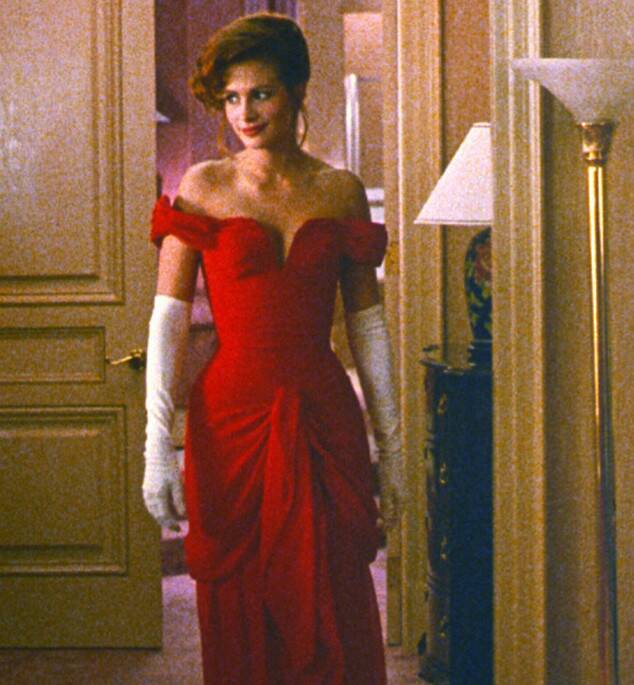
Everyone knows La Traviata. Whether you’re an exuberant opera fan or not, the tuneful music that sets the story of the consumptive courtesan, Violetta, is as recognizable as the Ten Commandments are to a man without Faith. From countless television commercials, to the iconic chick flick, “Pretty Woman”, it’s hardly a secret that Verdi’s 1853 hit left an indelible stamp on the opera world as well as in pop culture.

Going to the opera ─ a scene from “Pretty Woman”

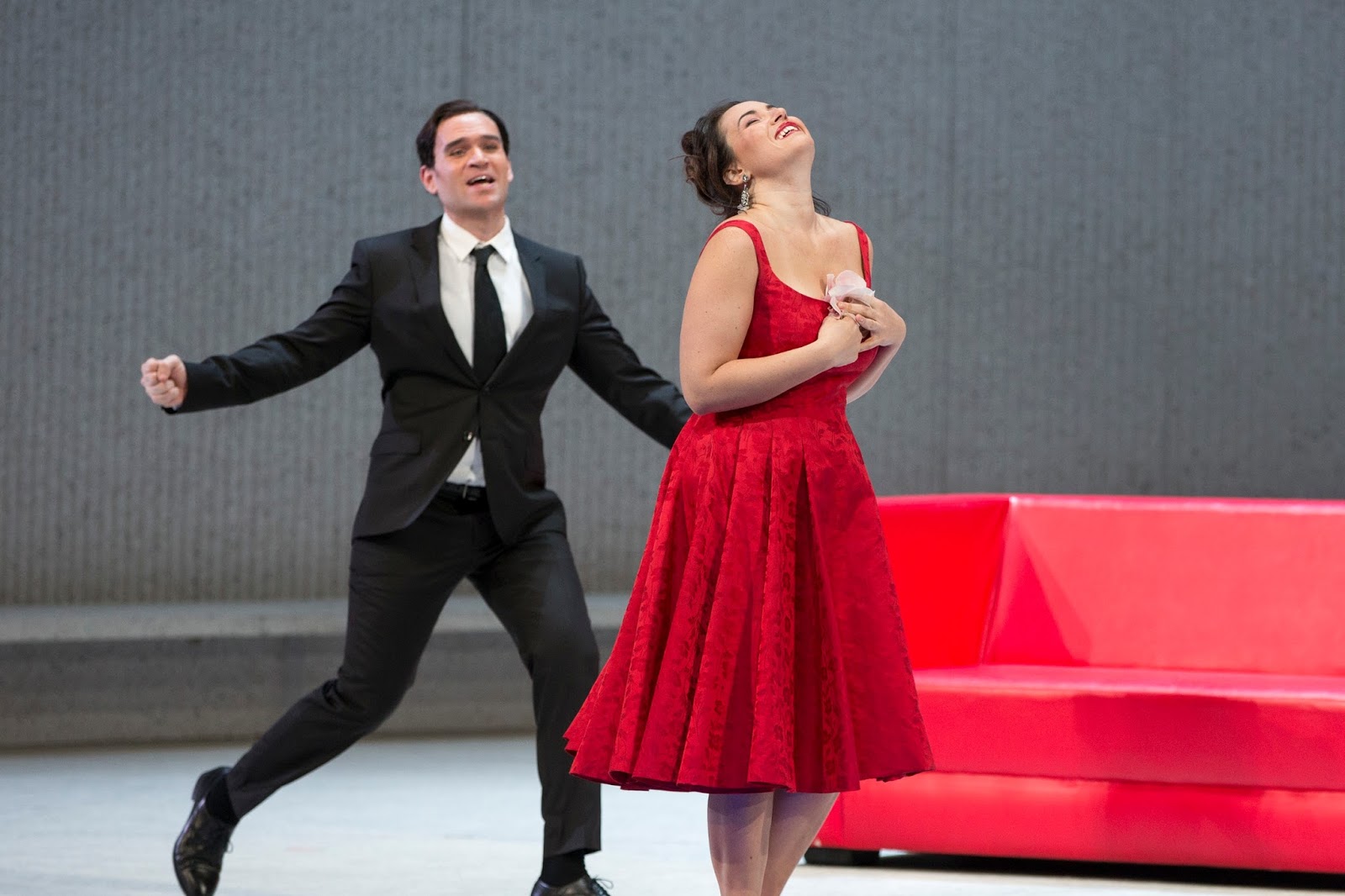
Typically, I strongly prefer to experience an opera set traditionally before ever dipping my toe into the pool of a modern interpretation. But although an abstract production, I still wanted to see La Traviata when it came to theaters. Willy Decker’s stark sets and tuxedoed chorus members stripped the scenes to minimalist proportions. Languoring in a curve of the corrugated circular stage sat an enormous face clock with a latent theme. Was the intent ─ to allegorize Violetta’s time running out ─ effective ? That’s debatable. Unless previously enlightened, the concept was rather abstruse to grasp ─ at least it was for me. However, there was one upside to the bare bones production and that was the adorable little red dress worn by Violetta during the vibrancy of the opera.

Sonya Yoncheva as Violetta in Willy Decker’s La Traviata / Metropolitan Opera

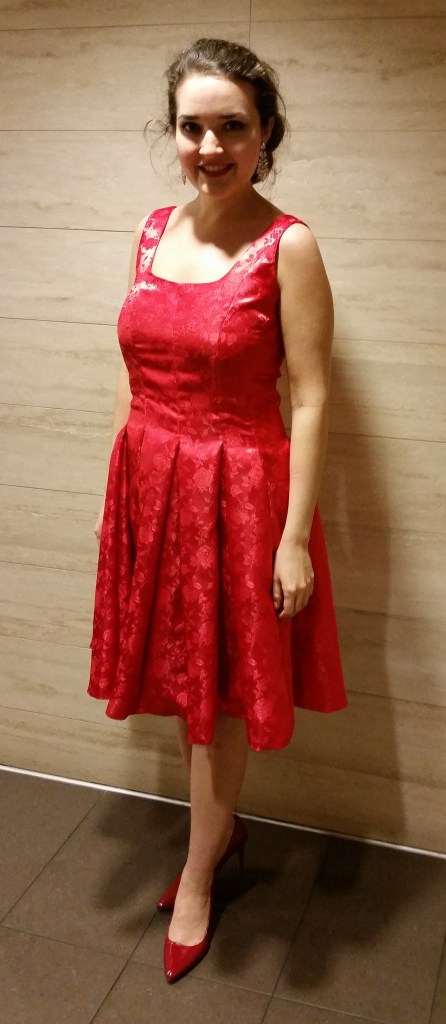
Since debuting at the prestigious Salzburg Music Festival in 2005, the production’s scarlet flouncy floral brocade dress has been worn by leading sopranos around the world. From Anna Netrebko to Natalie Dessay, the pictorial research was readily available. Hitherto, my only sewing projects amounted to a yukata sewn for Madama Butterfly and a mop cap for my Hebrew slave costume for Nabucco. To take on a complex dress, I needed a real pattern. And after months of scouring and rumination, I found it !

It’s even red ! McCall’s 6834

With a full pleated skirt and the promise of Palmer and Pletsch fitting, I was elated to begin sewing McCall’s 6834 as my Traviata pattern. But obviously, some alterations needed to be made to elevate the style to the Violetta Valéry standard.

Michael Fabiano as Alfredo and Sonya Yoncheva as Violetta in La Traviata / Metropolitan Opera

First adjustment ─ the front and back neckline. My goal was a “rounded square scoop” neckline for the front and so I fiddled with whittling down the existing pattern to how I intended it to look. But I needed help, especially with the curve of the back, so I pulled out an old sleeveless dress pattern from my mother’s bulging pattern box and used its pieces for the design of the straps and necklines. So far, so good !

See & Sew by Butterick 6398 / Circa 1988

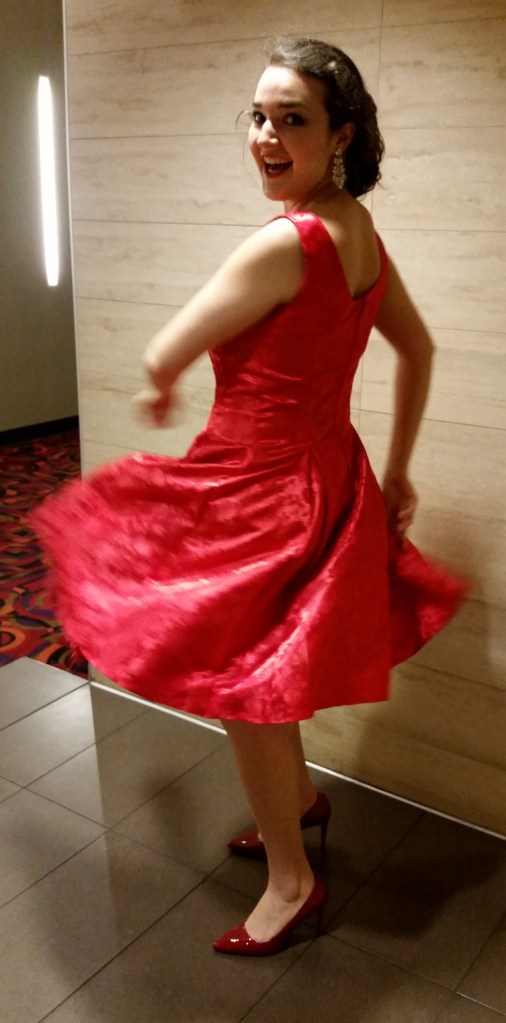
The dress was a near replica of the one worn in the opera. So uncanny was the resemblance that a nearsighted lady, slowly forging her way towards the concession stand during intermission, came close to bumping into me where she halted and gasped, “You look just like Violetta !” The greatest of all compliments was received.

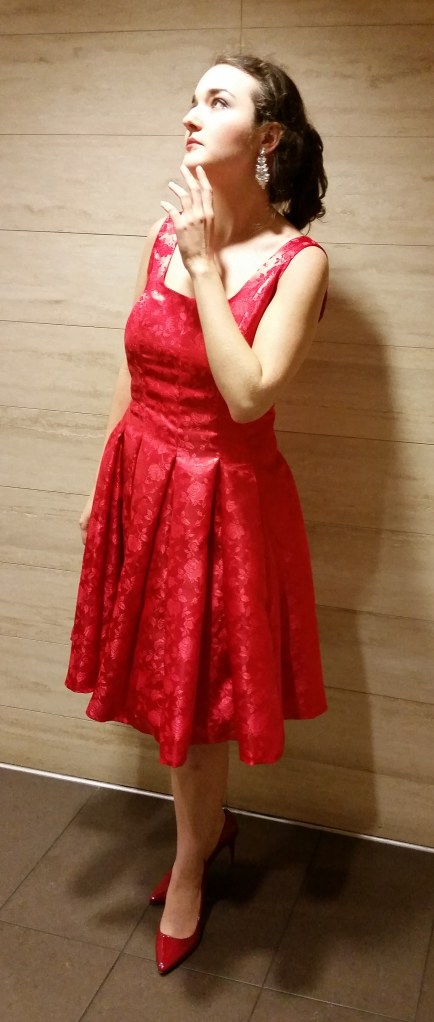
Because this was my first commercial sewing pattern project, I made many mistakes. My sizing was off and goodness, the rosy polyester satin frayed terribly ! The fibers continued to shed and tickled my bare legs with every step. Carefully, I toddled around the theater in my shiny crimson pumps, allowing a twirl every now and then.

Pondering life’s toughest questions: which party to attend next and with whom ?

The evening encore outing was a moderate success, however I look forward to seeing a more traditional Traviata in the not-too-distant future. Whether in a flouncy red cocktail dress or a grand antebellum ball gown, one thing remains constant: the emotional power and beloved recognition of Verdi’s timeless opera, La Traviata.

Toi, Toi, Toi,

Mary Martha

Cast and Credits:

La Traviata ─ Giuseppe Verdi (1853)
Live in HD air date: March 11, 2017
(Encore seen: March 15, 2017)

Cast:
Violetta Valéry ─ Sonya Yoncheva
Alfredo Germont ─ Michael Fabiano
Giorgio Germont ─ Thomas Hampson

Credits:
Conductor ─ Nicola Luisotti
Production ─ Willy Decker
Set and Costume Designer ─ Wolfgang Gussmann
Associate Costume Designer ─ Susana Mendoza
Lighting Director ─ Hans Toelstede
Choreographer ─ Athol Farmer
Live in HD Director ─ Matthew Diamond
Host ─ Isabel Leonard

Turandot (2019)

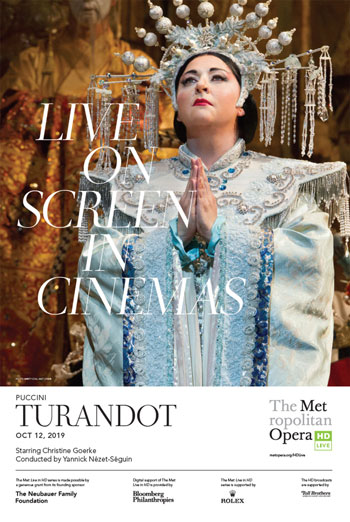
Hope. Blood. Turandot ! If my first brush with opera in 2015 hadn’t of been so life-altering, Puccini’s grandest spectacle (and final opera) would be the undisputed favorite of my heart. I remember when I first saw the opera in theaters in early 2016: it was the encore showing the following Wednesday evening since I was out of town for the live Saturday matinee broadcast. So monumental was the feeling I had while witnessing the story unfold on stage that when the Met announced that Turandot would be returning to theaters in 2019, I jumped on the affirmative decision faster than a Ferrari at top speed.

Turandot has everything. There’s drama, romance, passion, mystery, sacrifice, joy, and best of all, some of the most heart-pounding, resplendent music your ears will ever hear. The emotional power behind the fearless and triumphant aria, “Nessun dorma”, sends me to the brink of tears while elevating me from my terrestrial state. There are many renditions on the web, but I am especially moved by the English/Italian translation of the Pavarotti performance below. Divine !


Luciano Pavarotti singing “Nessun dorma” (video: MeastroPava4Ever)

As much as I adore the greatest tenor aria ever written (and that is not an exaggeration), my favorite moment in the opera comes during the high-stakes Riddle Scene showdown. Regardless of how many times I’ve seen the opera and know its plot inside and out, I can’t help but think I’ve missed something and fear a fatal slip-up by Calàf. Thankfully, my trepidation is always unfounded.

Christine Goerke and Yusif Eyvazov in Turandot / Metropolitan Opera

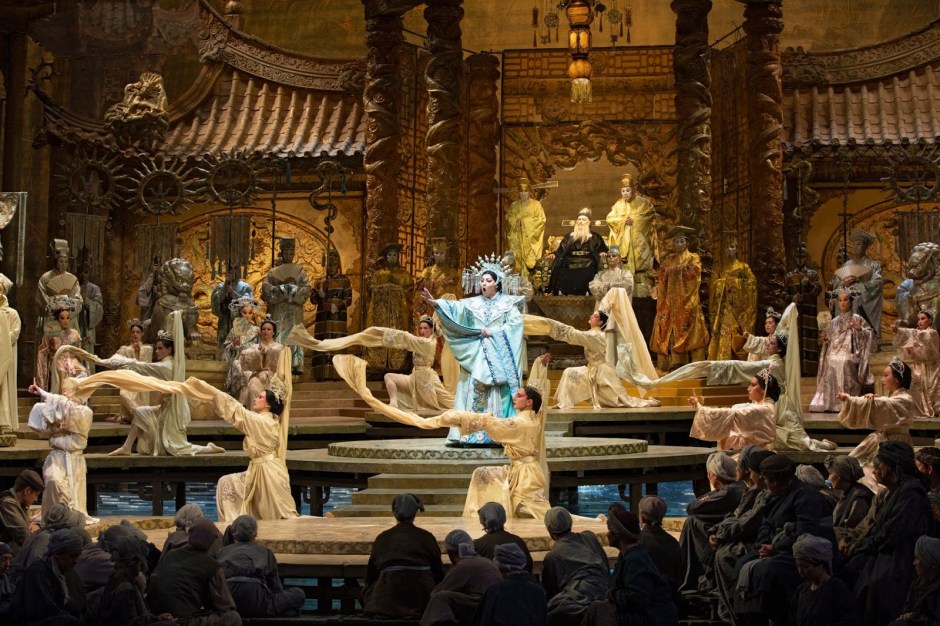
While this performance of Turandot had its plusses (Eleonora Buratto’s Liù) and minuses (an overly sensitive Calàf), the reigning winner is still Franco Zeffirelli’s magnificent production. Everything from the sets and costumes to the choreography of the chorus is perfectly enacted for an otherworldly experience. The feeling is magical. Your breath is taken away.

Yusif Eyvazov and Christine Goerke in Turandot / Metropolitan Opera

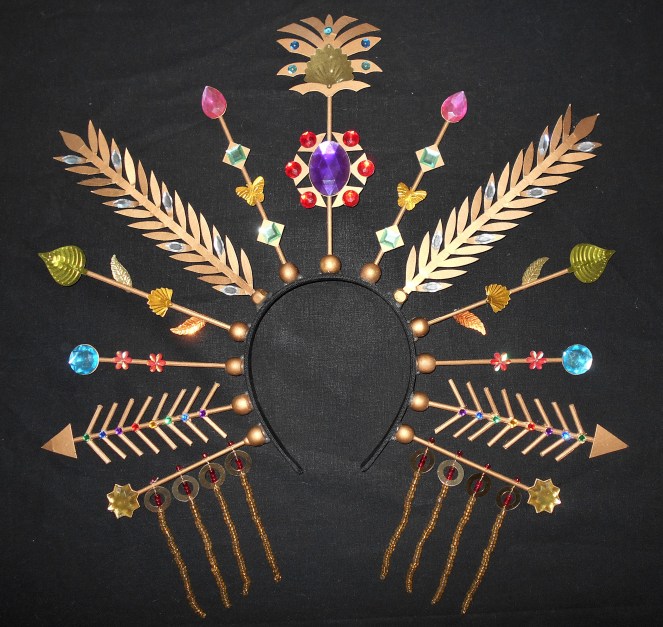
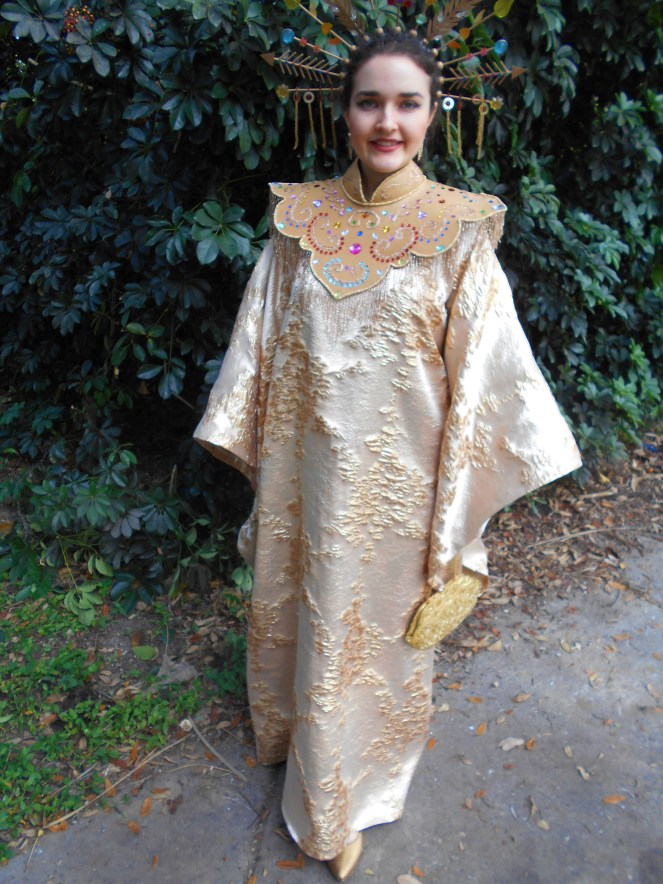
Heavily influenced by traditional Beijing Opera, the characters in Zeffirelli’s extant 1987 staging of Turandot are loaded with symbolic make-up, ornate robes, symmetrical cloud collars, and other brightly colored embellishments. As I contemplated the design of my costume for the 2019 Turandot, I had one prerequisite: whatever I wished to make HAD to coordinate with the headpiece I created for my 2016 outing since I was pressed for time (ahem, Manon) and didn’t want to fiddle with the engineering logistics of building a new headpiece from scratch.

The headpiece worn to Turandot in 2016

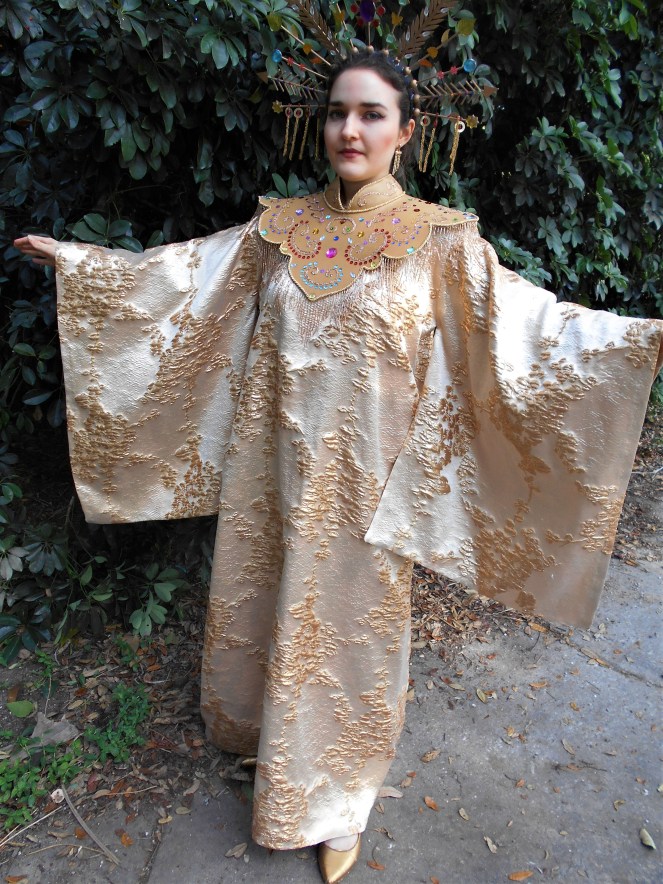
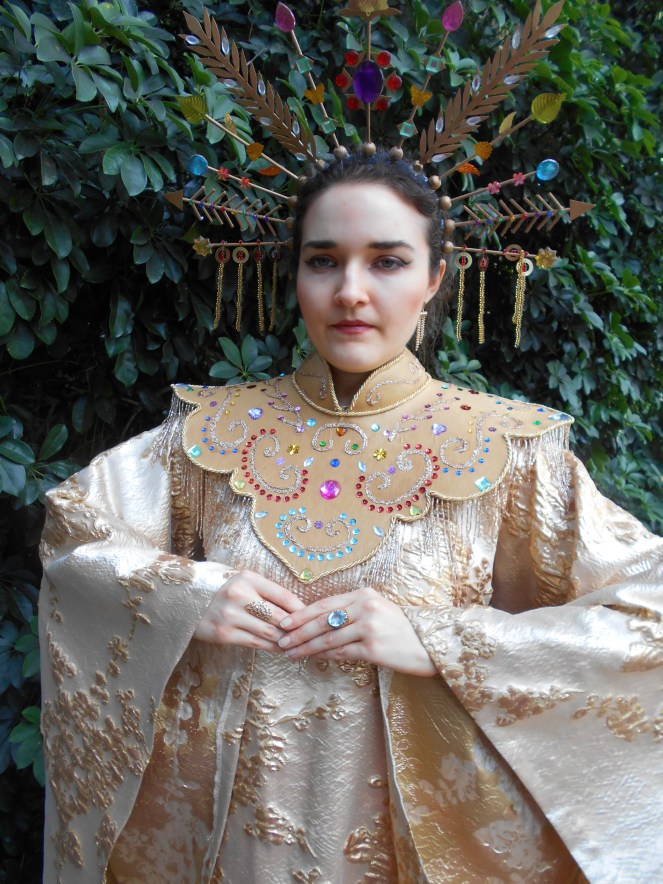
With guidelines established, I fashioned my outfit entirely around the color scheme of the headpiece: predominantly gold with LOTS of colorful jewels ! My friend, Judy, snapped this picture during the intermission at the theater:

The Turandot “death stare”… Thank you, Judy !

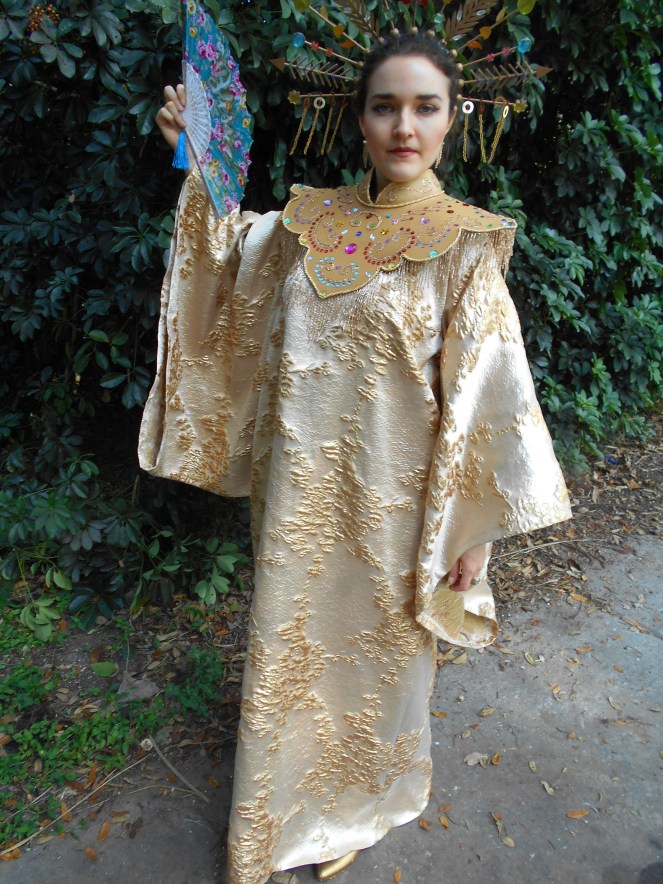
The brocade robe was self-drafted using only the measurements of the shoulder width and hem diameter. The sleeves were long rectangles folded in half out of the pillowy metallic material and sewn together at the bottom edge.

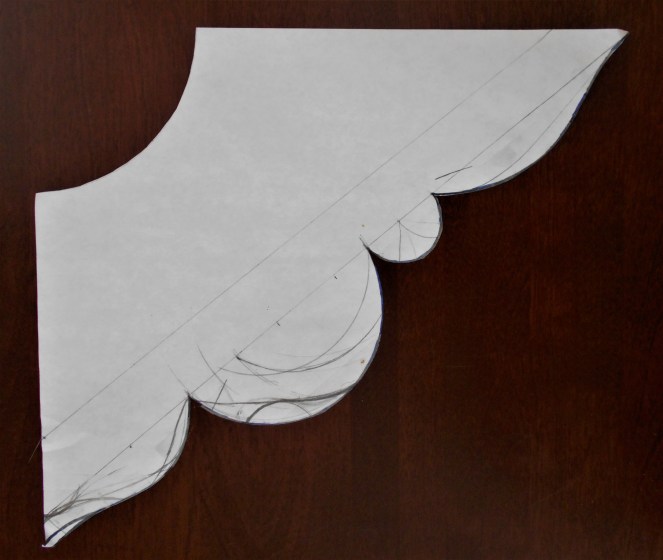
Creating the cloud collar was not as straightforward. Studying the specimen from the opera, I fiddled with drawing a quartered pattern using a compass as well as freehand curves.

Drafting the cloud collar

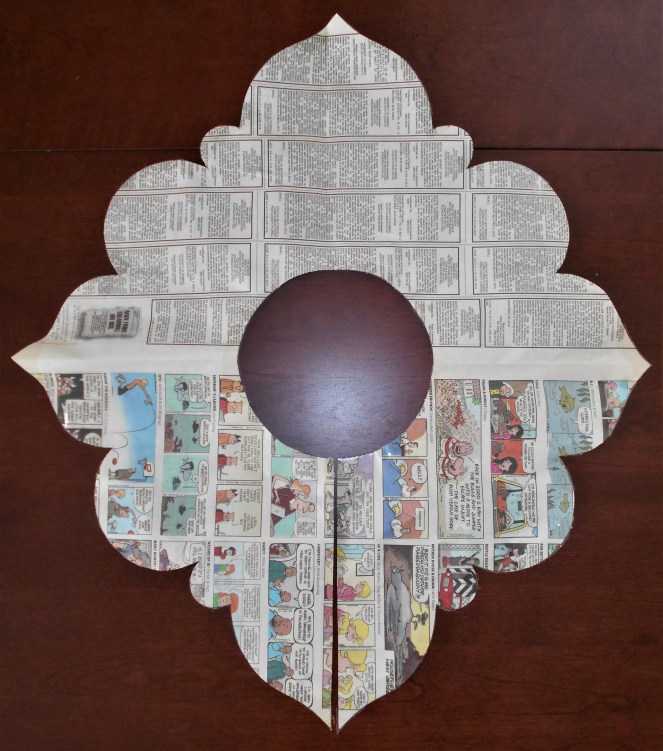
With just a few tweaks, the finalized pattern, which I copied onto newspaper, turned out great ! The full 4 quadrant newspaper replica was then taped to a sheet of thin foam, leftover from my Valkyrie days, and cut from its pliable surface as well as two layers of mustard colored stretch taffeta.

Pattern cut from newspaper

Through trial and error, the separate pattern for the pop-up mandarin collar was finally completed to my satisfaction and applied the foam and taffeta in the same manner.

Finalized Mandarin collar pattern

All that was left was the decoration ! The hot glue gun and I have an on again/off again relationship, but for Turandot, we were most definitely on !

Thank you for the fan, Faith !

My Chinese robe on the cheap made me feel like a citizen of Peking attending the riddle ceremony ! Careful, Calàf !

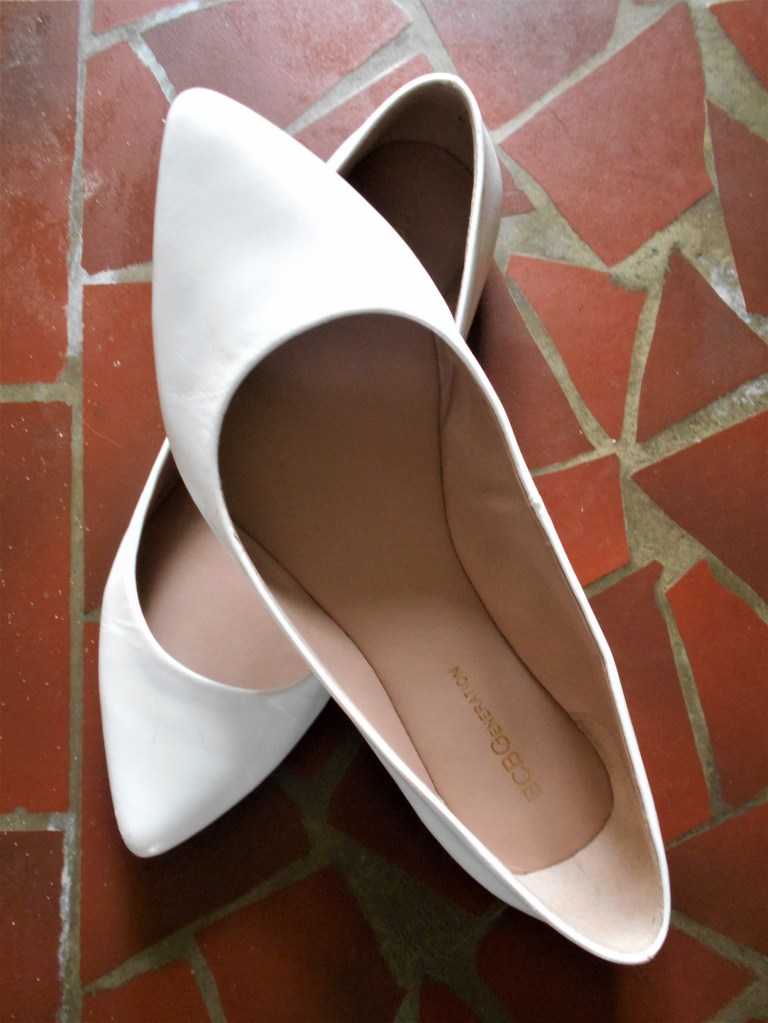
One mention of my shoes… those ballet flats ? Well, they’re not really gold. They’re white. And I bought them specifically to wear with my Empire gown to Tosca in 2018… certainly not Chinese ! But dousing dollars on new shoes for a one-time occasion is not really my style. The level of the flat was right ─ the hem of my robe wouldn’t allow for any height of heel ─ and so I changed their appearance temporarily with gold colored duct tape.

Without question, Zeffirelli’s majestic Turandot is my favorite opera in which to introduce a complete newcomer. Maybe the next time Turandot returns to the Live in HD schedule, you’ll be my first-timer and the spell of Puccini’s score will bewitch you with its undeniable magic.

Toi, Toi, Toi,

Mary Martha

Cast and Credits:

Turandot ─ Giacomo Puccini (1926)
Live in HD air date: October 12, 2019

Cast:
Turandot ─ Christine Goerke
Calàf ─ Yusif Eyvazov
Liù ─ Eleonora Buratto
Timur ─ James Morris

Credits:
Conductor ─ Yannick Nézet-Séguin
Production ─ Franco Zeffirelli
Set Designer ─ Franco Zeffirelli
Costume Designers ─ Anna Anni, Dada Saligeri
Lighting Designer ─ Gil Wechsler
Choreographer ─ Chiang Ching
Live in HD ─ Gary Halvorson
Host ─ Angel Blue

Tosca

With a static setting of June 17-18, 1800, how does a stage director erect an enlivened production of Puccini’s Tosca ? When tasked to the capable hands of Sir David McVicar, the opera, no matter the setting, is bound to be a hit. That prediction held true: the Met’s enthralling new production of Tosca was bold and dramatic, pious and perilous.

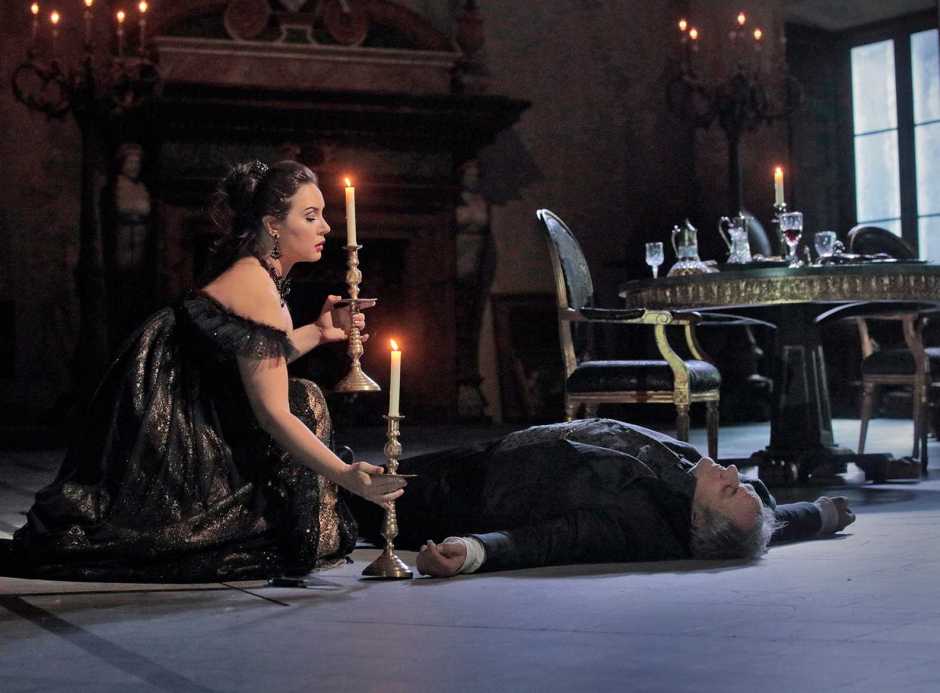
A scene from Act III of Tosca / Metropolitan Opera

Although the McVicar production was a huge success, it’s almost unfathomable to believe that the entire principal cast and conductor originally slated to perform bowed out before the first curtain ever ascended. However, the new players were arguably just as effective with tempestuous Sonya Yoncheva and swarthy Vittorio Grigolo igniting passion as the lovers Floria Tosca and Mario Cavaradossi.

Vittorio Grigolo as Mario Cavaradossi and Sonya Yoncheva as Floria Tosca / Metropolitan Opera

Everyone loves a good romance. But for me, the highlight of Tosca is the riveting Te Deum, a processional of hallowed majesty and lascivious scheming. If I had to choose a small handful of favorite lines from all the operas ever written, Scarpia’s blasphemous and ironic pronouncement (“Tosca, you make me forget God !”) would be ranked in the top three. The sacrilegious statement simultaneously occurs with the conclusion of the chorus’ magnanimous hymn of praise… In the middle of a cathedral. During High Mass. Priceless.

Željko Lučić as Scarpia (far right) during the Te Deum of Tosca / Metropolitan Opera

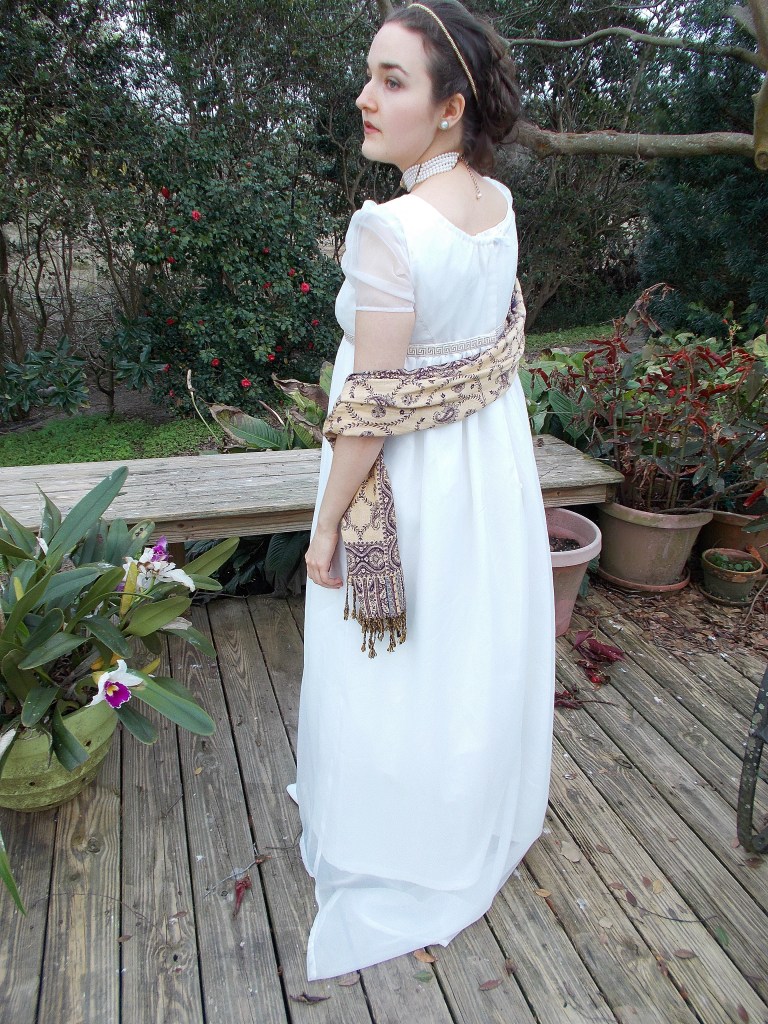
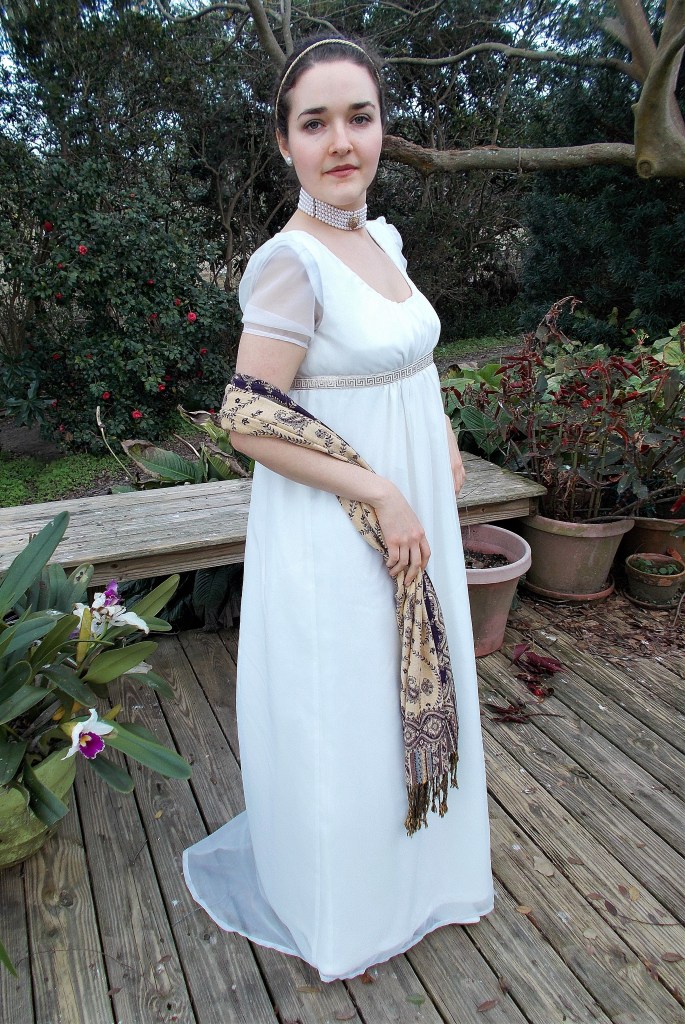
Previously mentioned, Tosca is set in 1800, often referred to as the Regency/Napoleonic era in history. I’ll be frank ─ never have I thought the extremely elevated waistlines of empire gowns to be flattering on any woman. The style invariably reminds me of two things: nightgowns and maternity clothes. But, alas ! It was the required look for the opera so I began to contemplate my own gown. While there are a multitude of commercial sewing patterns for Empire/Regency gowns on the market, I chose Butterick 6074 because it appeared more historically accurate and brought the added value of five different pattern options in one envelope. I made a variation of version A.

Butterick 6074

Nearly every detail of my Empire ensemble was modeled after the simplistic gowns (they must always be called gowns, I learned) worn during the infancy of the 19th century. The sheer train and sleeves, drawstring neckline, and accenting Greek key ribbon at the waistline were all characteristics of the most popular gowns of the day. Pearls and a hair ribbon accessorized my look as well as a shawl from the Orient.

Aiding me in my research were the very helpful articles from Fashion-Era.com and the University of Vermont. These two online resources were invaluable as I often referred to their guidance. Curiously, the gauzy whitework gown worn in Act I of the opera was fairly accurate ─ especially when speaking in terms of theatrical costumes ─ albeit, the short gathered tulle ruffles around the neckline were a mere artistic deviation.

Sonya Yoncheva as Tosca and Vittorio Grigolo as Cavaradossi / Metropolitan Opera

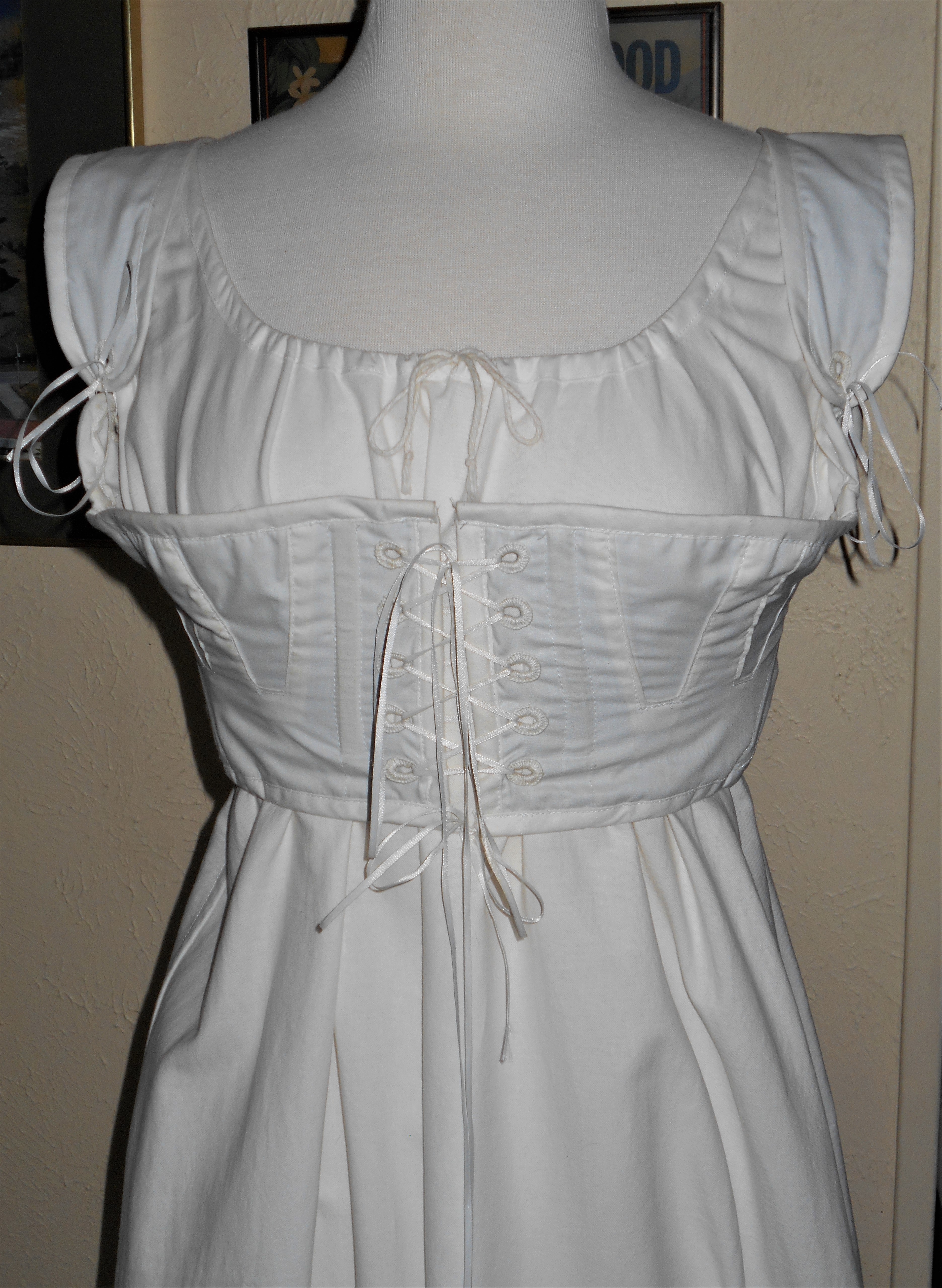
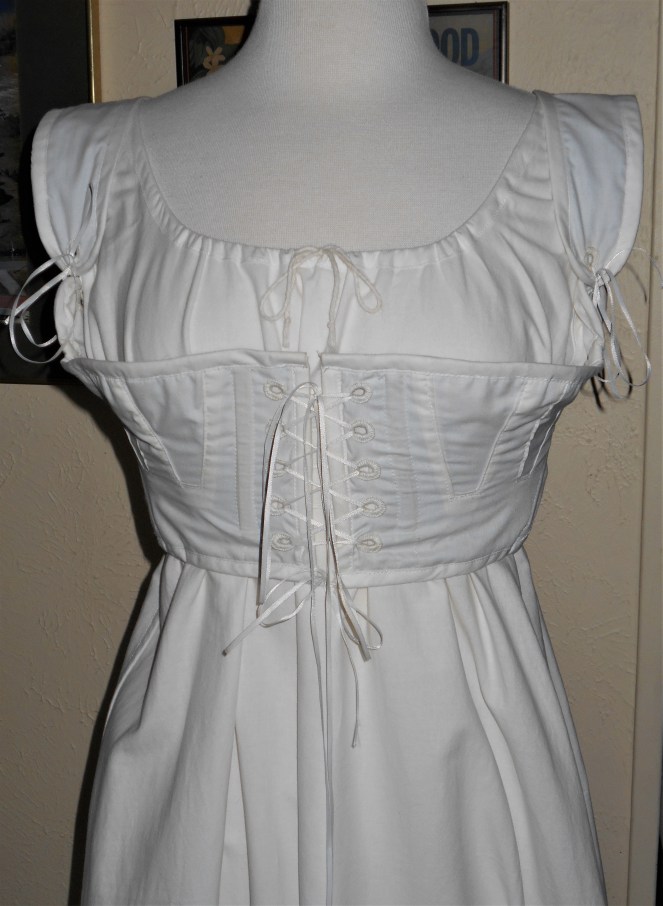
What most people wouldn’t know is that in addition to the floor length gown, I also had to sew a chemise and set of short stays (the corset of the period) to obtain the proper “column” silhouette that was so ubiquitously envied during the Napoleonic Era. In addition to shaping the figure into that of a Grecian statue, the height of the bustline was also raised by the stays. Who would have thought that a few stubby lengths of nylon cable ties and some strategic bust gores could give such heavenly lift ?

Regency chemise and short stays

Despite my general distaste for women’s clothing of the early 19th century, I gained an… appreciation… for the Empire style and learned the reasoning behind its popularity during the time. Undoubtedly, the greatest advantage to my costuming is the breadth and retention of knowledge that is acquired during my extensive research. While the gowns of early 1800’s were soft and demure, the military battles and civic rivalries during the period made for fiery reading. Perhaps drawing upon history, that same combustible drama was clearly emanated in the verismo verses of Tosca.

Toi, Toi, Toi,

Mary Martha

Cast and Credits:

Tosca ─ Giacomo Puccini (1900)
Live in HD air date: January 27, 2018

Cast:
Tosca ─ Sonya Yoncheva
Mario Cavaradossi ─ Vittorio Grigolo
Scarpia ─ Željko Lučić
Sacristan ─ Patrick Carfizzi

Credits:
Conductor ─ Emmanuel Villaume
Production ─ Sir David McVicar
Set and Costume Designer ─ John Macfarlane
Lighting Designer ─ David Finn
Movement Director ─ Leah Hausman
Live in HD Director ─ Gary Halvorson
Host ─ Isabel Leonard

Adriana Lecouvreur

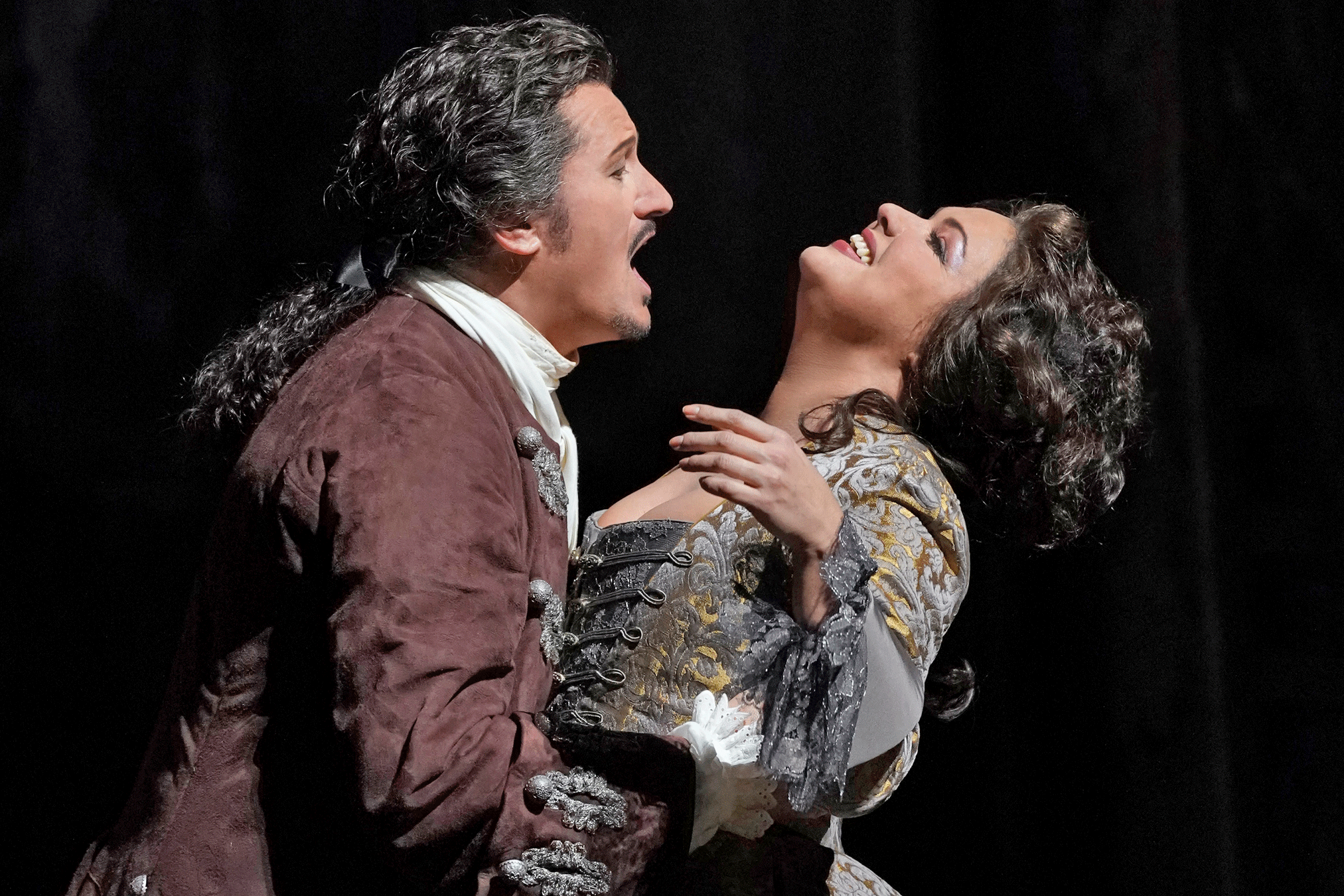
It has been quipped that in order to perform Adriana Lecouvreur successfully, real-life divas must be cast. Art must imitate life and despite thrilling drama and chest-heaving music, the current stock of bona fide divas is rather sparse. Therefore, Adriana Lecouvreur remains mostly on the shelf of the operatic repertoire. However, the Met assembled a perfect bill of spectacularly strong singers for the star-studded Live in HD broadcast. The heat was on !

Piotr Beczała as Maurizio and Anna Netrebko as Adriana Lecouvreur / Metropolitan Opera

Sir David McVicar’s elegant production embodied the powder and pomp of 18th century French theater. With a bust of Molière gracing the stage like a god watching and listening in silence to his progeny perform, one could almost immediately grasp the nucleus of the opera: no one is faithful to anyone in love.

A scene from Adriana Lecouvreur / Metropolitan Opera

A love triangle with deadly stakes, my brain was twisted in two trying to unravel the deception of it all. But probably the most anticipated of all the action was the impending battle between Anita Rachvelishvili and Anna Netrebko. This was to be Round 2 of the Anna vs. Anita vocal boxing match ─ the first occurring in Aida just a few months prior.
“They bit, they glared, gave blows like beams, a wind went with their paws;” to quote from the famed poem by James Leigh Hunt… I loved every moment of it !

Anita Rachvelishvili as the Princess of Bouillon, Ambrogio Maestri as Michonnet, and Anna Netrebko as Adriana Lecouvreur / Metropolitan Opera

While the plot twists and intrigue of the opera were at times difficult to untangle, my 18th century gown was anything but a chore, which surprised even me !
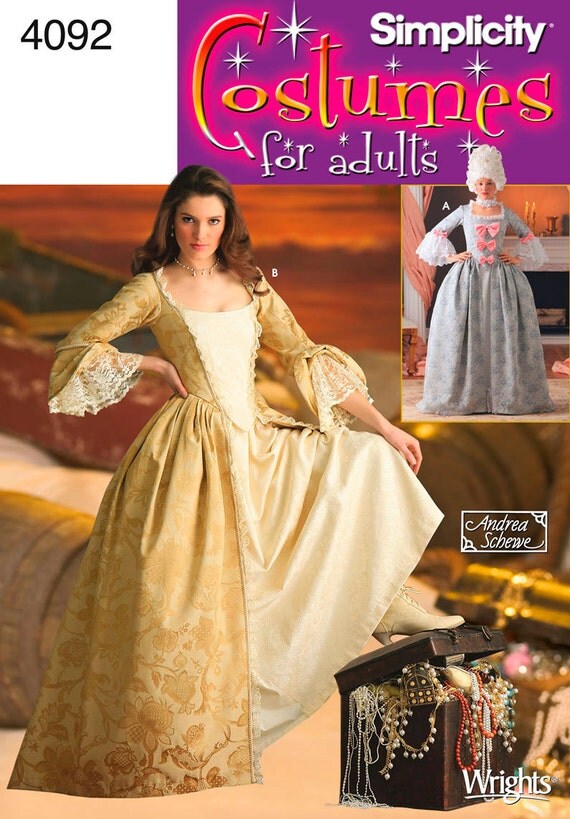
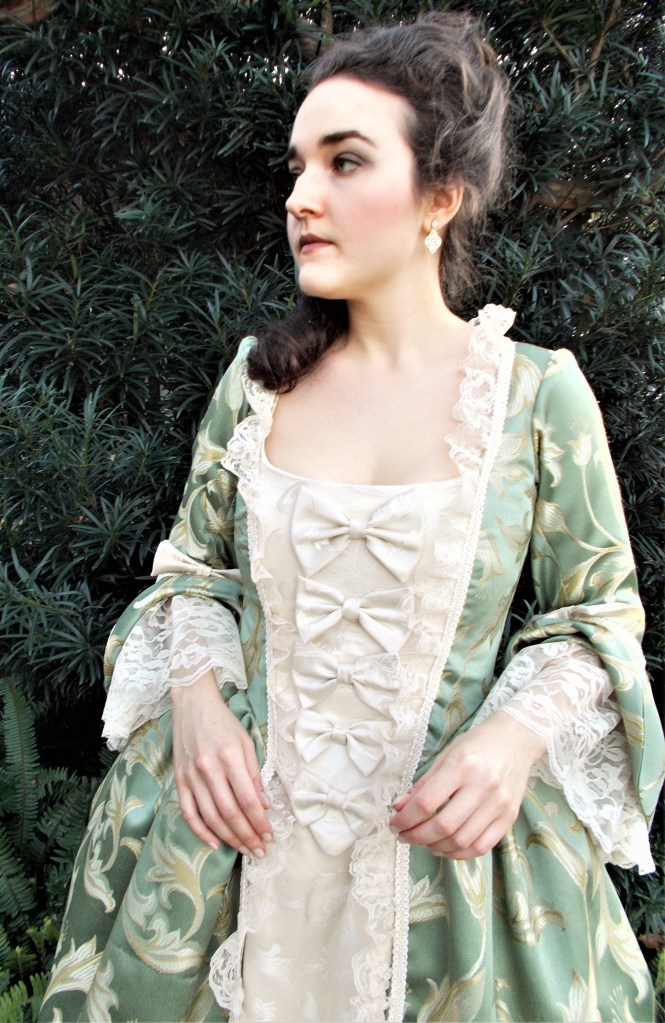
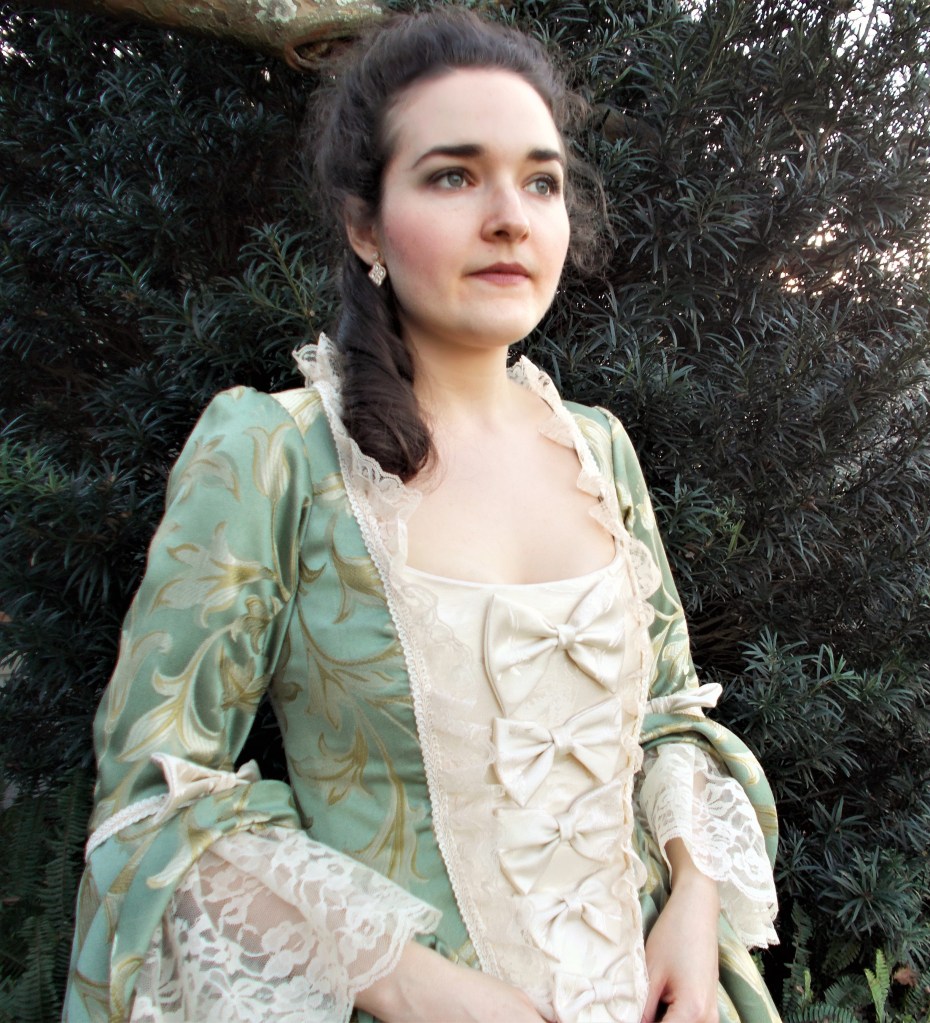
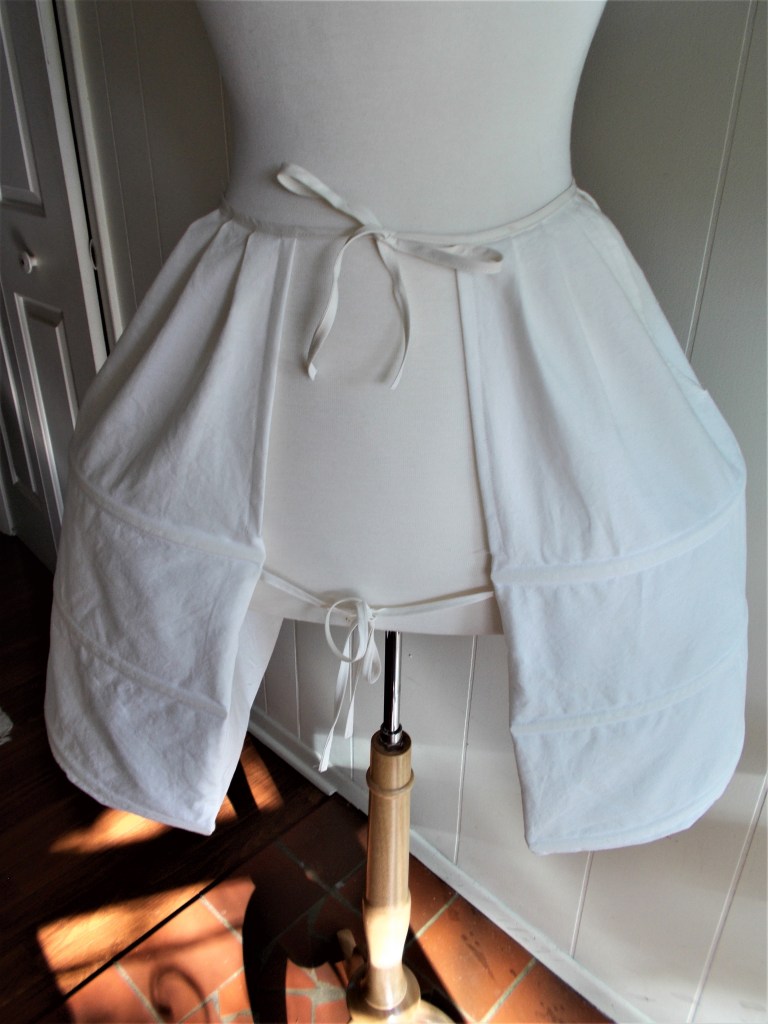
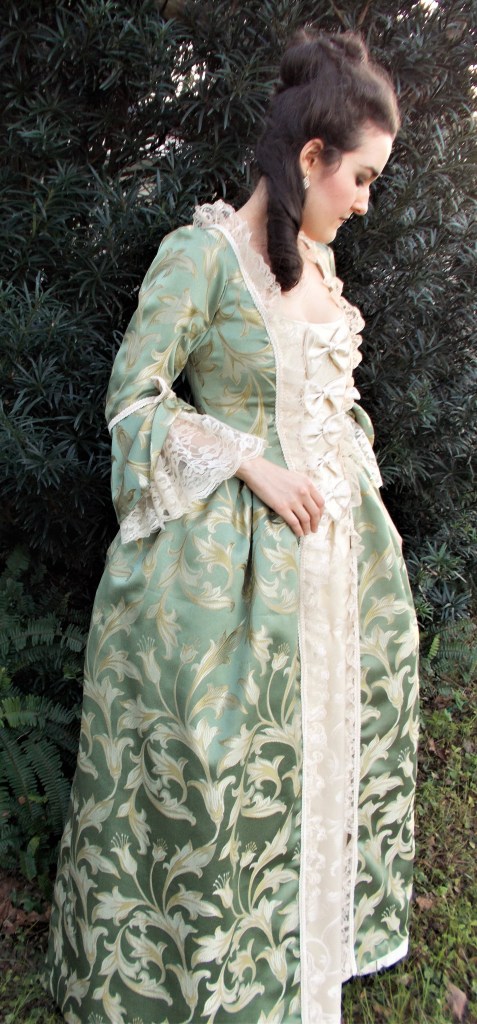
Using the Simplicity 4092 pattern that included pocket hoops for support of a proper silhouette (a terrific perk to Andrea Schewe’s delightful design), I made the featured gold version on the envelope (B), and began working on my Rococo-inspired gown as the very first project on my brand new Baby Lock sewing machine and serger.

Simplicity 4092 / Designed by Andrea Schewe

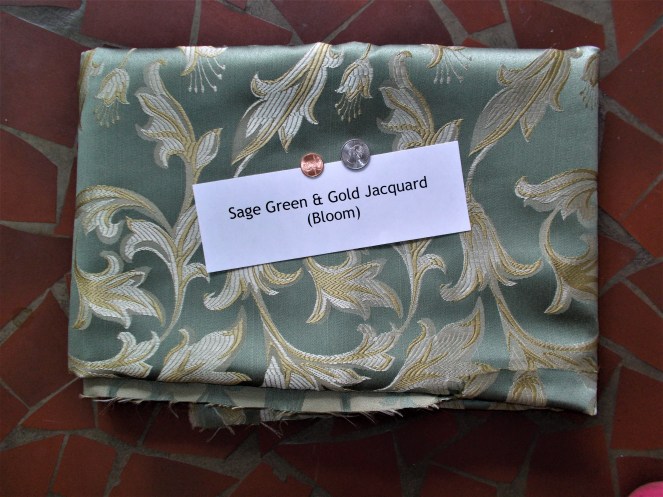
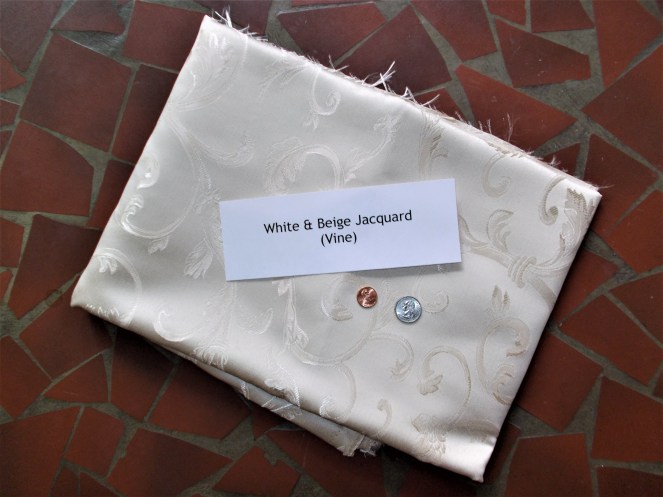
But the real secret to such a regal gown without breaking the bank on luxurious silks and brocades is that I used extra wide width polyester curtain fabric, which significantly cut down on the costs of materials. (Can someone say, “Scarlett O’Hara” ?) According to the pattern instructions, the gown called for close to 5 yards of fabric. However, with the 3+ meter width of the green and gold floral damask upholstery material I used, I only needed to purchase 2 yards (2 yards @ 120 inches wide ≈ 6 yards) in addition to 1 yard of a contrasting cream material for the stomacher and underskirt. Instead of spending over $100 on standard width material (54-60″), I rounded my totals to just under $33, minus the shipping costs ─ what a steal !

My alterations were few: I lowered the neckline slightly in order to achieve the peeking bosom look of the era as well as slimming down the sleeves to fit more snugly. Bows were a must and frilly trims, too. But the bow pattern that was included in the packet was much too “cartoonish” in its original format for my taste, so I reworked those to better suit the width of the front stomacher. They were so cute !

And check out the pocket hoops ! Although not as wide as traditional panniers, they provided just the right “oompf” to the pleated skirts of the gown.

Perfectly fashioned in the 18th century style, my mother had the task of arranging my hair. Didn’t she do a great job ? It reminded me of Belle from the ballroom scene in “Beauty and the Beast”.

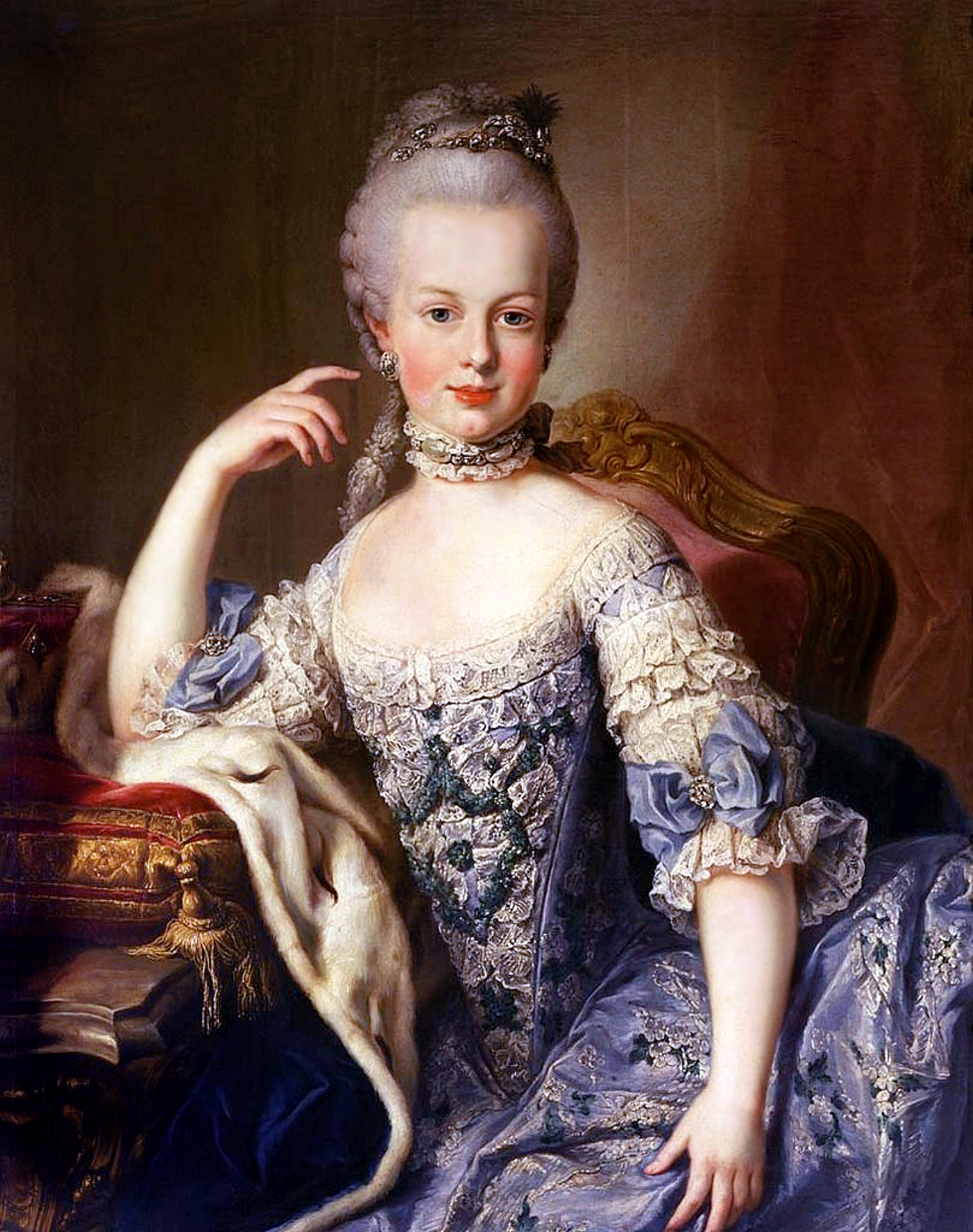
This was a fabulous gown worn to an equally glamorous opera with captivating historical backstories ! Marie Antoinette would’ve been proud.

Toi, Toi, Toi,

Mary Martha

Cast and Credits:

Adriana Lecouvreur ─ Francisco Cilea (1902)
Live in HD air date: January 12, 2019

Cast:
Adriana Lecouvreur ─ Anna Netrebko
Maurizio ─ Piotr Beczała
Princess of Bouillon ─ Anita Rachvelishvili
Michonnet ─ Ambrogio Maestri
The Abbé ─ Carlo Bosi
Prince of Bouillon ─ Maurizio Muraro

Credits:
Conductor ─ Gianandrea Noseda
Production ─ Sir David McVicar
Set Designer ─ Charles Edwards
Costume Designer ─ Brigitte Reiffenstuel
Lighting Designer ─ Adam Silverman
Choreographer ─ Andrew George
Associate Director ─ Justin Way
Live in HD Director ─ Gary Halvorson
Host ─ Matthew Polenzani

Aida

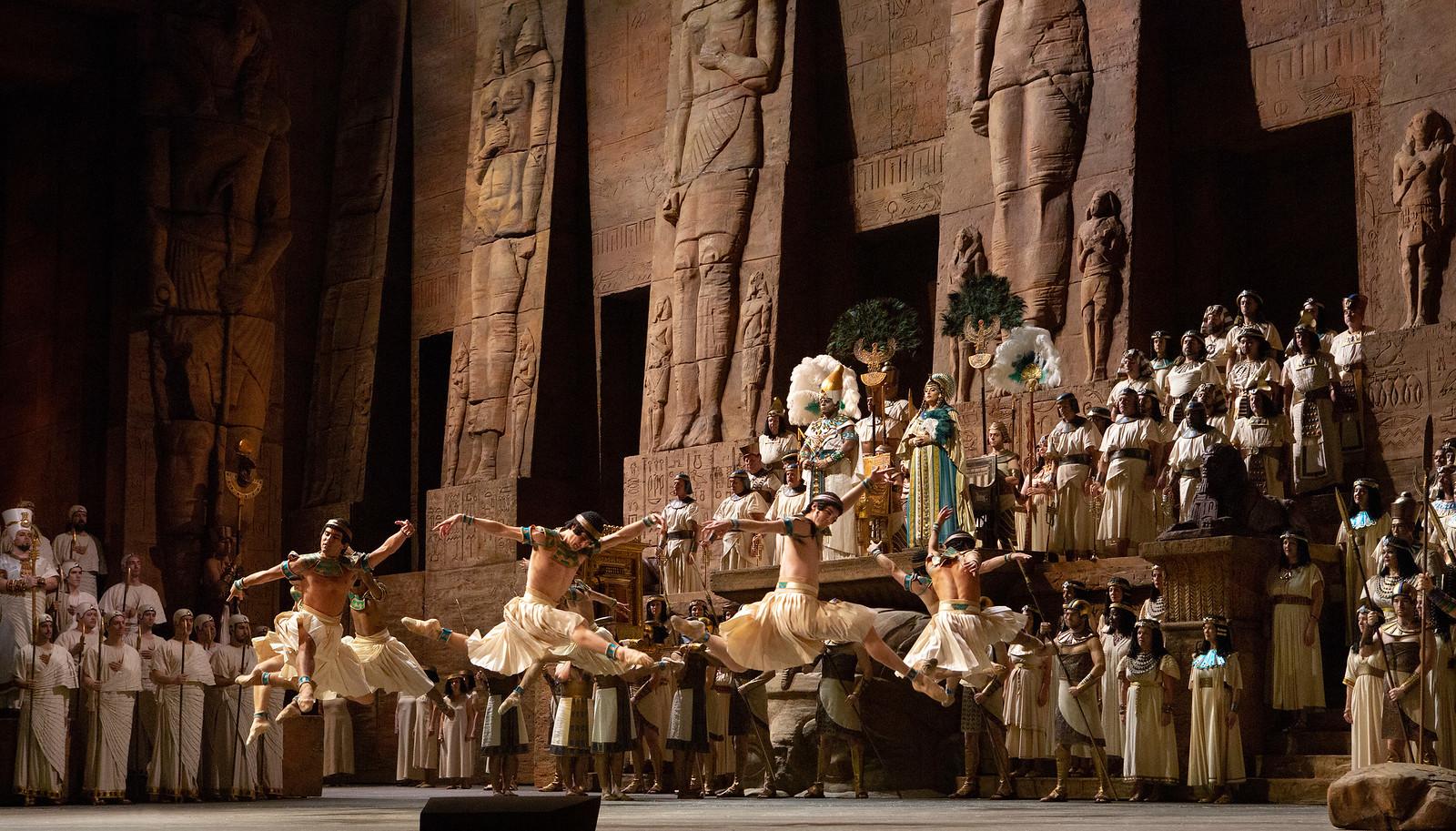
Aida is a grand opera. There are horses. There are ballet numbers. There are massive sets and ornate costumes. And what could be grander than having Anna Netrebko headline the Met’s 2018-2019 Live in HD season opener ?

A scene from Verdi’s Aida / Metropolitan Opera

I’ll be the first one to admit that Aida has never interested me. Whether it be the mercilessly hot desert locale of Egypt or the tension of two women fighting over one man (I infinitely prefer two disparate, but equally impassioned, suitors sparring over one fair maiden in my ideal operatic amorous affair), the opera has never been a very important “must see” for me except for its fame alone.

But this was Anna Netrebko’s Met role debut as Aida… how was I to miss that ????

Anna Netrebko as Aida / Metropolitan Opera

We all knew that Netrebko would be lauded as the star of this opera. More surprisingly, she had arguably one of the toughest battles of her career up against her mezzo-soprano rival, Anita Rachvelishvili’s fearsome Amneris. Hailing from Georgia (and I don’t mean the state), Rachvelishvili prowled the stage like a lioness eyeing her prey. Gripped and enraged, her stentorian voice roared during the showdown scene with Netrebko upon learning of her slave’s concealed love for the warrior, Radamès. I ate it up like a meaty dish of stew, salivating for more. It was the highlight of the opera for me.

Anna Netrebko as Aida and Anita Rachvelishvili as Amneris / Metropolitan Opera

The opera fizzled to a slow burn after the early fireworks between Netrebko and Rachvelishvili. Was my opinion changed after seeing Aida for myself ? Not particularly. Oh, well… There is a possibility of my future attendance, but only if Anna and Anita are cast in the starring roles ! Another toe-to-toe contest of prodigious prowess would be worth the sullen bore of the plot.

Anna Netrebko and Anita Rachvelishvili in Aida / Metropolitan Opera

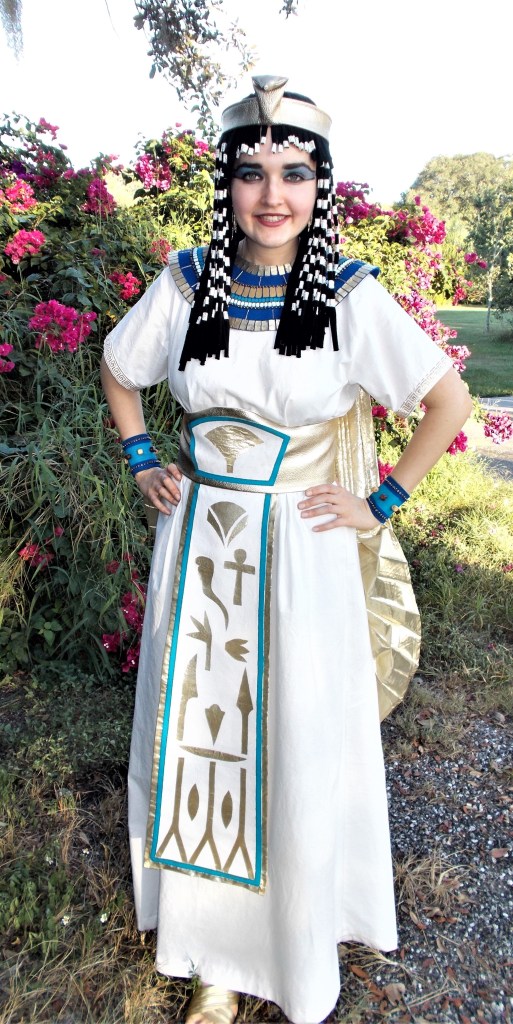
Due to a previous project which swallowed up my sewing schedule unexpectedly (ahem, Dalila), I had under a month to conceive, curate, and craft my costume for Aida. I doubt I’ll ever do that again. Since the Met’s production has been around for over 30 years, the pictorial research wasn’t difficult. While the obvious choice would have been to masquerade as the titular Ethiopian slave/princess, I was more drawn to her glitzy Egyptian rival, Amneris, and began my work on mimicking the character’s garb, almost as if I was to be her doppelgänger.

Anita Rachvelishvili as Amneris in Aida / Metropolitan Opera

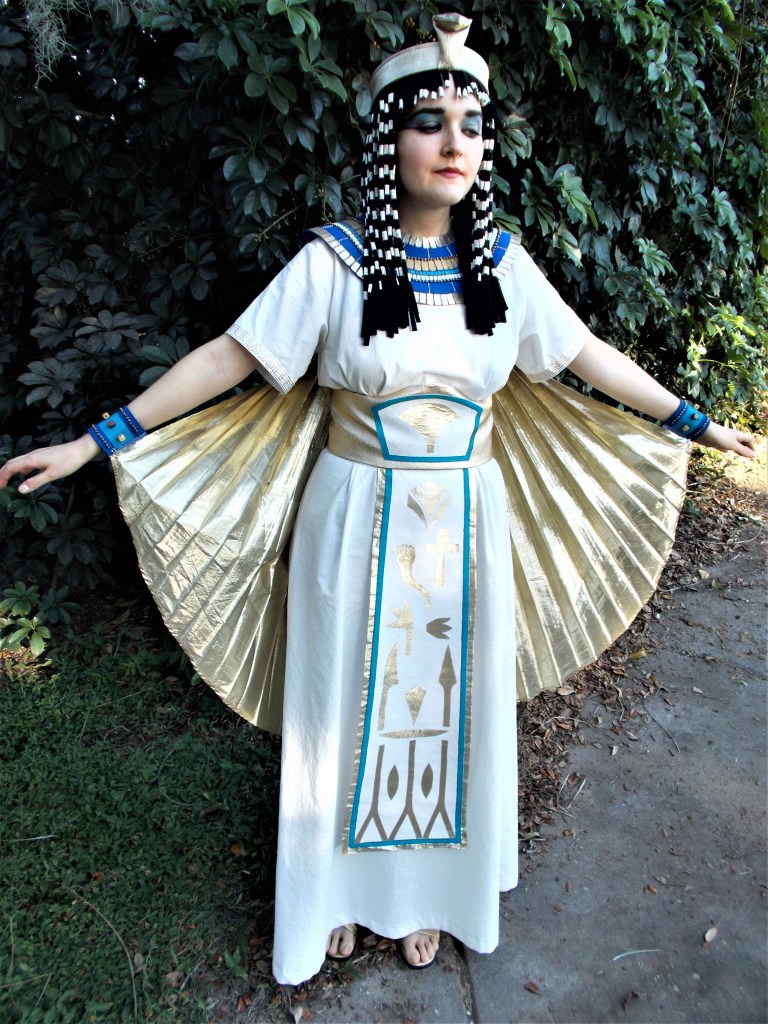
The outfit came together in the nick of time and was a fun way to immerse myself in the ancient Egyptian culture. Though I based my costume off of pictures from the opera, I still engaged in my usual research for historically-based operas.

The lamé cape was my favorite part… as well as the patrons of the theater ! I was repeatedly asked to spread its golden folds to reveal its full glamour.

Later in the month, I wore this same costume for Halloween as it was perfectly acceptable for Cleopatra. While the flocks and droves easily recognized me as the most famous Queen of the Nile, I wonder how many of them knew of the other great Egyptian Royal… the one in Verdi’s grand opera… Amneris !

Toi, Toi, Toi,

Mary Martha

Curious about how I crafted my Egyptian ensemble in such a hasty dash ? Read my tutorial post detailing the creation of my lookalike costume ! https://costumeclosetcouture.com/2020/06/16/amneris-%e2%94%80-from-broadcloth-to-egyptian-glamour-in-under-a-month/

Cast and Credits:

Aida ─ Giuseppe Verdi (1871)
Live in HD air date: October 6, 2018

Cast:
Aida ─ Anna Netrebko
Amneris ─ Anita Rachvelishvili
Radamès ─ Aleksandrs Antonenko
Amonasro ─ Quinn Kelsey
Ramfis ─ Dmitry Belosselskiy
The King ─ Ryan Speedo Green

Credits:
Conductor ─ Nicola Luisotti
Production ─ Sonja Frisell
Set Designer ─ Gianni Quaranta
Costume Designer ─ Dada Saligeri
Lighting Designer ─ Gil Wechsler
Choreographer ─ Alexei Ratmansky
Live in HD Director ─ Gary Halvorson
Host ─ Isabel Leonard

Manon

The score of Manon is a sensual pleasure for the ears… It’s a pity that I wasn’t more enthused about opera from the get-go ! But after my repelling experience with Puccini’s Manon Lescaut in 2016, I was tepid to take on the French version of the same tale. However, I sought to give the Massenet piece a fair shake ─ and it’s a good thing I did !

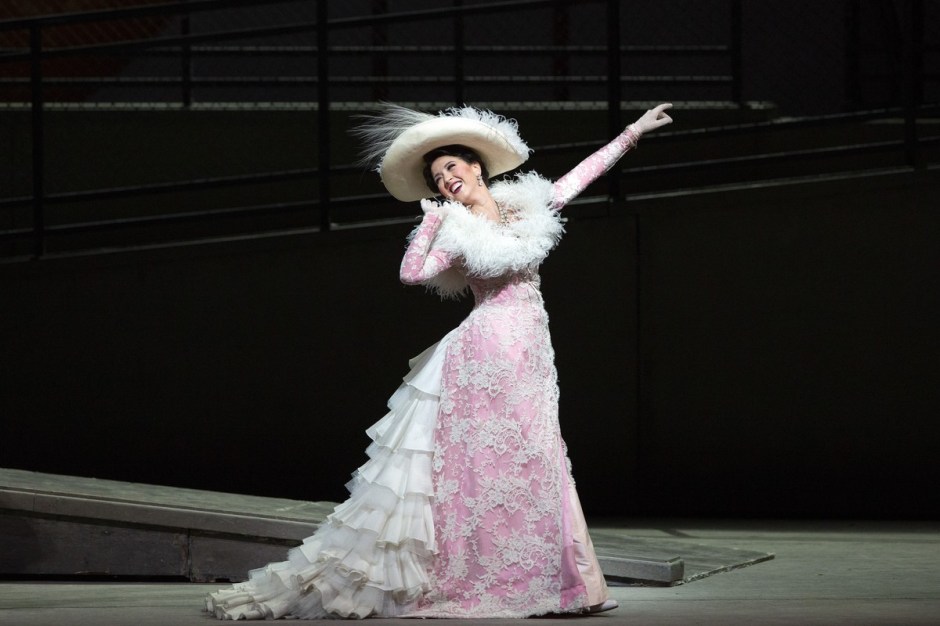
Lisette Oropesa as Manon / Metropolitan Opera

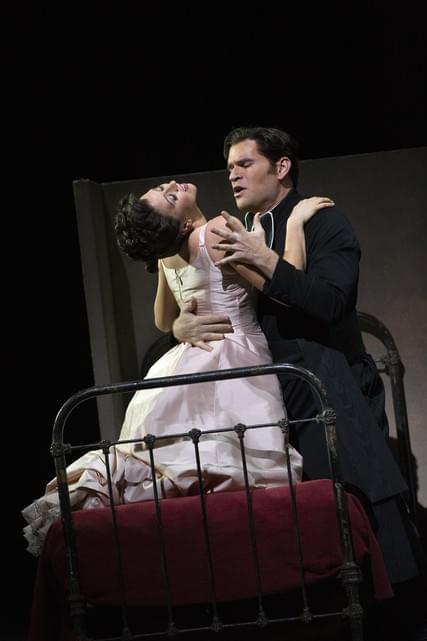
With charms tantamount to a Cartier necklace, Lisette Oropesa and Michael Fabiano lit up the stage with their untamable chemistry. It flowed and never ebbed, even in spite Manon’s tastes for frivolous Parisian luxuries. I confess that the blush on my cheeks turned redder than beets during the smouldering peak of Manon and des Grieux’s passion… atop a battered bed in the open sanctuary of a church. Awkward.

Lisette Oropesa as Manon and Michael Fabiano as des Grieux / Metropolitan Opera

While the screen was seared by the heat of the lovers, I had my eye on the historical aspects of the opera, namely, the costumes.

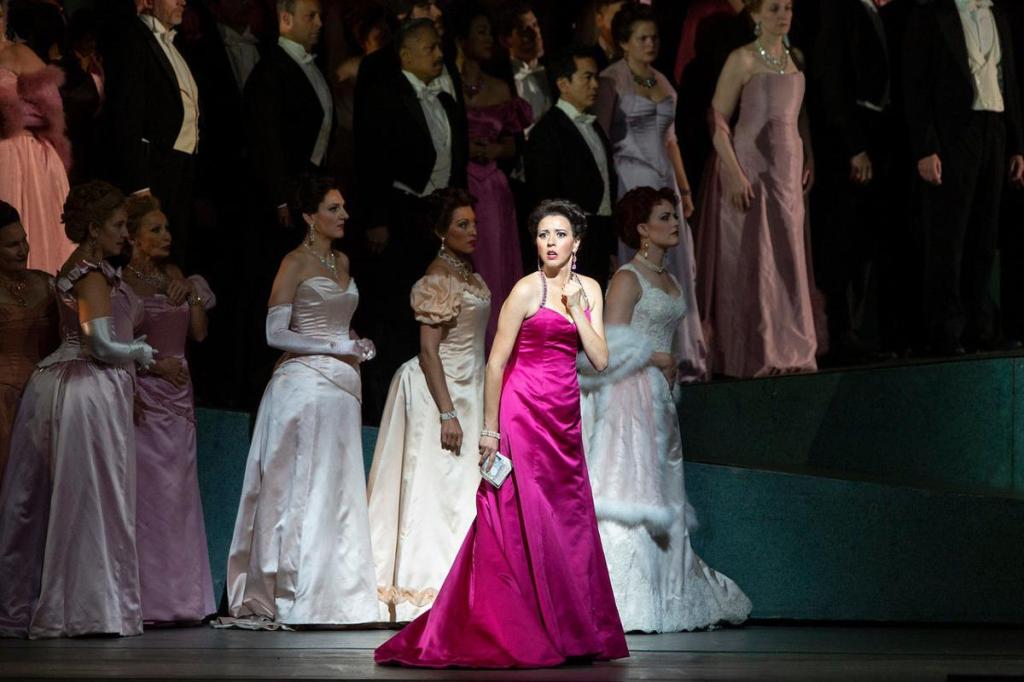
Although Manon is originally set in the Parisian courts of the 18th century, the Met’s current Laurent Pelly production has switched the setting to the late 19th century, or “La Belle Époque” as it is called among fashion historians. While rich with possibilities for sumptuous gowns, the costumes for this particular production looked a tad… “polyester”… and were all over the place in terms of isolating a specific decade: I noticed armored cuirasse bodices and fluffy bustles ─ indicative of the 1880’s ─ to gored skirts and enormous feathered hats, synonymous to the early Edwardian period of the 1900’s. There were even contemporary gowns of no historical basis. The myriad of differing modes of dress spanning 30+ years made for a lack of continuity as well as identity in the production. Was it traditional ? Was it modern ? The answer remained obscure.

Lisette Oropesa in Manon / Metropolitan Opera

Knowing that Laurent Pelly productions are filled with whimsy and topsy-turvy lineages, I didn’t aim to directly copy any one single costume from the opera since I knew, in taking that tack, the possibilities for future wear would be slim to none.
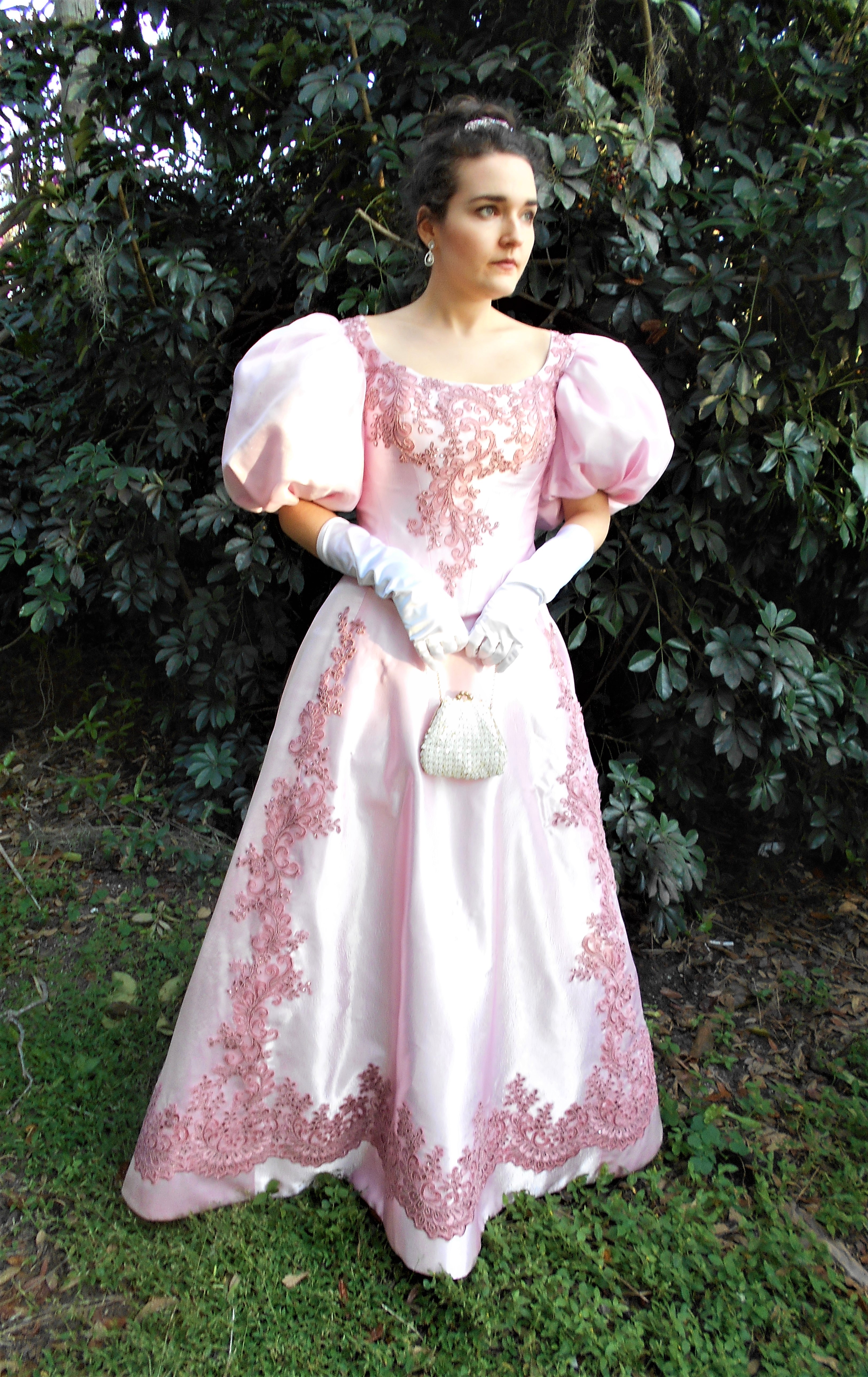
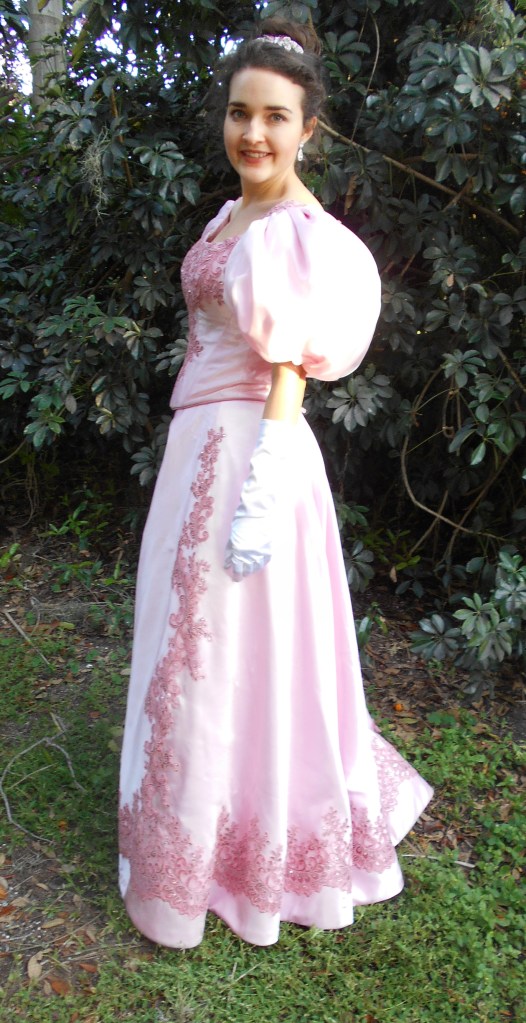
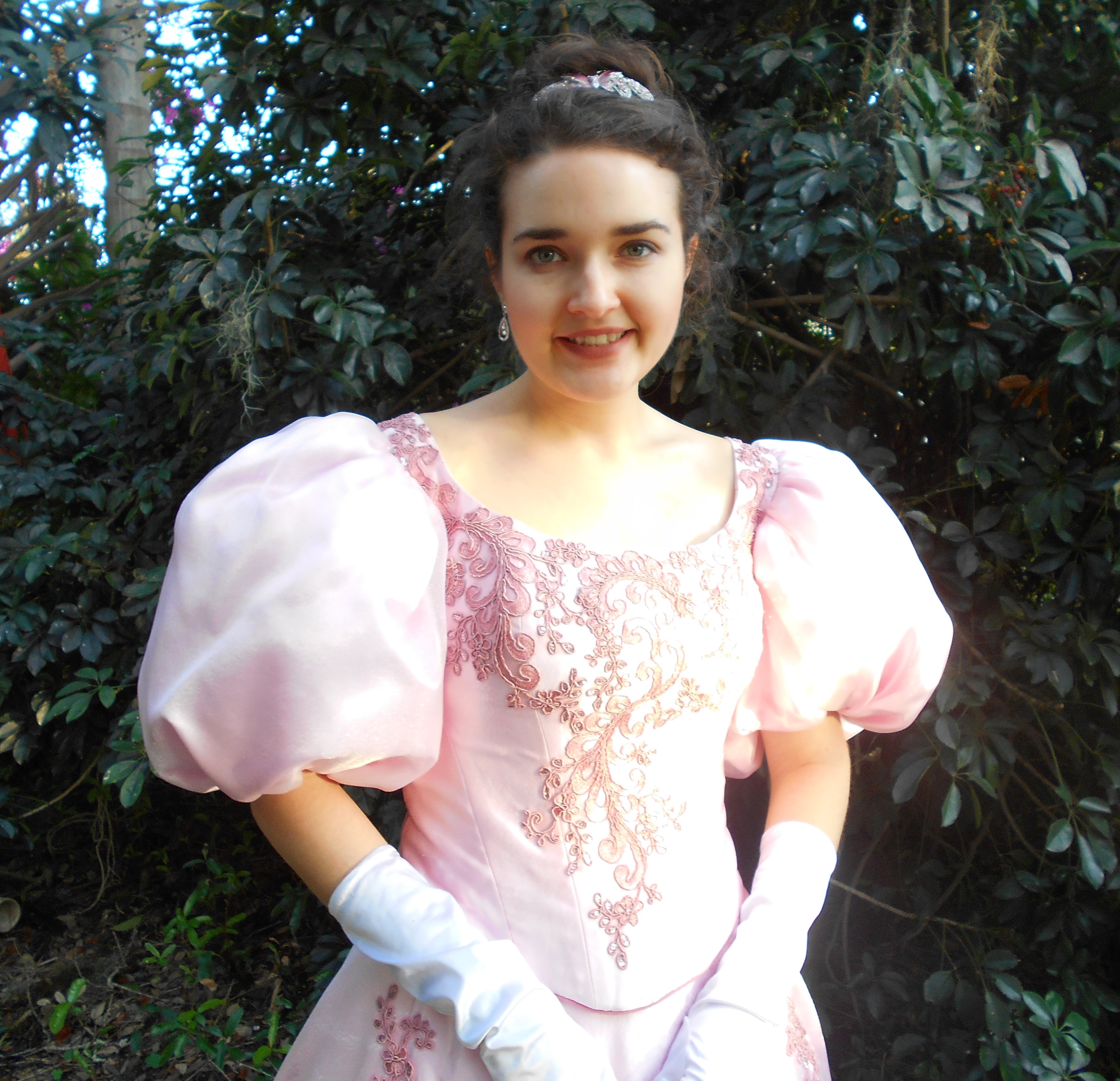
Coming to the decision was tough, but I eventually opted to create an 1890’s ball gown inspired by the mauve, pink, and silver butterfly clip perched in my hair.

The puff sleeves were enormous and reminded me of spun cotton candy…

With lace hand sewn onto the bodice and front gores of the skirt, this costume had couture qualities about it.

Paris, here I come ! I remember walking (or waltzing ?) into the theater that sunny late October afternoon and observing the gentleman ticket taker rendered speechless as he approached the podium. While approbation is never my motivation, it’s always a pleasure to receive remarks about the enjoyment elicited in others and their gratitude for what the craft adds to the Live in HD simulcasts.

Toi, Toi, Toi,

Mary Martha

For more information on how I created my “pretty in pink” 1890’s ball gown from start to finish, check out my tutorial post: https://costumeclosetcouture.com/2020/04/21/the-making-of-manon-the-1890s-ball-gown/

Cast and Credits:

Manon ─ Jules Massenet (1884)
Live in HD air date: October 26, 2019

Cast:
Manon ─ Lisette Oropesa
Chevalier des Grieux ─ Michael Fabiano
Guillot de Morfontaine ─ Carlo Bosi
Lescaut ─ Arthur Ruciński
de Brétigny ─ Brett Polegato
Comte des Grieux ─ Kwangchul Youn

Credits:
Conductor ─ Maurizio Benini
Production ─ Laurent Pelly
Set Designer ─ Chantal Thomas
Costume Designer ─ Laurent Pelly
Lighting Designer ─ Joël Adam
Choreographer ─ Lionel Hoche
Associate Director ─ Christian Räth
Live in HD Director ─ Gary Halvorson
Host ─ Nadine Sierra