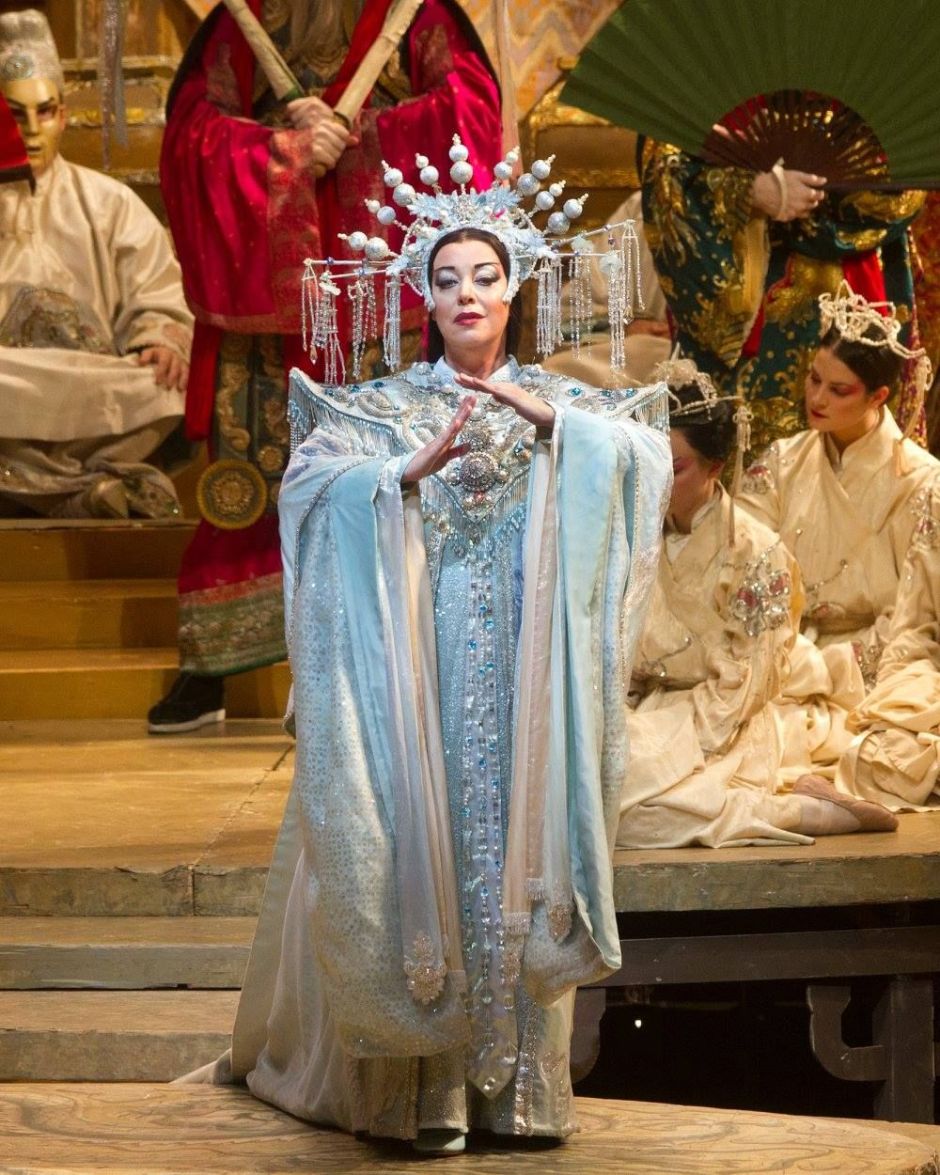
The Princess and the ‘Piece ─ Turandot

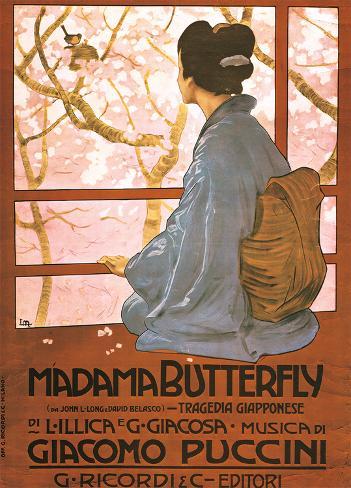
My first Puccini opera… what a thrill ! Posthumously premiering in 1926, Turandot feels more like a Grimm Brothers’ fairy tale than an Italian opera ─ a haughty princess, arduous riddles, and a mysterious suitor sheltering a life-or-death secret all lead to a storybook outcome. Having heard the praises of Puccini (and the exulting melody of “Nessun dorma”), I was more than ready to attend the encore of Turandot in early 2016. I even unfurled my reproduction poster for the occasion !
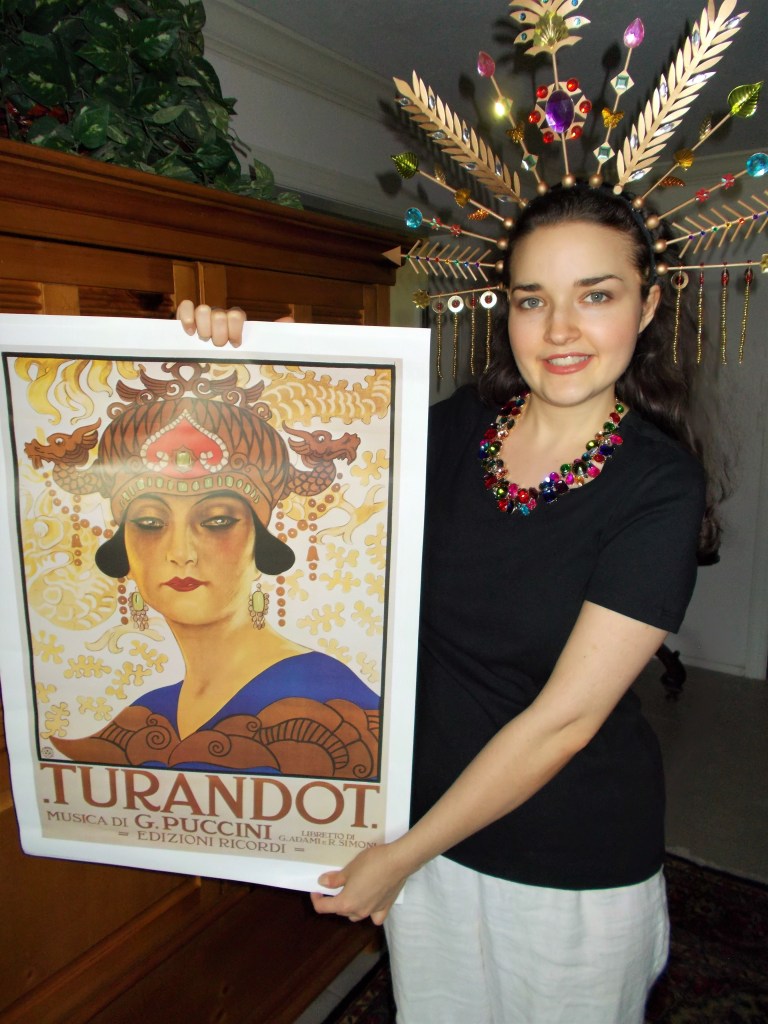
Thanks, 303 !

Only Franco Zeffirelli could create the spectacular setting of Turandot. Still a Met favorite from when it debuted in 1987, the sets and choreography shine as brightly as the music itself. When the stage darkens during the scene change in Act II, the resulting lapse rewards the spectator with a breathtaking display of an ancient Chinese palace.

A scene from Turandot / Metropolitan Opera

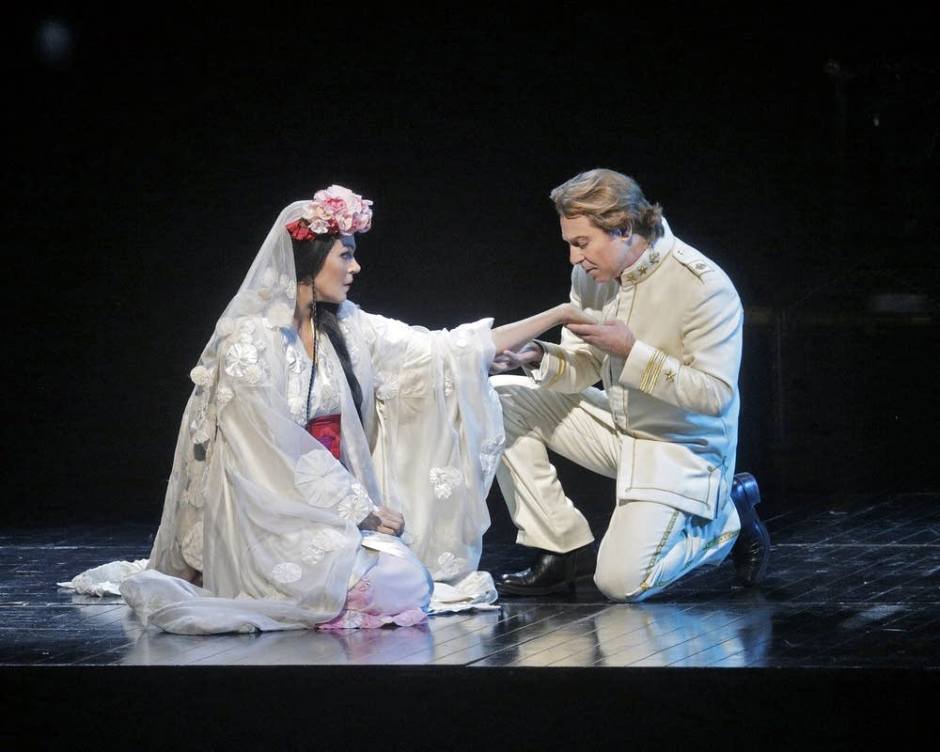
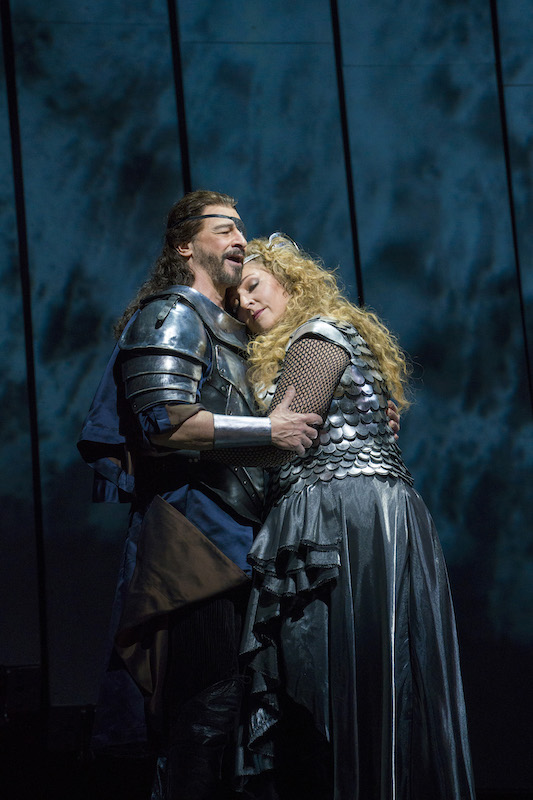
Even more exhilarating was the famed Riddle Scene. Although I had read the synopsis and knew the correct answers to the enigmatic questions posed by the tyrannical princess, I still suffered from a classic case of head-to-toe goosebumps as Calàf won the hand of the hitherto unattainable Turandot. The victor’s salivating looks of desire and the fingering of the princess’s silky mantle were too seductive for words. My heart was aflutter !
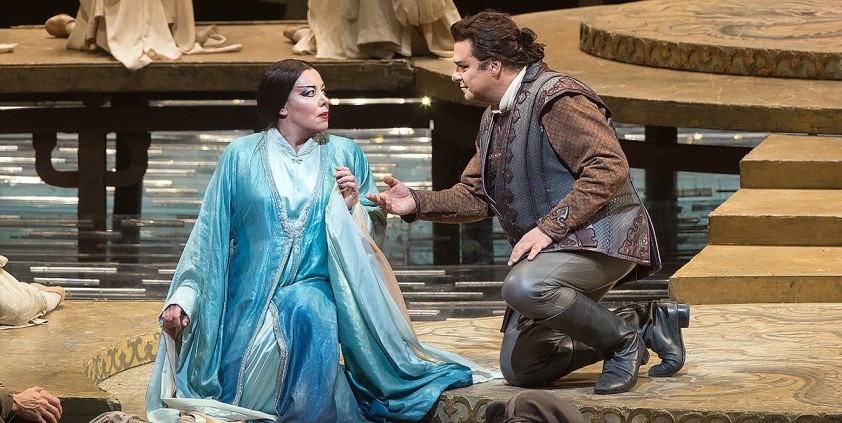
Nina Stemme and Marco Berti in Turandot / Metropolitan Opera

Here I must opine… As the audience anticipates the much beloved “Nessun dorma” in Act III, I couldn’t help but wish for a supplemental scene prior to the big aria of a frazzled Turandot, pacing in her bedchamber with her servants while racking her brain as to what the stranger’s name could be… I think it would have added another dimension to the desperate drama.

Nevertheless, I adored the opera and everything about it: the treacherous secret (which cost Liù her life), the surrender to love, the happy ending ─ what’s not to like about Turandot ?

Alexander Tsymbalyuk as Timur, Anita Hartig as Liù, Dwayne Croft as Ping, and Nina Stemme as Turandot / Metropolitan Opera

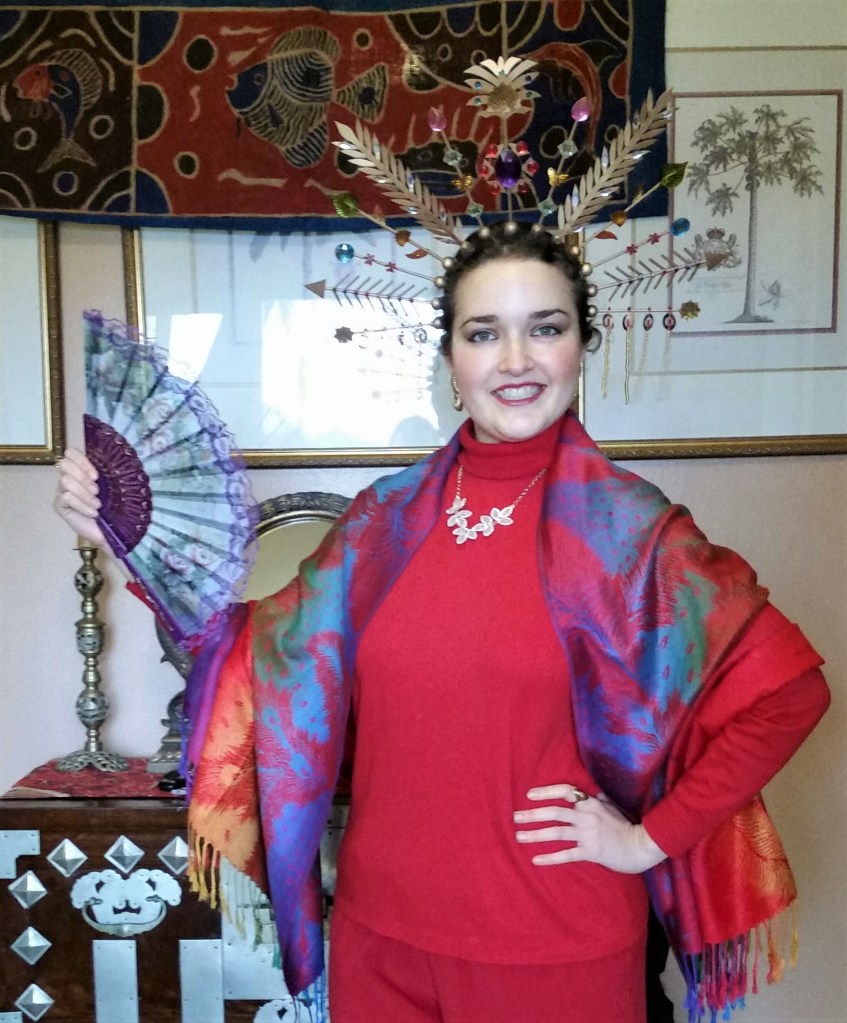
“Chinese” is not a style typically engendered by my closets. However, there was something I could manufacture in order to convey the right amount of dynastic imperialism… While Zeffirelli’s sets are extraordinary, the costumes in Turandot are just as jaw-dropping, especially the ostentatious headpieces worn by the titular character. My goal was to create my own unique headpiece that was as visually stunning as it was logistically sound. Browsing ideas for Turandot headpieces, Birgit Nilsson’s ornate costume from 1961 was my favorite and became the inspiration for my own creation.

Birgit Nilsson as Turandot in 1961 / Metropolitan Opera

Before creation could begin, some engineering chicanery needed to occur since there were many obstacles in the way of the perfect head accessory. Just imagine ─ wearing the headpiece in the car on the way to the opera, leaning back on the headrest of the seat in the theater, potentially blocking someone’s view of the screen, etc. Using a basic headband as the foundation for the headpiece, I took measurements of height and width from the top and sides of my head in order to avoid any damages to the headpiece (and theater patrons) while realistically evaluating how tall and wide I could reasonably fashion the accessory.
There was also the ‘weight’ component to contemplate: when the entire superstructure is built off a cheap headband, the overall weight of the headpiece needed to be kept to a minimum. Keeping this in mind, I used bamboo skewers for the tall, emanating stakes and was careful to select materials that doubled as both fashionable and functional.

Decorated in sequins, rhinestones, and beads, a healthy spray painting of gold helped turn an ordinary cereal box and plain wooden skewers into a dazzling work of art.

The Turandot headpiece up close

Although my closets lacked chinoise appeal, I still tried my best to create a Chinese-themed outfit: a monochromatic red turtleneck and pants proved a reliable choice for the chilly February evening while the vibrant scarf I bought at the Port Authority in New York was just the right pop of color to match the headpiece’s prismatic brilliance.
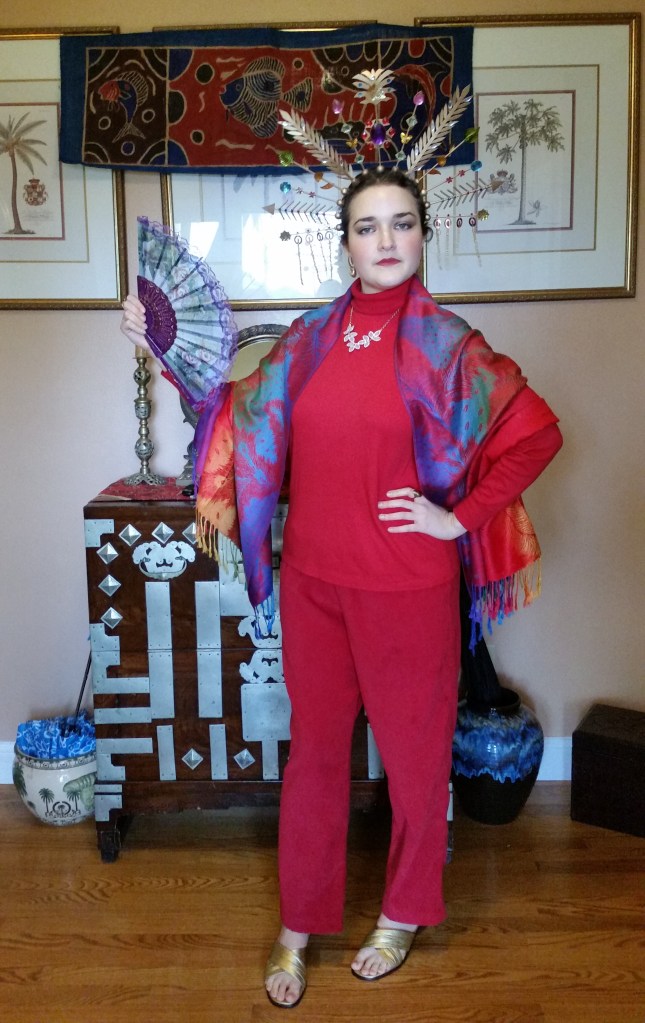
The pre-work engineering paid off: I was able to ride to the theater with the finial just barely clearing the headliner of the car. And even though I accidentally bumped into the dark corridor on the way to my seat, no one was injured in the process, including the headpiece.
From Birgit Nilsson to Franco Zeffirelli, Puccini’s final opera is a fountain for artistic pleasure. Turandot may have been my first Puccini opera, but it certainly won’t be my last !

Toi, Toi, Toi,

Mary Martha

Cast and Credits:

Turandot ─ Giacomo Puccini (1926)
Live in HD air date: January 30, 2016
(Encore seen: February 3, 2016)

Cast:
Turandot ─ Nina Stemme
Calàf ─ Marco Berti
Liù ─ Anita Hartig
Timur ─ Alexander Tsymbalyuk

Credits:
Conductor ─Paolo Carignani
Production ─ Franco Zeffirelli
Set Designer ─ Franco Zeffirelli
Costume Designers ─ Anna Anni, Dada Saligeri
Lighting Designer ─ Gil Wechsler
Choreographer ─ Chiang Ching
Live in HD Director ─ Barbara Willis Sweete
Host ─ Renée Fleming
An Ode to the Don (Giovanni, that is)

Devilish and cunning, the rakish Don Giovanni swept into town.
His words beguiling and gestures disarming, his reputation carried more than a frown.
And now with his fellow, by name, Leporello, he made his latest attempt.
For poor Donna Anna, betrothed to Don Ottavio, could offer only contempt.
It was her elderly father of nobility’s blood that came to her rescue at once,
But “too little, too late” was the defense and at sword’s jab the man fell like a dunce.

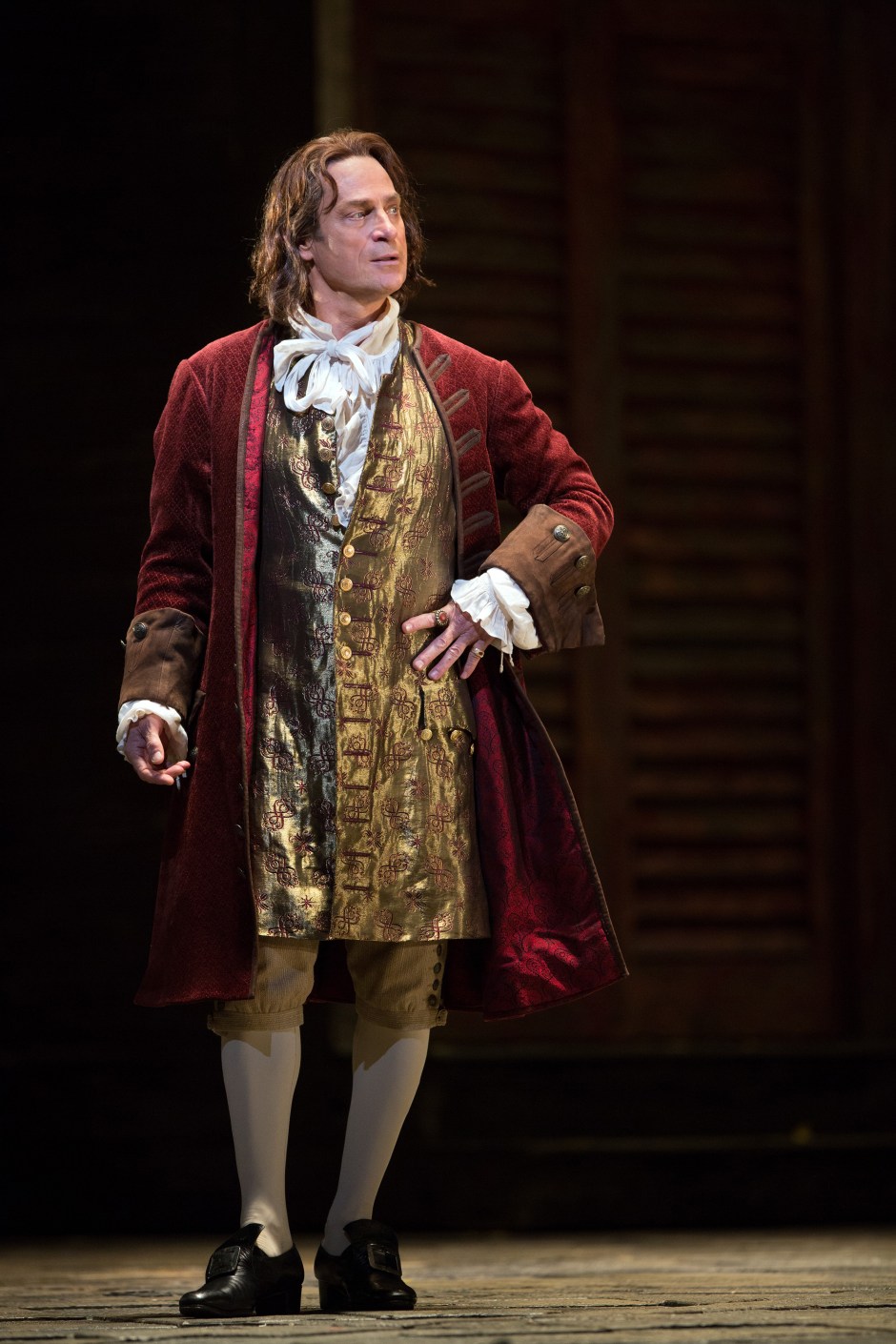
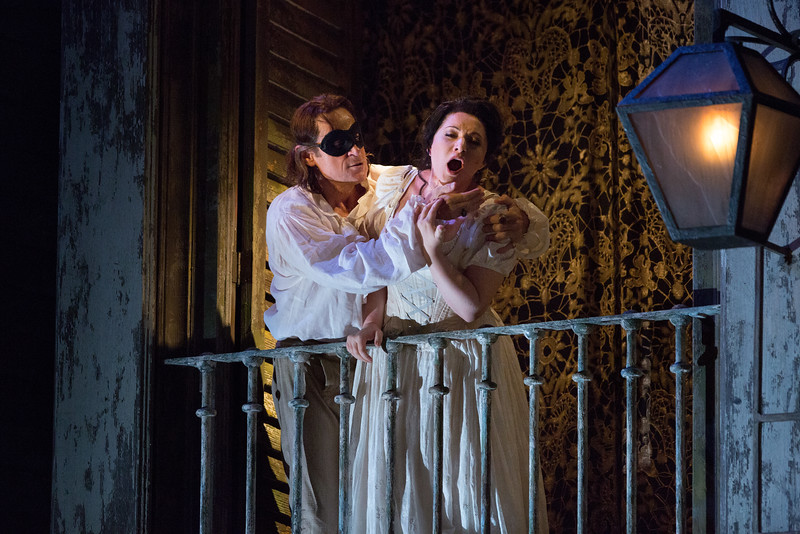
Simon Keenlyside as Don Giovanni and Hibla Gerzmava as Donna Anna / Metropolitan Opera

With conquests left to behold, the Don ran after the rustling skirt.
If only he knew that the scorned Elvira would turn his life into trodden dirt;
A crusade and mission urged her on and from town to town she flew,
Warning the women (and most likely victims) of what they unknowingly knew.
From peasant to princess, no one was safe from Giovanni’s philandering curse.
Now to the banquet of happiest couple, shouldn’t I try to keep this terse ?

Simon Keenlyside and Malin Byström in Don Giovanni / Metropolitan Opera

Zerlina succumbed; Masetto enraged, he gathered together a mob,
To pluck from the earth the sly and brazen cad of unholy, calamitous job.
Backed in a corner, his person in peril, the man of misbehavior in doubt;
He swapped into clothes of his hapless friend (turned foe) and escaped without a shout.
His pursuits still vulgar, his actions unchanged, could the villain ever be stopped ?
A walk in the graveyard, perhaps the evening repast, could render the charges be dropped.

Serena Malfi as Zerlina and Matthew Rose as Masetto in Don Giovanni / Metropolitan Opera

Remember the man, called “Commendatore”, who departed with last breath spent ?
His ghost revived in chiseled stone with the dire last call of “Repent !”
But the obstinate rake refused to relinquish his grips on feminine flesh,
With no other choice, the floors agape, the hellish flames swallowed his body afresh.
The vermin extinguished, the story could end, but here’s the final sitch ─
When Mozart’s to blame, one should expect a lesson for both the poor and rich.

Kwangchul Youn as the Commendatore, Simon Keenlyside as Don Giovanni, and Adam Plachetka as Leporello / Metropolitan Opera

What should I wear, I asked myself, to an opera of class shown about ?
For distinctions are clear between master and slave, the truest of nobles and the notable lout.
Mozart’s maidens are timeless and fair regardless of rank or style of their hair;
From Anna, Elvira (both Donnas, you see), to lowly Zerlina, her dress with a tear.
Baffled and miffed, I wrestled with such: for whom to portray, which one of the doves ?
A closet of merit should cater to all, but given the choice, pass me the gloves !

A lady who’s worth her virtue at all must harbor her secrets from the presence of all,
But since I’ve managed to rhyme thus far, why not divulge both big and small ?
The golden tank of consignment birth, resurfaced from outings of drawer-bound dearth;
Yes, it’s true how much it is used, from Indian sari to Desdemona’s innocent mirth.
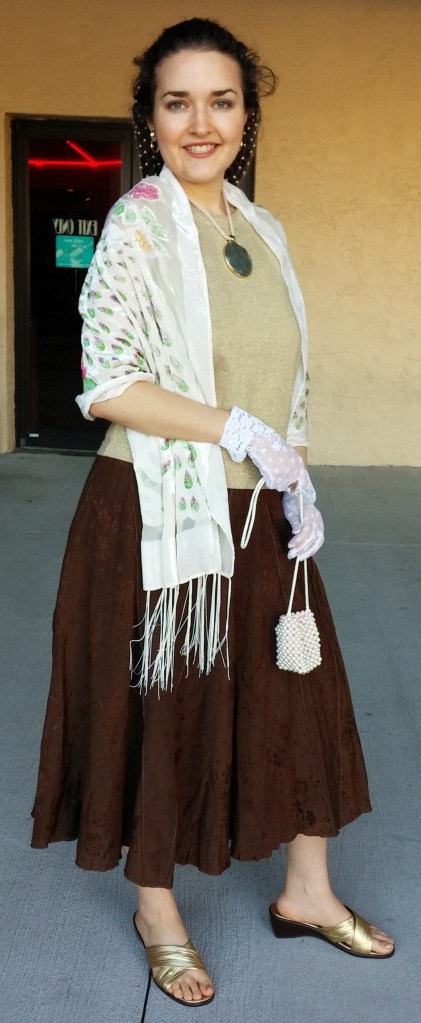
Demure was the purse, deluxe the skirt (whose waist was pinned after a bout of torque),
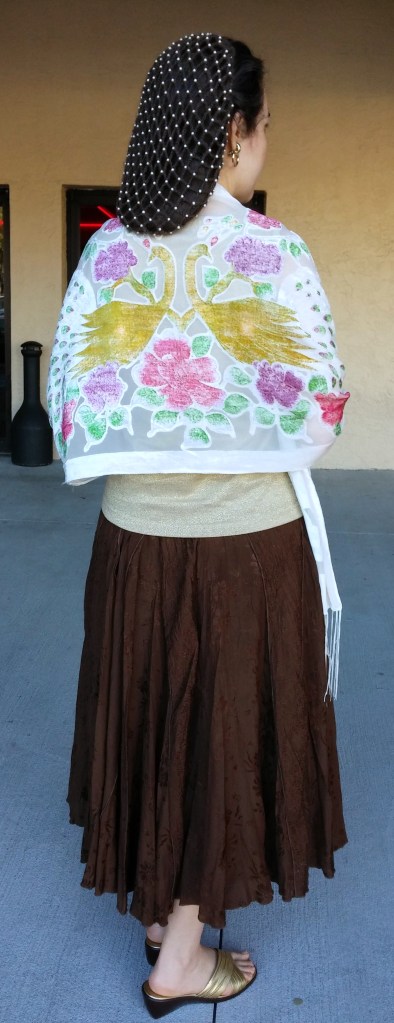
And best of all, this I confess, a velvet shawl from the Port Authority in New York.

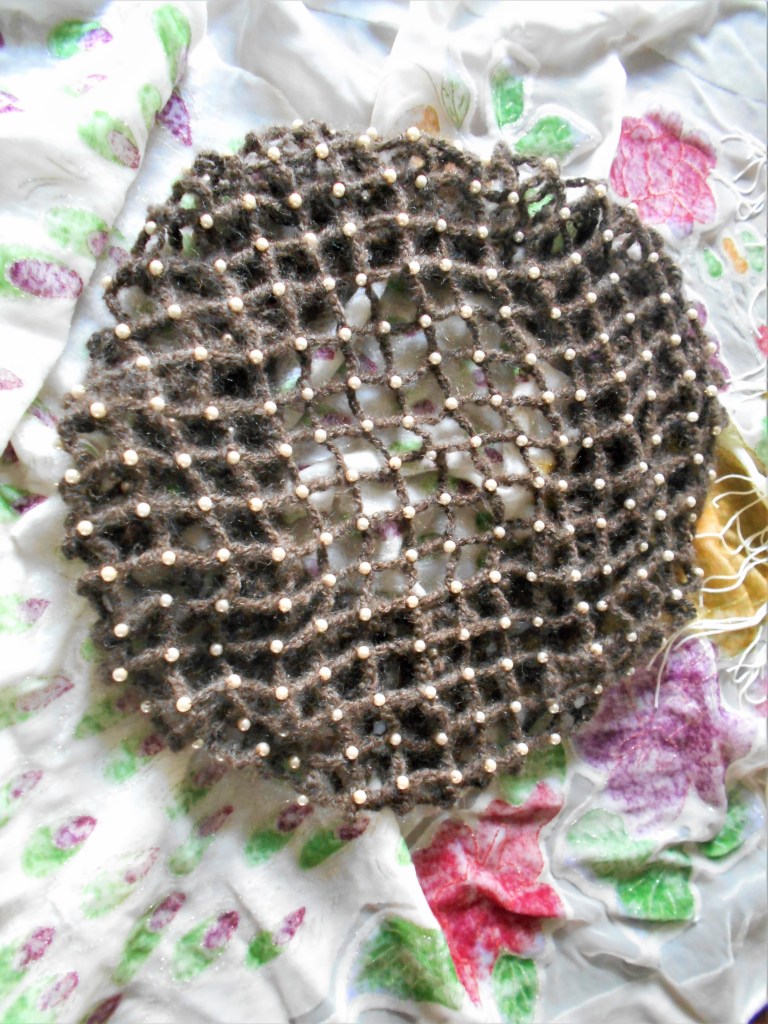
What are those dots, which catch the eye, and bring to sight a glimmering shine ?
To keep at bay the disheveling wind, a thought ─ an act ─ must supplant the crowning line.
When a lady needs to look her best, she never leaves home with her hair in a mess;
Aristocracy gave need for address, for women of rank needn’t accept anything less.
And now with my hooks and needles aflight, a snood I fashioned with all of my might─
Yarn of alpaca to match the hue of my hair and beads of pearl knotted on tight.

Prim and proper, my hair was corralled like a breath-beaten filly who’s had it with crowds.
Accented with jewelry and earrings of gold (and let’s not forget the gloves of renown),
The outfit was ready to make its debut for all of them who bought tickets to view,
The opera, a gem for Mozart’s raptly devote, which escapes the feelings of only a few;
It’s part of that limited group to which I submit: with Mozart, I’m often not “over the moon”,
But the Don was persuasive, unscrupulous, too; no lady immune: all I could do was swoon !

Toi, Toi, Toi,

Mary Martha

Cast and Credits:

Don Giovanni ─ Wolfgang Amadeus Mozart (1787)
Live in HD air date: October 22, 2016

Cast:
Donna Anna ─ Hibla Gerzmava
Donna Elvira ─ Malin Byström
Zerlina ─ Serena Malfi
Don Ottavio ─ Paul Appleby
Don Giovanni ─ Simon Keenlyside
Leoporello ─ Adam Plachetka
Masetto ─ Matthew Rose
The Commendatore ─ Kwangchul Youn

Credits:
Conductor ─ Fabio Luisi
Production ─ Michael Grandage
Set and Costume Designer ─ Christopher Oram
Lighting Designer ─ Paule Constable
Choreographer ─ Ben Wright
Live in HD Director ─ Matthew Diamond
Host ─ Joyce DiDonato

Madama Butterfly (2016)

Tragedies have always attracted me. Fully aware that the ending will be sad and the experience will most likely cause some degree of physical and emotional depletion, I still find myself being drawn to the most dramatic literary form like a batty moth to a glaring light. And when one of opera’s most famous tragedies is set to some of the most beautiful, heart-soaring music, the call to attend is heeded without question.

Intriguingly, Madama Butterfly could have been my first opera: glancing over the 2015-2016 Live in HD schedule, I thought it would be a perfect “first-timer” opera since its title is readily on the lips of laymen. But other decisions were made and now stepping into the theater in early April 2016, my opera attendances had now totaled beyond what could be counted on one hand.

The opening pantomime from Madama Butterfly / Metropolitan Opera

So what did I think of Madama Butterfly ? I loved it ! The music was thematic and stunning while the costumes were colorful and imaginative. Also appropriately mimicking the clean, Japanese aesthetic were the sets designed by the late director, Anthony Minghella.
Of course, there was heartbreak, but the unwavering balance created by the supporting characters of Suzuki and Sharpless added stability to an otherwise distressing story.

Kristine Opolais as Cio-Cio-San and Maria Zifchak as Suzuki / Metropolitan Opera

However, my winner of the day goes to Kristine Opolais, who sang Butterfly. What a sublime actress ! Her ability to convey both tenderness and frustration as the unfortunate geisha was unmatched, even though her voice sounds a bit too “hollow” for my liking. If only she and Roberto Alagna (Pinkerton) could have swapped heights… Too many times did I notice Opolais purposefully stooping as she pattered on stage in order to diminish the deficit between her head and that of her leading man’s.

Kristine Opolais and Roberto Alagna in Madama Butterfly / Metropolitan Opera

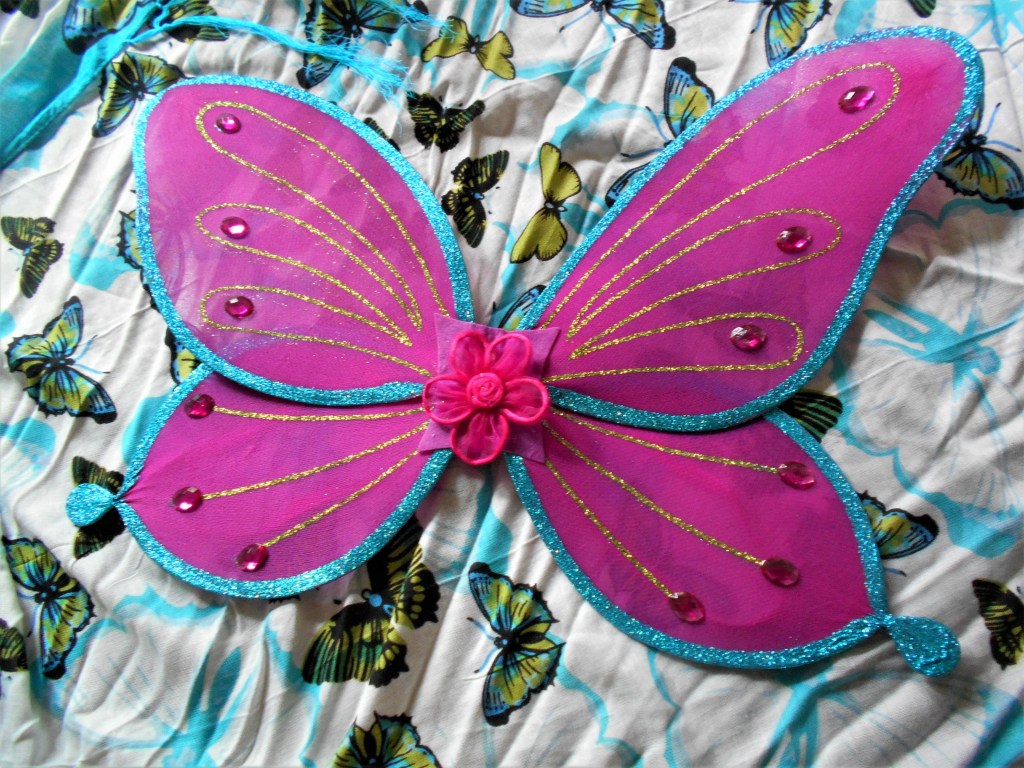
“Now, what to wear…?” Hitherto, I had been able to furnish themed costumes out of accessories in my closets with limited issues. Butterfly was a different story. Not knowing anything about the opera beforehand, I first toyed with the idea of draping a long skirt in a scarf printed with bright butterflies and donning a pair of child’s dress-up butterfly wings… Just as Pinkerton abandoned Butterfly, so I also jettisoned that silly notion.

Madame Butterfly ? Not quite…

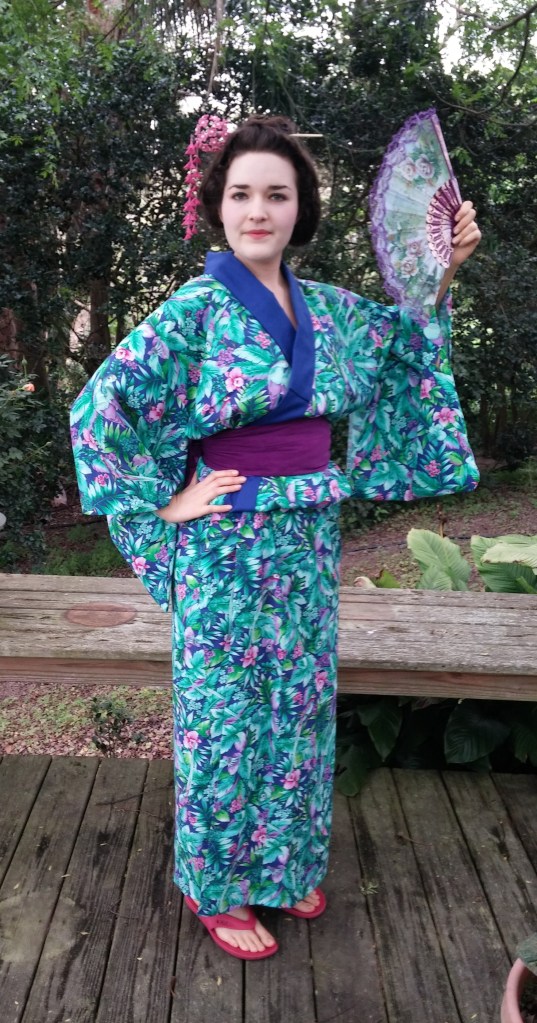
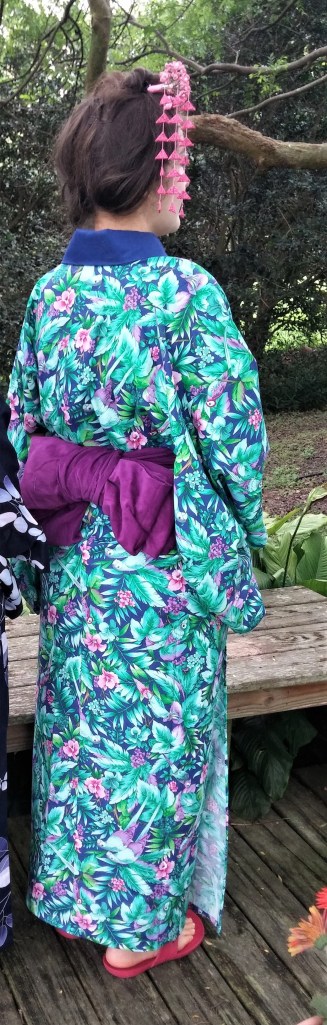
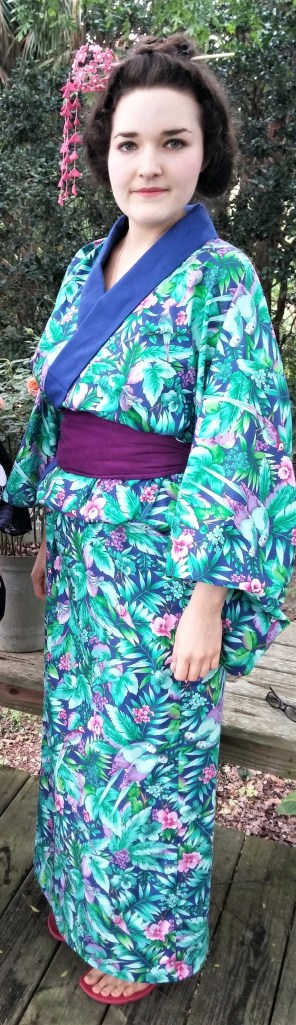
Desperate for a solution japonaise, I realized I had no other option but to make my own kimono. But where to begin ?! I didn’t even know how to operate a sewing machine ! Determination, however, was stronger than Doubt. Unearthing the old Singer sewing machine, sheathed in dust, from under my mother’s bed, I sat on the floor of my bedroom trying to understand how the machine worked. Turning the hand wheel and observing how and where the needle fell was a fascinating procedure, but I wasn’t gaining ground on my endeavour. Thank goodness for online articles and YouTube ! After many failed attempts at propelling the needle on its journey, something finally clicked and I sewed my first line of stitches. Eureka ! Now to begin the staggering challenge of sewing a yukata…

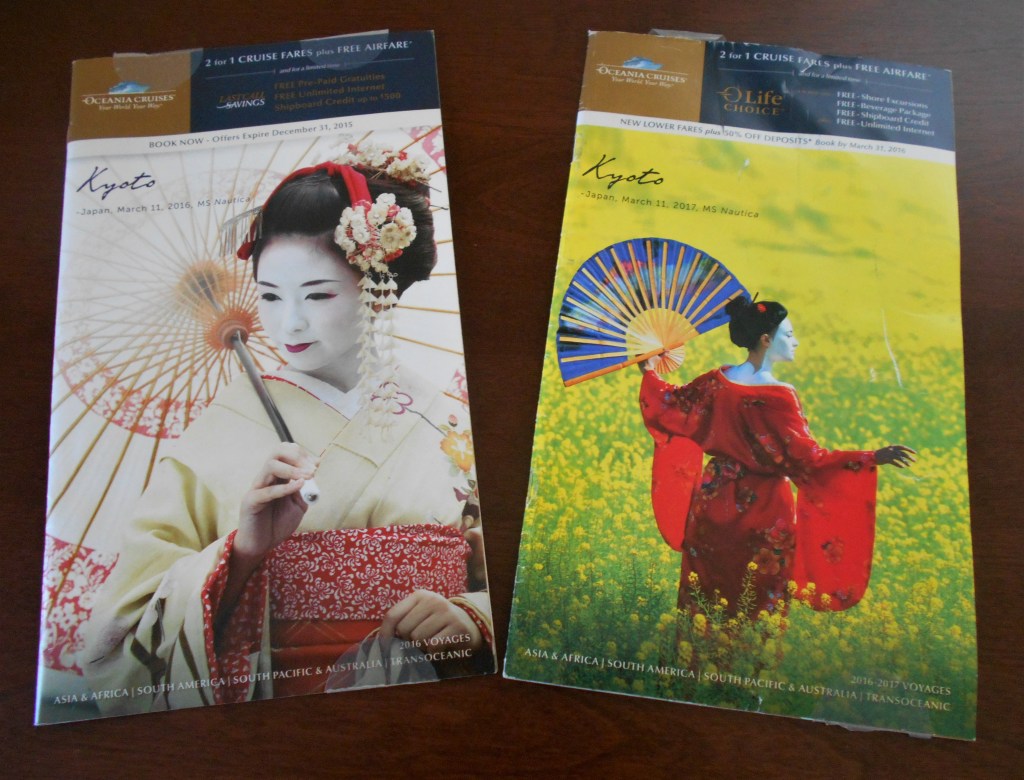
Inspiration while working on my yukata: cruise line travel brochures !

Keeping my project a secret, I worked late hours in my bedroom following the instructions for a homemade yukata. Astoundingly, I learned and retained more information about kimonos, yukatas, and Japanese geisha culture than I ever imagined. One of the greatest benefits of sewing costumes is the amount of research needed to facilitate an authentic look and therefore, the knowledge gained in the process. Differentiating the method from textbook learning is the hands-on approach that ensures greater retention even after the project is complete. Even now, I can name off all the parts of a kimono and some of the little intricacies of geisha manners.

Nearly all the design aspects of my cotton yukata are traditional (except the contrasting bachi eri, but that’s only because I ran out of the main fabric !). From the ohashori (pouched fabric beneath the obi) to the left-over-right okumi panels (NEVER right-over-left ─ that’s for corpses only !!!!), my yukata was fit for a Japanese festival. I even made a matching kanzashi chopstick hairpiece to tie into the tropical print of the yukata.

Kanzashi hairpiece and obi tied into a bow

Overall, I was proud of my very first sewing project─ wearing my creation to the theater made me feel as if I had conquered an unimaginable feat !
With Madama Butterfly, my taste for tragedy was well satiated. In matters of sewing, my palate had just been whetted.

Toi, Toi, Toi,

Mary Martha

Cast and Credits:

Madama Butterfly ─ Giacomo Puccini (1904)
Live in HD air date: April 2, 2016

Cast:
Cio-Cio-San ─ Kristine Opolais
Pinkerton ─ Roberto Alagna
Suzuki ─ Maria Zifchak
Sharpless ─ Dwayne Croft

Credits:
Conductor ─ Karel Mark Chichon
Production ─ Anthony Minghella
Director and Choreographer ─ Carolyn Choa
Set Designer ─ Michael Levine
Costume Designer ─ Han Feng
Lighting Director ─ Peter Mumford
Puppetry ─ Blind Summit Theatre
Live in HD Director ─ Gary Halvorson
Host ─ Deborah Voigt*

*Matthew Polenzani originally scheduled to host broadcast.

Die Walküre

I couldn’t have asked for a better opera for my first outing of Wagner: from Bugs Bunny to WWE wrestler walk-up music, Die Walküre‘s fame and legacy permeates all realms of music and culture. Who hasn’t heard the irresistibly iconic “Ride of the Valkyries” or been amused by the warrior women with braids and Viking helmets ?

Part of an epic tetralogy know formally as “Der Ring des Nibelungen”, Die Walküre explodes with mythological drama and some of the most involving music ever written. Ever since I began attending operas, I’ve always heard mentions of Wagner’s “engrossing” music and how spectators loose track of time while taking in a performance, despite the harrowing length of most of Wagner’s works. Knowing this, I was a little apprehensive about how I would fare at my first Ring opera.

Jamie Barton as Fricka, Greer Grimsley as Wotan, and Christine Goerke as Brünnhilde in Die Walküre / Metropolitan Opera

I shouldn’t have been worried ─ I loved Die Walküre and was hooked on the Ring Cycle ! While the layered story dipped into several previous arcs that occurred in Das Rhinegold (the first opera in the tetralogy), I found I was able to keep pace with the action and inevitably slipped into that intoxicating Wagner “trance”. Brutish warriors and incestuous twins aside, there were greatly tender moments as well. The final farewell between Wotan, the flawed God of Valhalla, and his disobedient Valkyrie daughter, Brünnhilde, nearly sent my mascara running !

Greer Grimsley as Wotan and Christine Goerke as Brünnhilde in Die Walküre / Metropolitan Opera

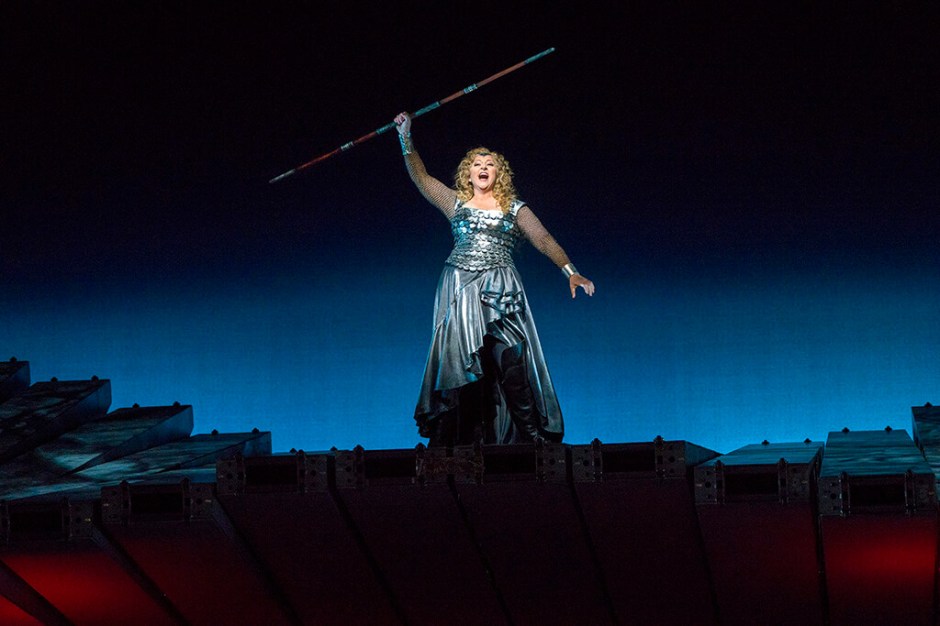
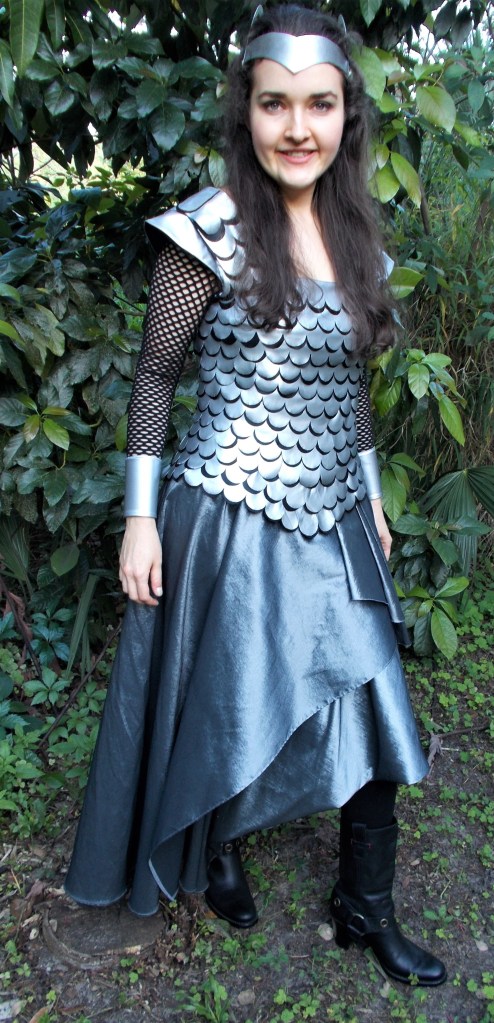
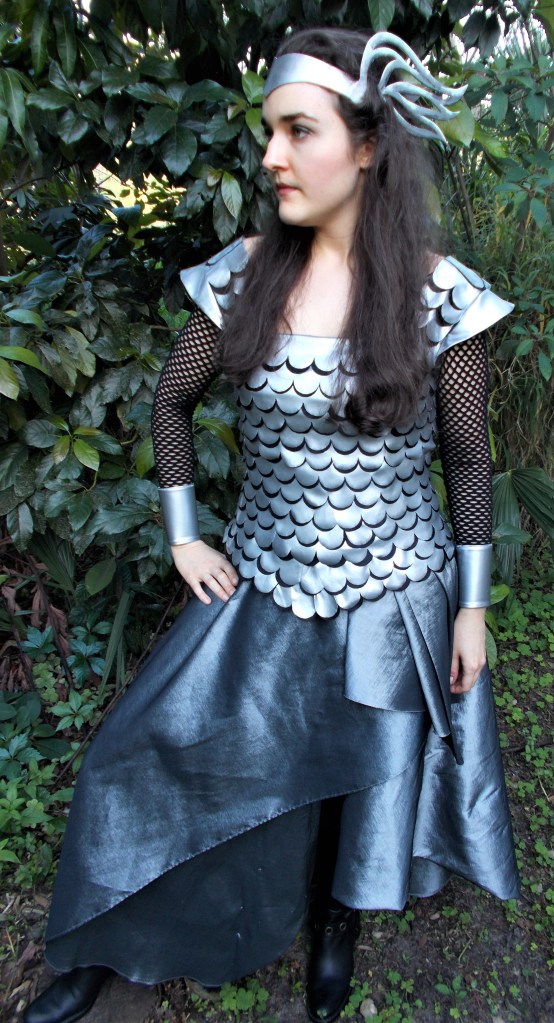
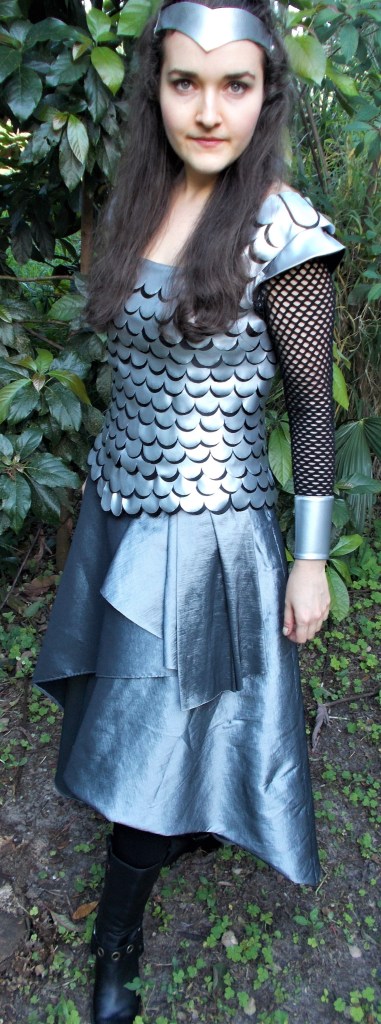
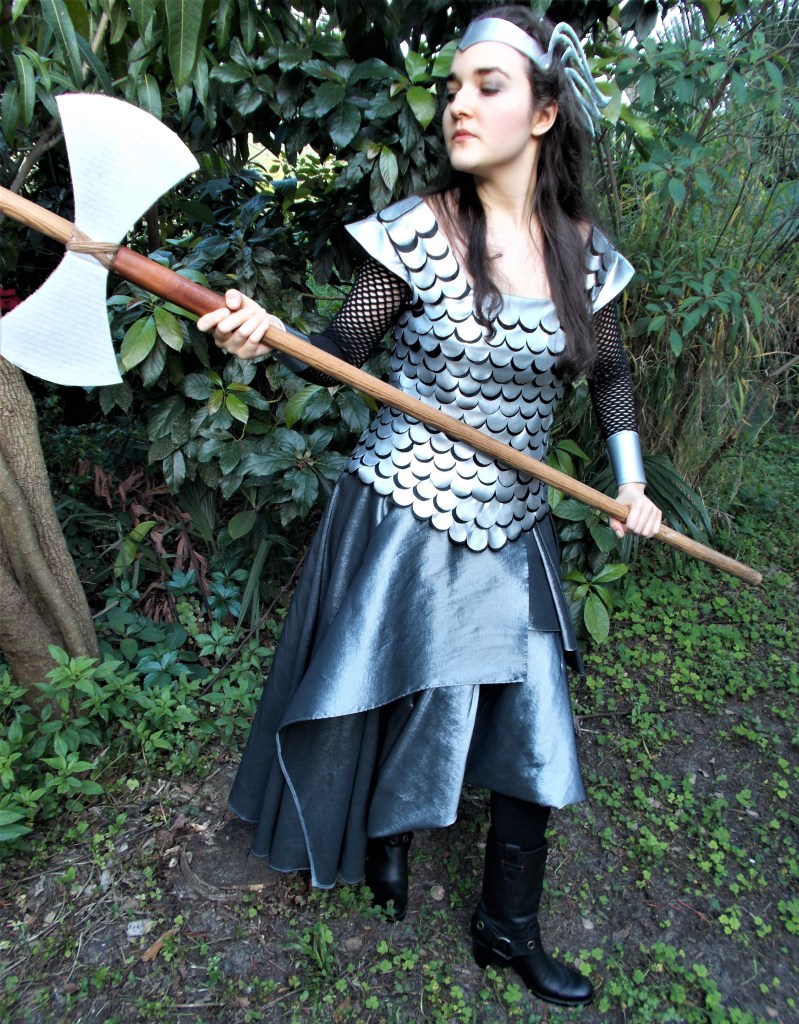
What is a ‘Valkyrie’ anyway ? In reading up on Norse mythology, I learned how Valkyries were immortal female fighters who aided in the battles among men on earth and safely carried the fallen heroes to Valhalla where they would live and serve Wotan in happiness. Although generally styled as Viking women with horned helmets and long braided pigtails, the Met’s Robert Lepage production has altered the women’s accoutrements to have filigreed chrome wings mounted to diadems and textured skirts of a metallic mylar material. As a costume that would unmistakably smack of cosplay, I set out to replicate the shiny scaled armor bodices and flashy skirts of the Met’s fearless Valkyries.

A scene with the Valkyries: Christine Goerke as Brünnhilde and Eva-Maria Westbroek as the Wälsung, Sieglinde / Metropolitan Opera

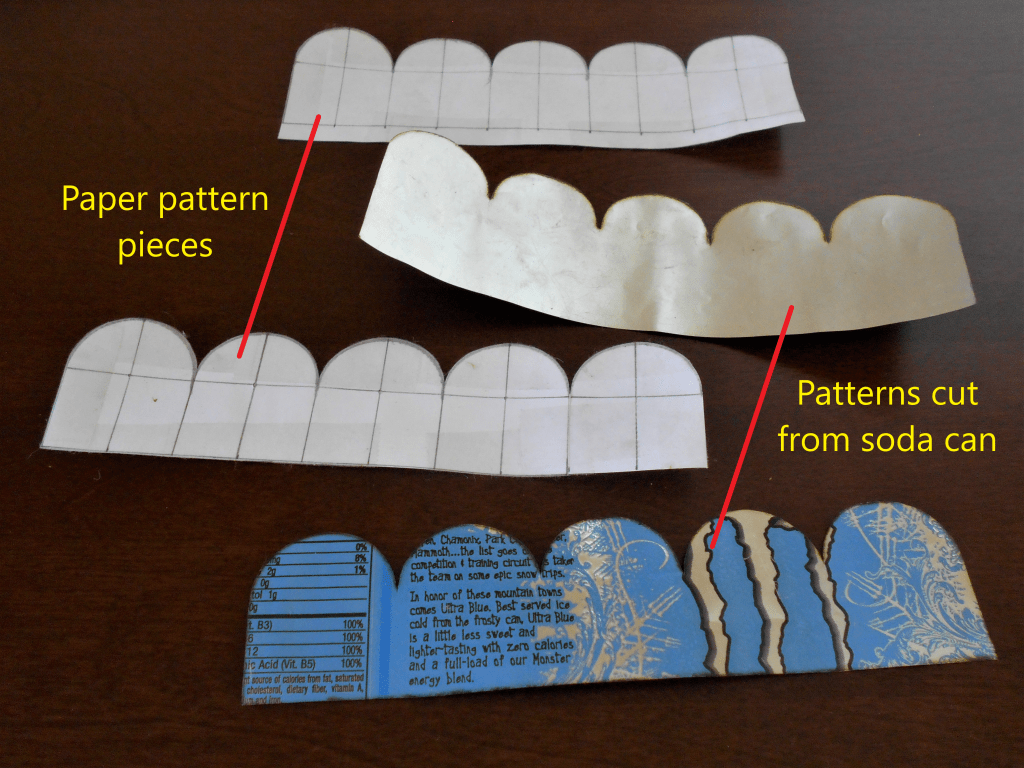
Sourcing the materials was the first step. Initially, I thought of using a spangle sequin fabric for the chain mail bodice, but decided against it in favor of hand cutting my “scales” out of versatile silver pleather for a more authentic look. In order to use my hot knife on the pleather, I needed a stencil and a sturdy one at that ! A branding pen devours paper like the flames of Brünnhilde’s bridal fire ─ I transferred my paper patterns onto an empty soda can and burned both pleather and black matte satin using their forms.

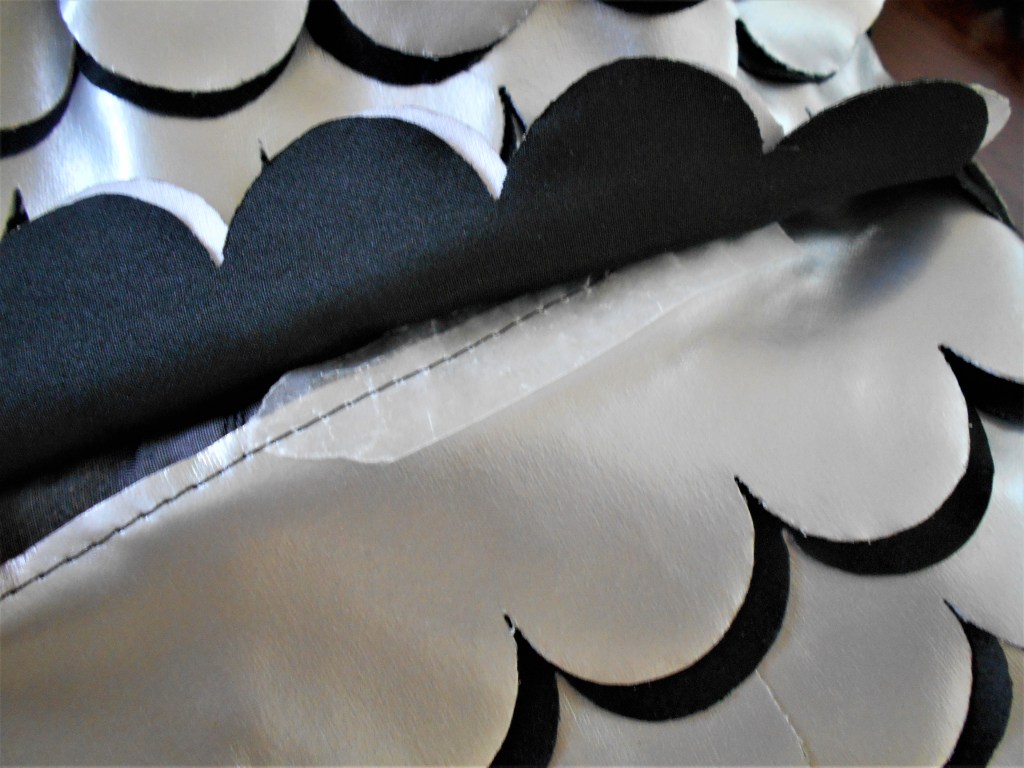
With long lengths of scalloped scales simultaneously cut and sealed, I sewed them alternately onto a princess bodice I drafted to fit my figure using patterns from the Corset Academy. Wax paper was the saving grace while stitching sticky, scrunching pleather…

Wax paper stitched on top of the pleather

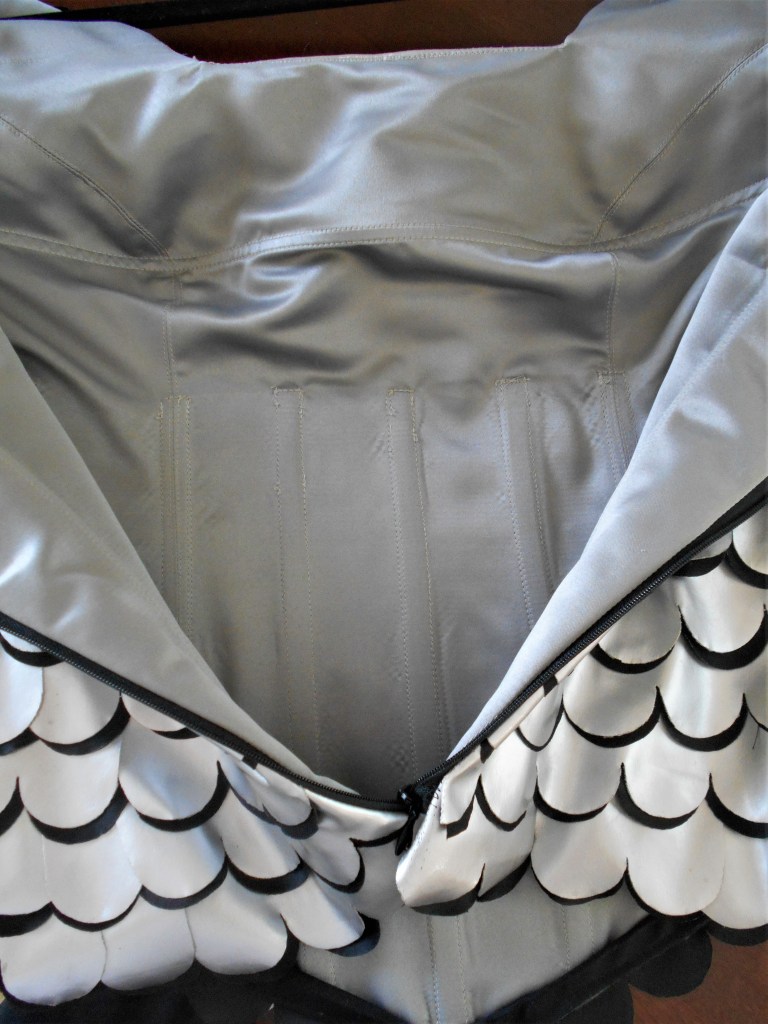
Just a note─ I don’t suggest making a lining out of heavy polyester satin, especially if you live in hot and humid climates like I do. While I could quell my mascara from running down my cheek, the sweat down my spine I could not. The bodice was a polyester sauna !

Bodice lined, boned, and topstitched along seams

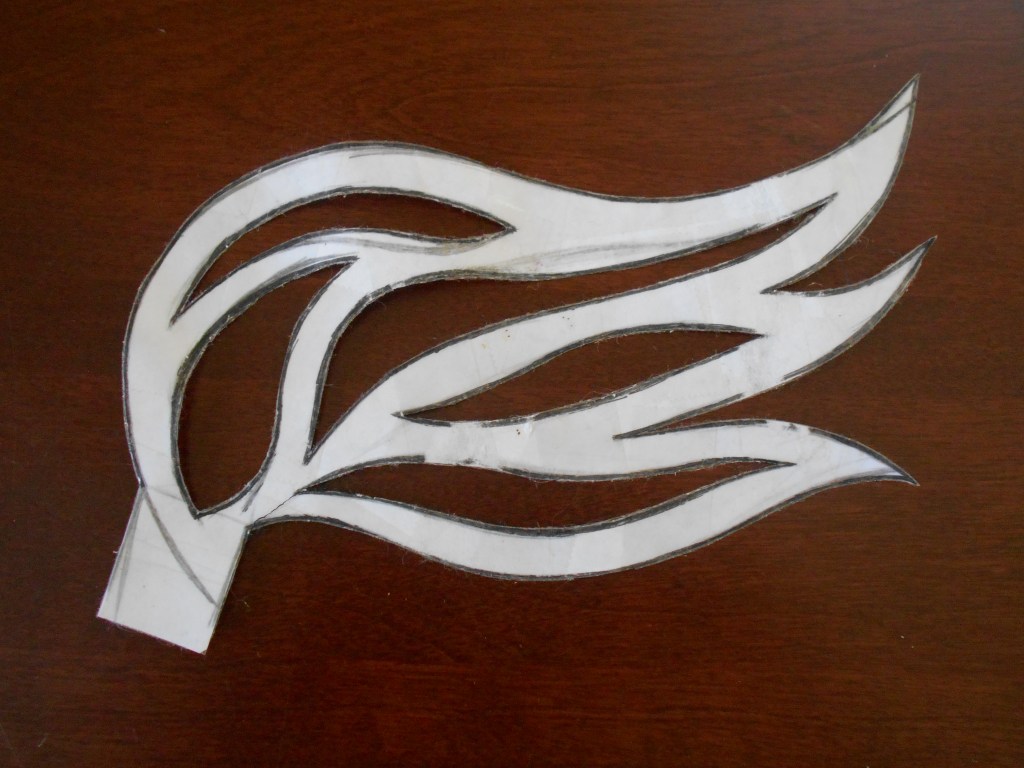
One of the most distinguishing features of the costume was the lofty pair of wings, glinting in the flashes of battle. Using pictorial resources available on the web (particularly, Deborah Voigt’s portrayal), I drew a freehand version of the openwork wing on paper and transferred it onto a thin cardboard cereal box to be spray painted later.

Deborah Voigt as Brünnhilde / Metropolitan Opera
The paper wing stencil

Once the wings were painted, they were affixed to a pleather covered foam diadem. Wrist cuffs out of the same foam/pleather combination anchored the tapered ends of the fishnet mesh sleeves. All that remained was the skirt, which was created from steely stretch taffeta by a series of angled half circles formed into a wrap style. The costume was finished and I was ready to take flight as a Valkyrie !

In spite of the poor choice of lining material, wearing this costume was a thrill ! After all, how many people can claim that they’ve been a Valkyrie ? This outfit also doubled as my Halloween costume for the year and just as at the theater, it sparked otherworldly interest.

“Hojotoho !”

Toi, Toi, Toi,

Mary Martha

Cast and Credits:

Die Walküre ─ Richard Wagner (1870)
Live in HD air date: March 30, 2019

Cast:
Brünnhilde ─ Christine Goerke
Sieglinde ─ Eva-Maria Westbroek
Fricka ─ Jamie Barton
Siegmund ─ Stuart Skelton
Wotan ─ Greer Grimsley
Hunding ─ Günter Groissböck

Credits:
Conductor ─ Philippe Jordan
Production ─ Robert Lepage
Associate Director ─ Neilson Vignola
Set Designer ─ Carl Fillion
Costume Designer ─ François St-Aubin
Lighting Designer ─ Etienne Boucher
Video Image Artist ─ Boris Firquet
Live in HD Director ─ Gary Halvorson
Host ─ Deborah Voigt

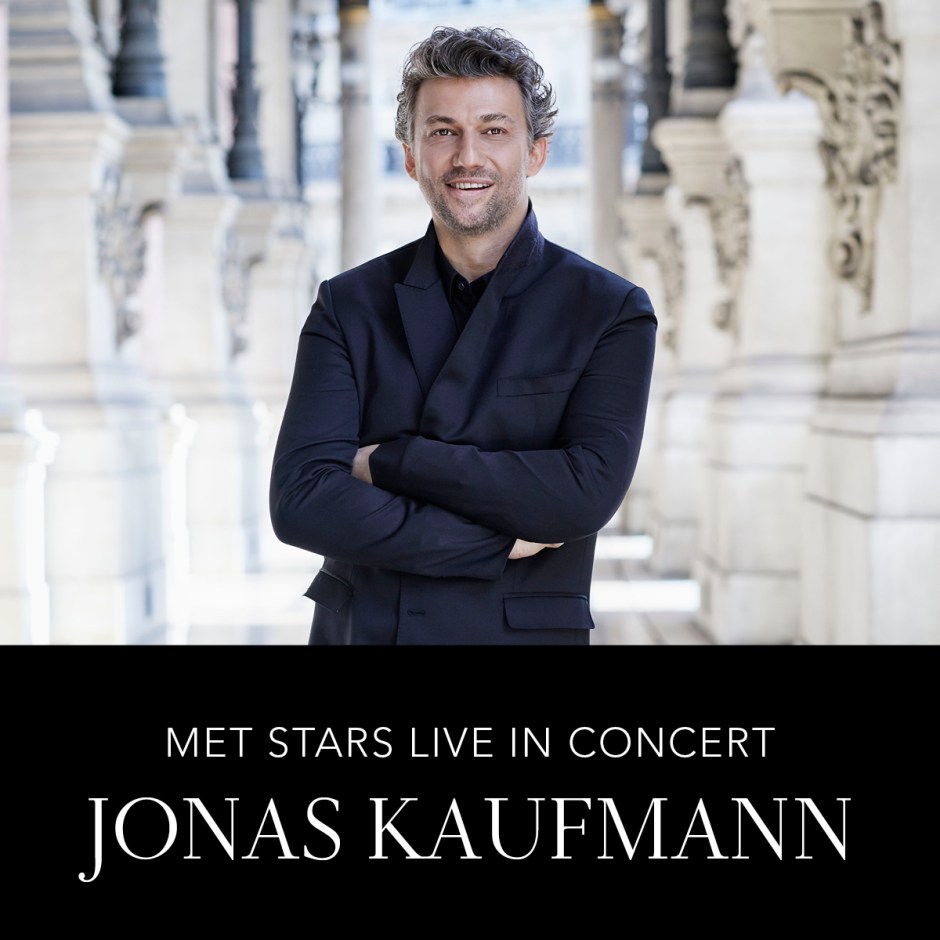
Met Stars Live in Concert: Jonas Kaufmann

Is there anyone who doesn’t love Jonas Kaufmann ? He’s handsome, personable, full of charisma, and one of the greatest tenors to date. When it was announced that Jonas would be headlining the Met’s new concert initiative, how could I resist the opportunity to see the spectacular tenor perform ? For the cost of $20, one could be treated to an intimate and breathtaking performance with the craveable comforts of home. It was to my delight when my dear friend, Chris, invited me over to view the event on her mega screen TV, fully equipped with augmented surround sound.

Broadcast live from the historic Polling Abbey in the tenor’s native region of Bavaria, the recital was stunning, as was the sacred setting. With songs ranging from popular Puccini favorites to more obscure operatic selections (like Ponchielli), Kaufmann dazzled with his attention to vocal detail and tempered interpretation of the music. Particularly moving was piano accompanist Helmut Deutsch’s rendition of the Intermezzo from Manon Lescaut and the engaging aria “Un dì all’azzuro spazio” from Andrea Chénier. Of course, my favorite has been and will always be “Nessun dorma”, which never ceases to thrill me.

Jonas Kaufmann singing “Nessun dorma” with Helmut Deutsch accompanying on piano

If I could have changed anything about the format of the concert, I would have preferred to have heard more songs and less “filler” that was injected into the program after every couple of numbers ─ it’s not difficult to find and watch snippets of Jonas’s past Met Opera performances on YouTube ! Personally, it would have been more meaningful to me if there had been a series of short, sit down interviews with Kaufmann and Deutsch that had been previously recorded specifically for this concert, giving insight into the songs, the challenges (if any) of performing without an audience, etc. This addition would have made the pay-per-view price well worth the cost in terms of value.

The Clothes

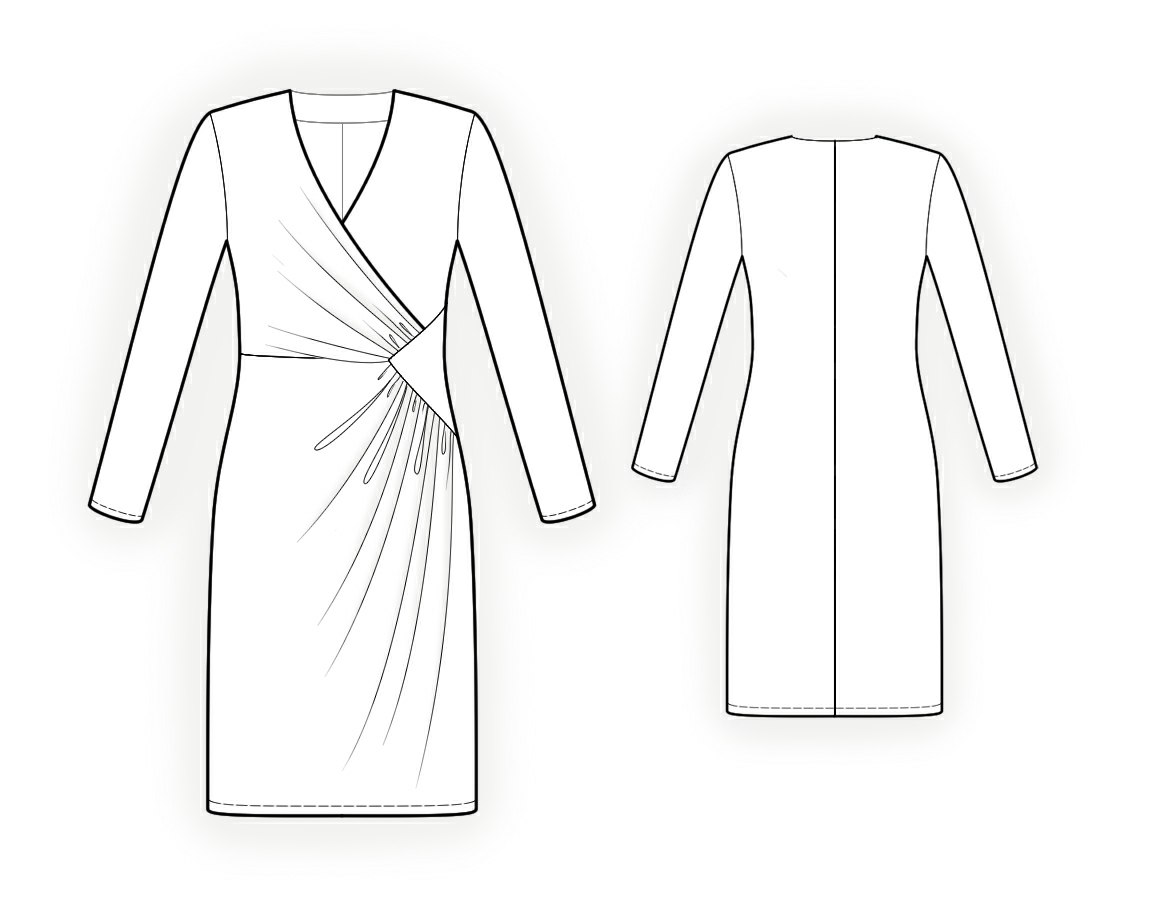
Given the opportunity to dress up, I will take it ! And since I was going to attend a concert for the esteemed Jonas Kaufmann, why shouldn’t I look my best ? Nothing in my closets tickled my fancy and I was coincidentally distraught that a lining material I had ordered for another project was regrettably unusable for its purpose. However, I had an idea. Instead of hording the unfit fabric in a closet for years, crossing my fingers that I would eventually find a use for it at some indeterminable point down the road, I decided to make a “mock-up” dress of the untested pattern for which I originally bought the too-bright lining material.

The purple ITY knit lining material
Lekala Pattern #4078

Pressed for time, I completed the dress in a weekend. Although there were minor fitting issues with the pattern, I was pleased with the final result ! Styled in classy and chic fashion, I paired my new ruched dress with monochromatic stockings and heels and accented the look with gold jewelry. Don’t be deceived by the pictures─ neither the purple material nor the vanda orchid are nearly as blue toned as in the photos.

The Cuisine

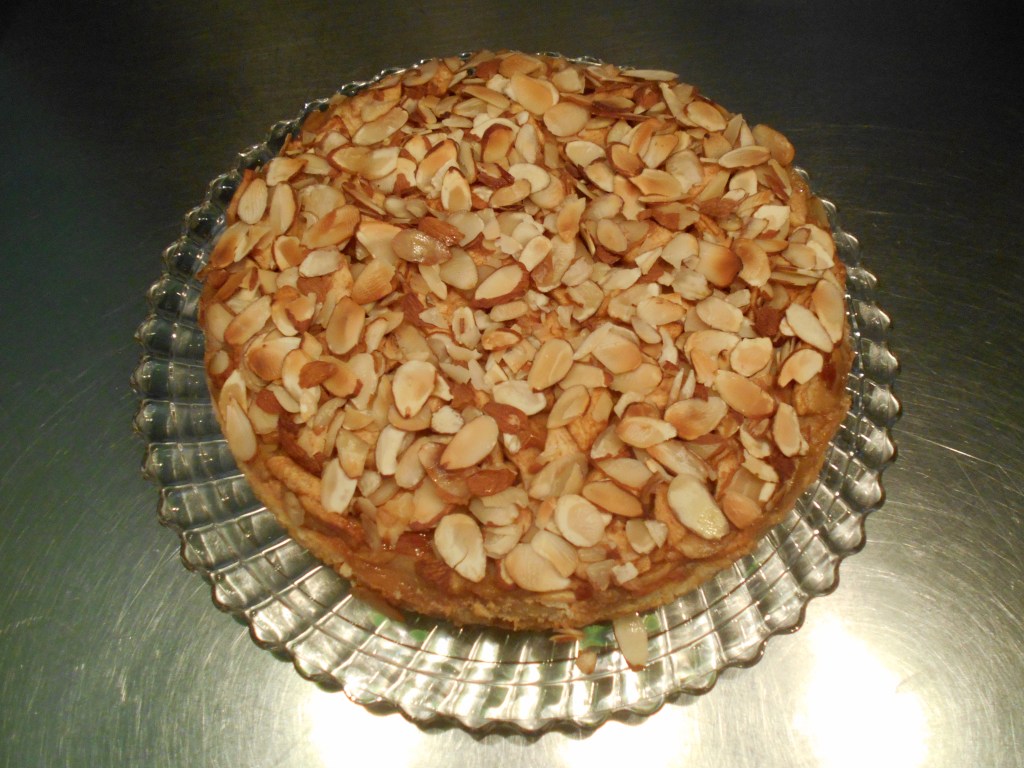
A new dress for the event was only the start. Chris planned to serve wine and cheese for the gathering and I wanted to bring some “themed” food for the festivities. Since Kaufmann is from Bavaria and the concert was taking place in Bavaria, what better dessert to bring than my great-grandmother’s beloved Bavarian Apple Torte ?

Bavarian Apple Torte

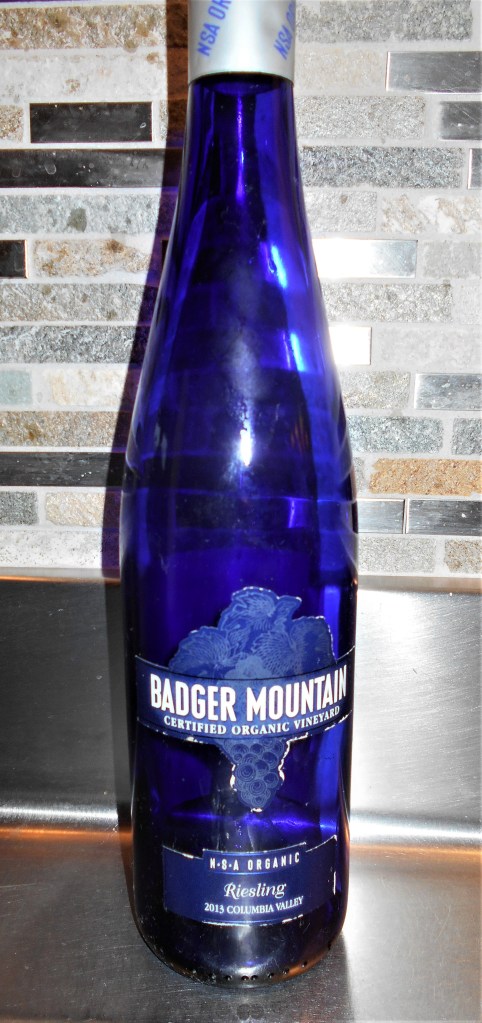
Shingled with sliced almonds to shelter the cinnamon apples and cream cheese filling cohabiting beneath, the torte was a hit ! Another supplement of mine, a chilled bottle of Riesling wine which had been awaiting its moment of glory for many years in the refrigerator, was supple and sweet.

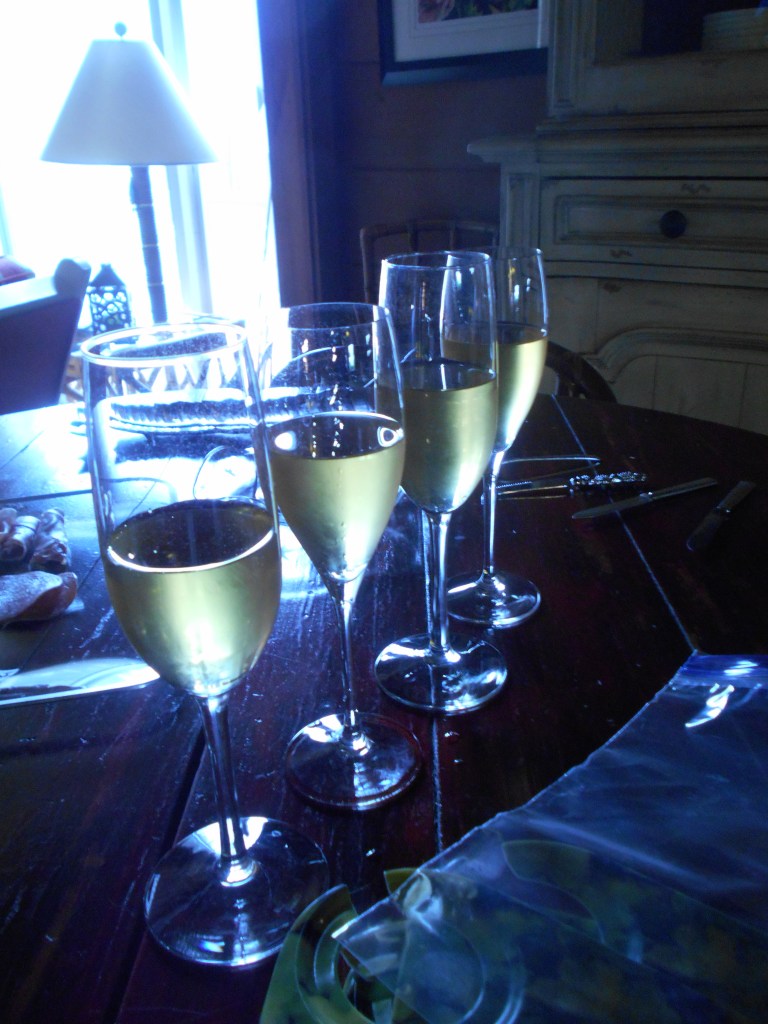
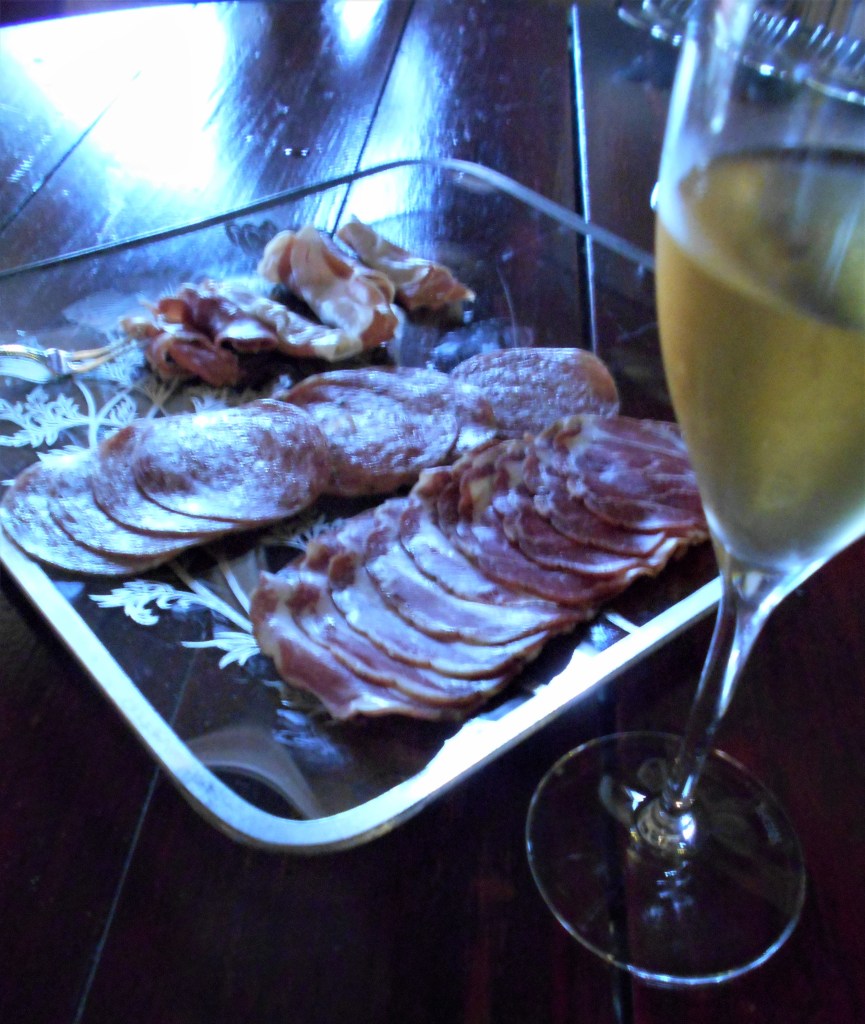
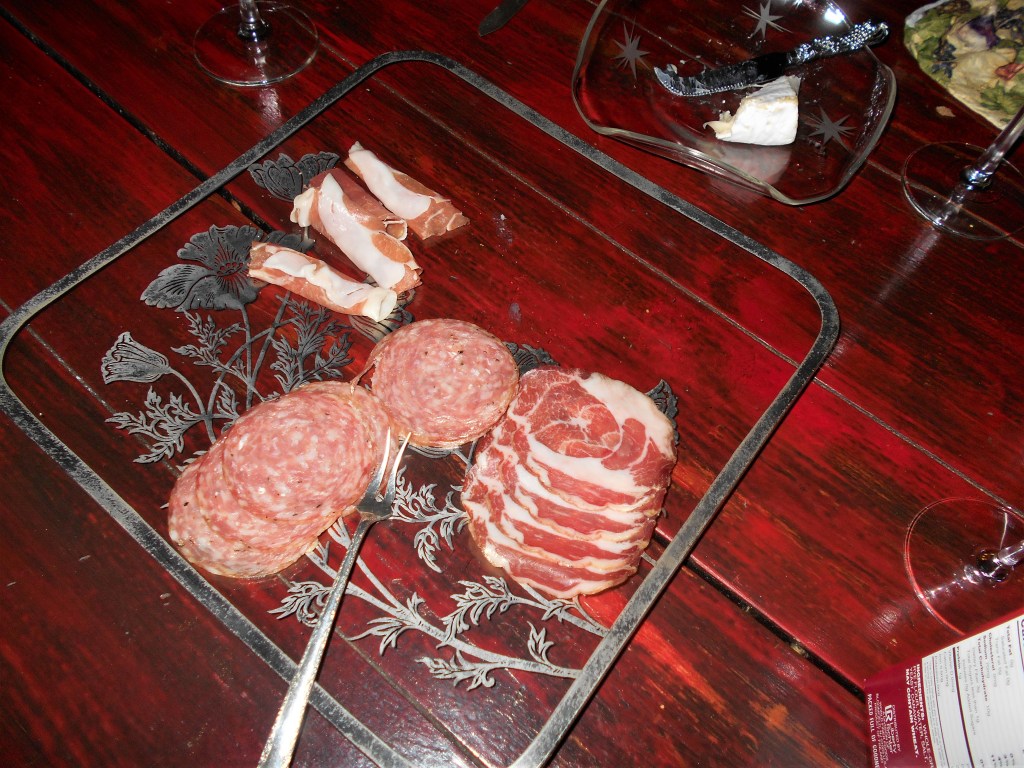
The sliced salami, prosciutto, and capicola were right up my alley ! I’ll never reject dry-aged salted meats !

All that was needed was a smattering of brie on a tangy sourdough rye cracker…

…and the sharing of laughter among friends. Who said classical music was stuffy ? Take me at my word: when Jonas Kaufmann is the subject of conversation and critique, there’s plenty to discuss !

Toi, Toi, Toi,

Mary Martha

Cast and Credits

Met Stars Live in Concert: Jonas Kaufmann
Polling Abbey
Polling, Bavaria
Live broadcast date: July 18, 2020
(Date seen: July 27, 2020)

Jonas Kaufmann ─ tenor
Helmut Deutsch ─ piano


La Fanciulla del West

When you think of the American Wild West, what comes to mind…? Cowboys ? Rocky mountains and perilous cliffs ? The California Gold Rush ?

What about Italian opera ?

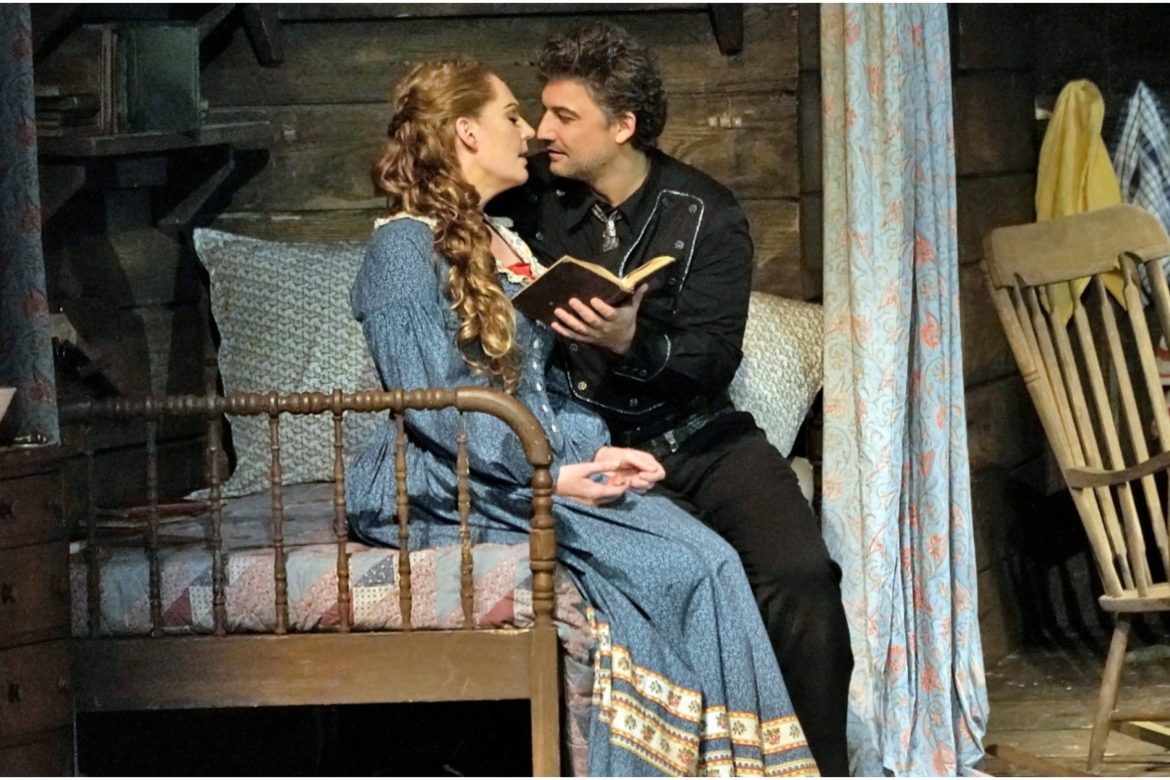
Puccini’s stirring masterpiece, La Fanciulla del West, wrangled together the landscape and romance of one of America’s greatest periods in history into an absolutely captivating production. The opening score swept with vastness and virility, like the opera’s elusive anti-hero, Dick Johnson, played by an even more elusive Jonas Kaufmann. I had waited years to finally catch Kaufmann in a Live in HD performance (he had previously backed out of both Manon Lescaut and Tosca) and I was ready for my due !

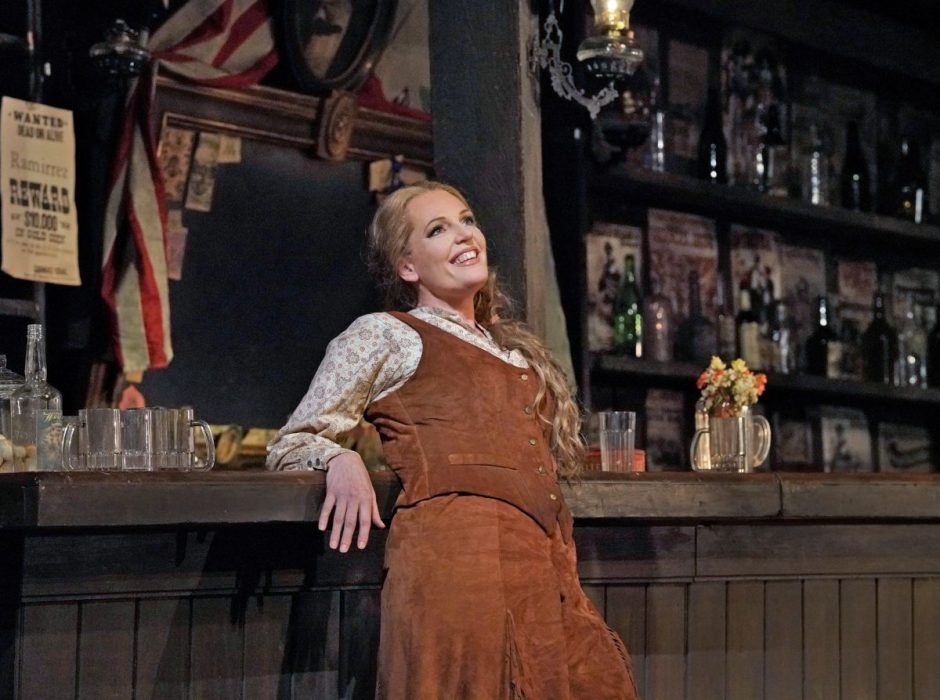
Eva-Maria Westbroek as Minnie and Jonas Kaufmann as Dick Johnson in La Fanciulla del West / Metropolitan Opera

I loved nearly everything about this opera: the wholesome heroine, the realistic production setting, the old-fashioned romance, and the wily game of 5 card draw. I laughed, I didn’t cry, I swooned. In fact, I found the opera and production so endearing that I went to see the encore the following Wednesday !

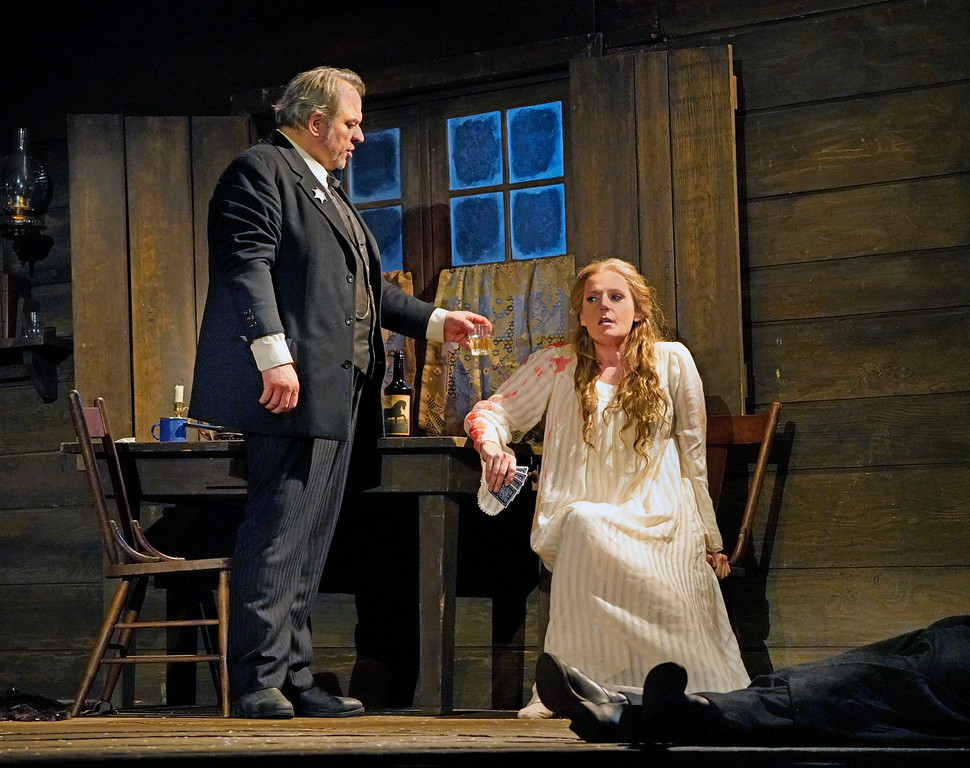
Željko Lučić as Jack Rance and Eva-Maria Westbroek as Minnie in La Fanciulla del West / Metropolitan Opera

What struck me as so poignant in this opera was how the librettists wove the theme of the opera around a line of Scripture from Psalm 51: “there isn’t a sinner in the world who can’t find salvation.” Little did I know that that passage would play an enormous role later in the opera as the title heroine, Minnie, saved Dick from being publicly hung. The effect was monumental.

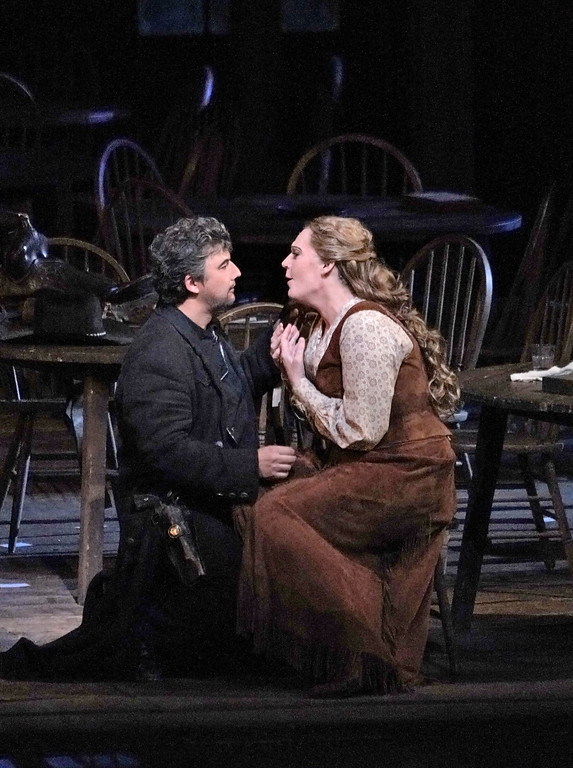
Jonas Kaufmann as Dick Johnson and Eva-Maria Westbroek as Minnie in La Fanciulla del West / Metropolitan Opera

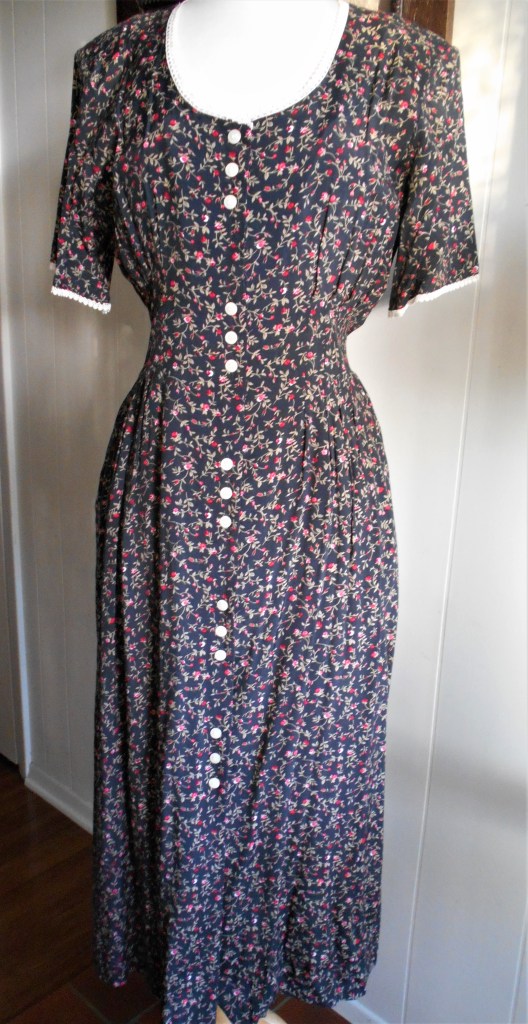
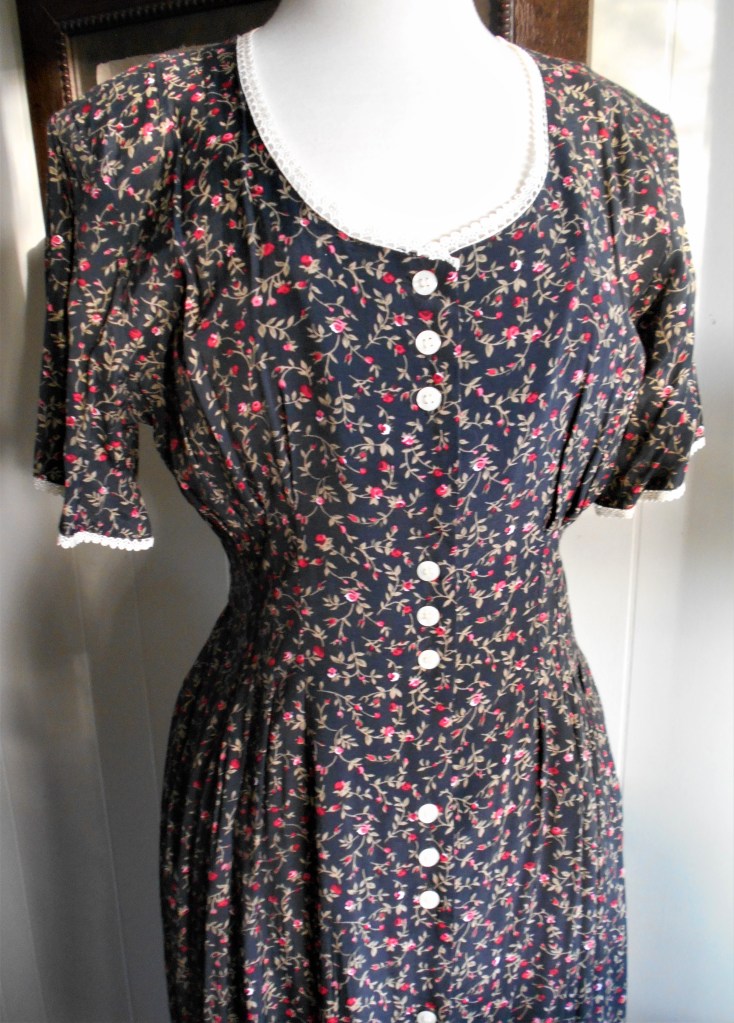
There was no doubt that my outfit for Fanciulla would come direct from my mother’s closet. Wearing an unworn dress my mother bought at the Mast General Store in North Carolina years ago (the tag was still on it), I had a solid foundation for my costume. The diminutive flower print and lace detailing around the collar and sleeves were fitting features to match Minnie’s simplistic and pure character.

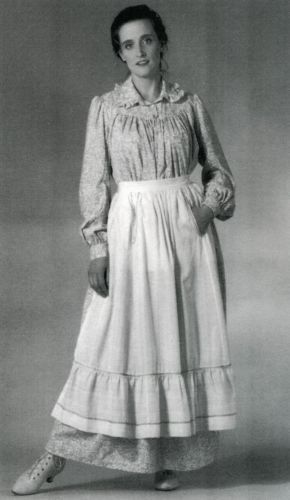
Alone, however, it wasn’t enough ─ it needed something extra… something “Little House on the Prairie”… I researched online and found a picture of a pioneer apron that I thought would be perfect for the outfit. Taking measurements, I drafted a quick pattern for a ruffled muslin apron with front pockets just like the one below:

Folkwear Historic 1800s Prairie / Pioneer Dress
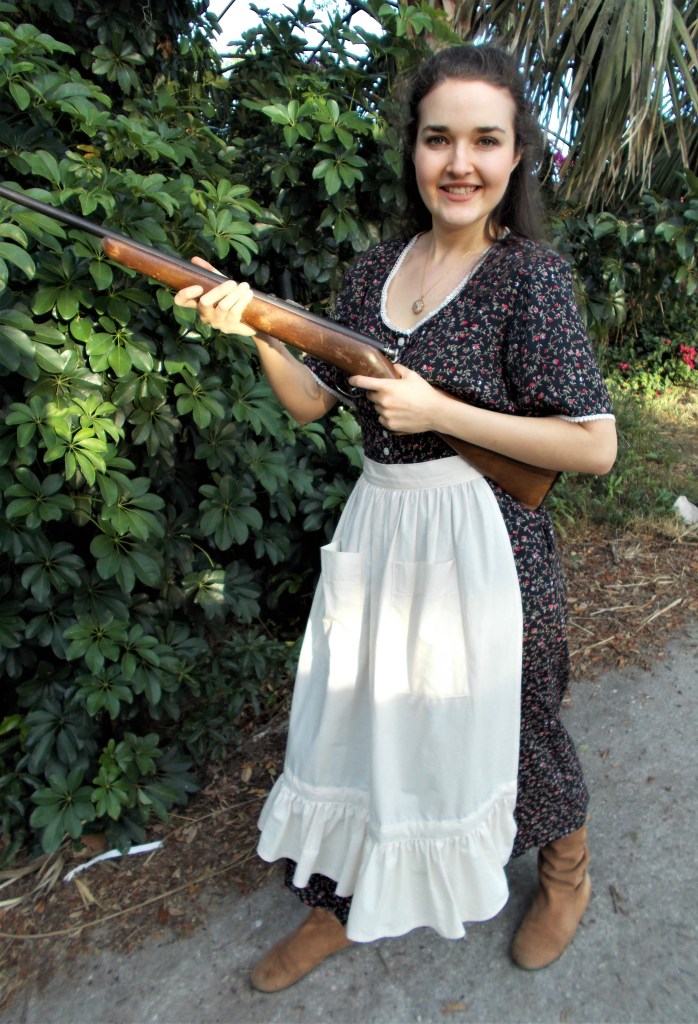
Minnie’s long lost cousin ?

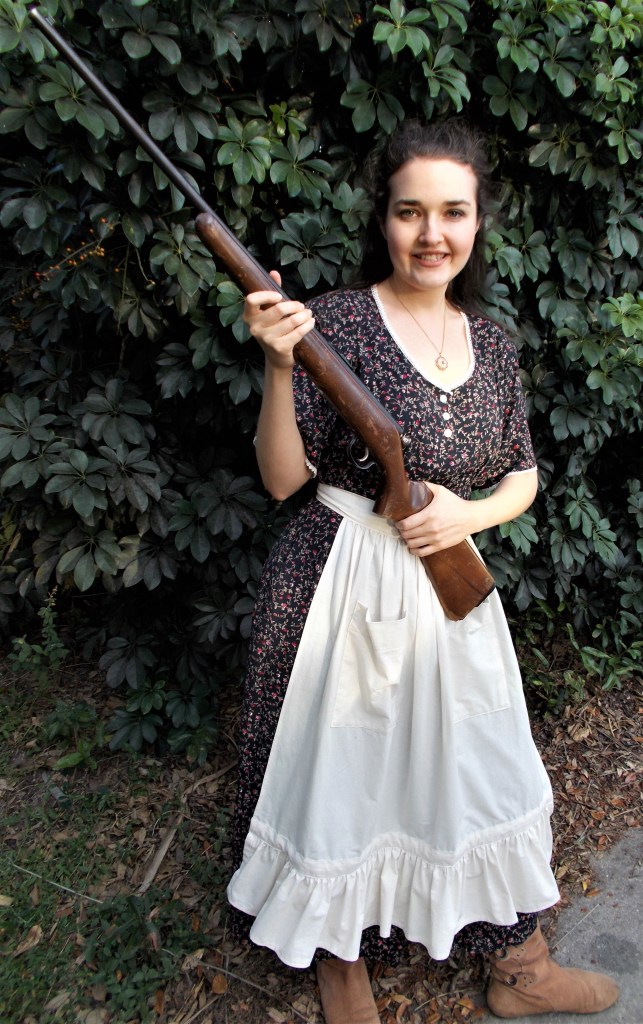
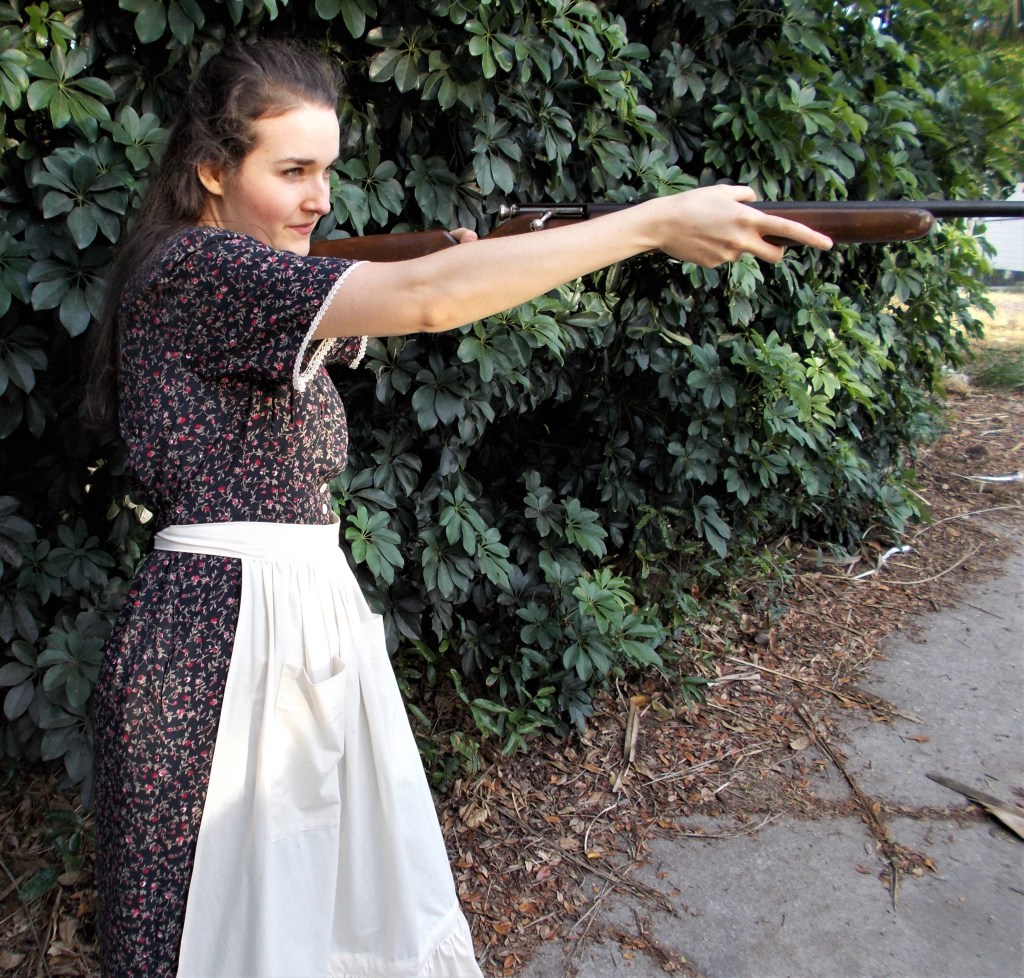
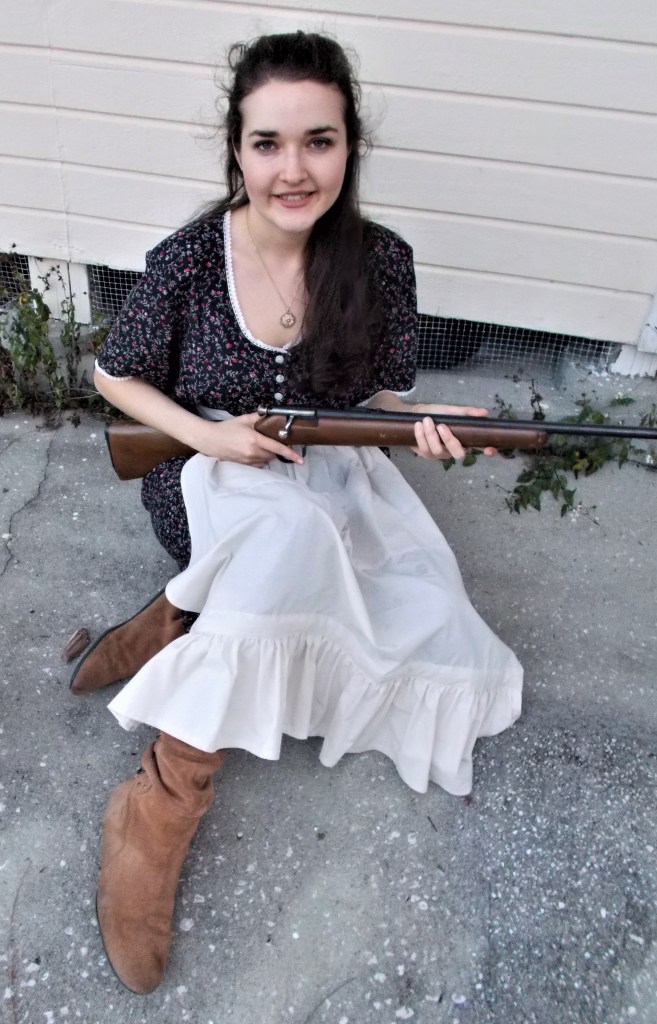
Now I looked the part ! But there was a missing piece to my frontier get-up ─ the addition of Minnie’s favorite companion: her rifle. This was essential to the character and also to my pictures, although you can imagine I left the gun at home while I went to the theater.

Thank you, Uncle Kim, for my .22 Stevens !

Ready, aim, fire !

While it is a known fact that Dick Johnson stole Minnie’s first kiss, it can also be confirmed that the tenderness of Puccini’s La Fanciulla del West stole my heart.

Toi, Toi, Toi,

Mary Martha

Cast and Credits:

La Fanciulla del West ─ Giacomo Puccini (1910)
Live in HD air date: October 27, 2018

Cast:
Minnie ─ Eva-Maria Westbroek
Dick Johnson ─ Jonas Kaufmann
Nick ─ Carlo Bosi
Jack Rance ─ Željko Lučić
Sonora ─ Michael Todd Simpson
Ashby ─ Matthew Rose
Jake Wallace ─ Oren Gradus

Credits:
Conductor ─ Marco Armiliato
Production ─Giancarlo del Monaco
Set and Costume Designer ─ Michael Scott
Lighting Designer ─ Gil Wechsler
Live in HD Director ─ Gary Halvorson
Host ─ Susanna Phillips

Becoming Butterfly: the white satin yo-yo kimono

Madame Butterfly represents a “full-circle moment” for me: it was in 2016 that I taught myself to sew when I didn’t have anything in my closets to wear to the movie theater performance of the opera. Seeking anything that gave the impression of an Asian aesthetic, I wound up sewing a cotton yukata, which was the genesis of my sewing passion. New doors had been flung wide open !

Madama Butterfly (2016)

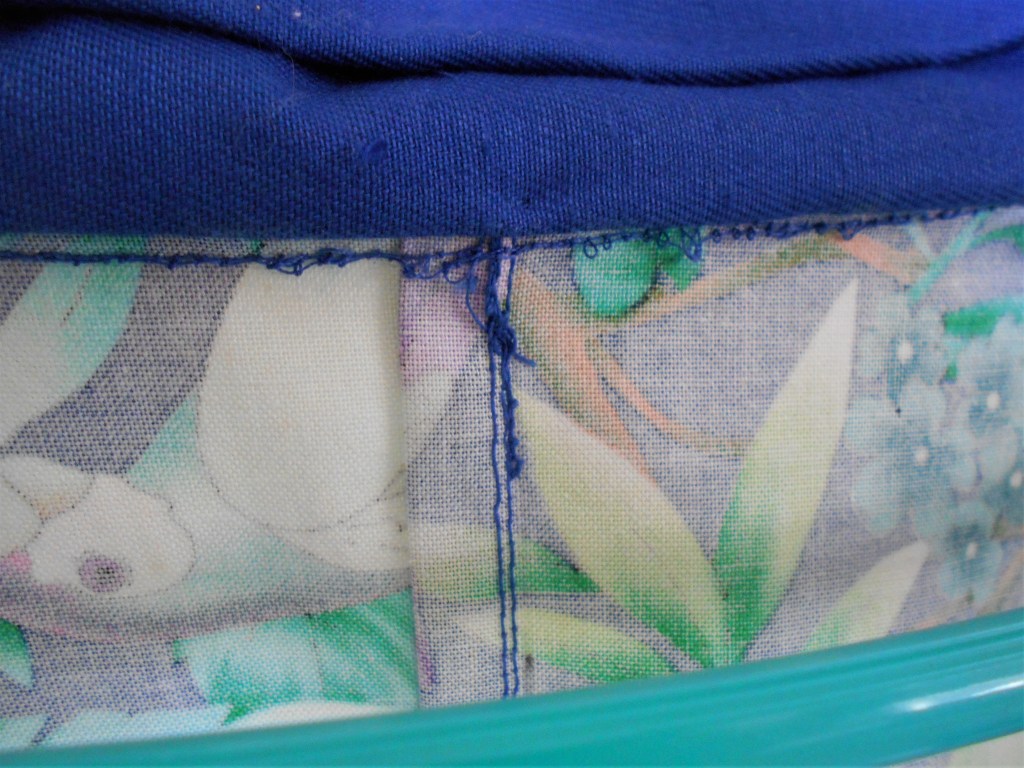
But it wasn’t a cakewalk. Despite the rather traditional manner in which the yukata was fashioned (save the contrasting collar ─ I ran out of tropical fabric !), my interior seams were horrendous ! Because of my previous ignorance of how to properly work a sewing machine, the bobbin threads are bunched and looped into chaotic cocoons, a sign of incorrect tension in hindsight. Although I was ashamed of how slipshod the inside of the yukata turned out, the disappointment was replaced by triumph as I overheard the whispers of a little girl to her mother about the “kimono lady” that silently slipped by in the theater. Priceless !

The novice’s stitches

Over three years later, Puccini’s immortal opera returned to the Live in HD schedule for the 2019-2020 season. I knew I had to go. However, since my sewing skills had improved exponentially, I wanted to create something that was more suited to the Anthony Minghella production’s styling of Cio-Cio-San. A wedding gown was in the works…

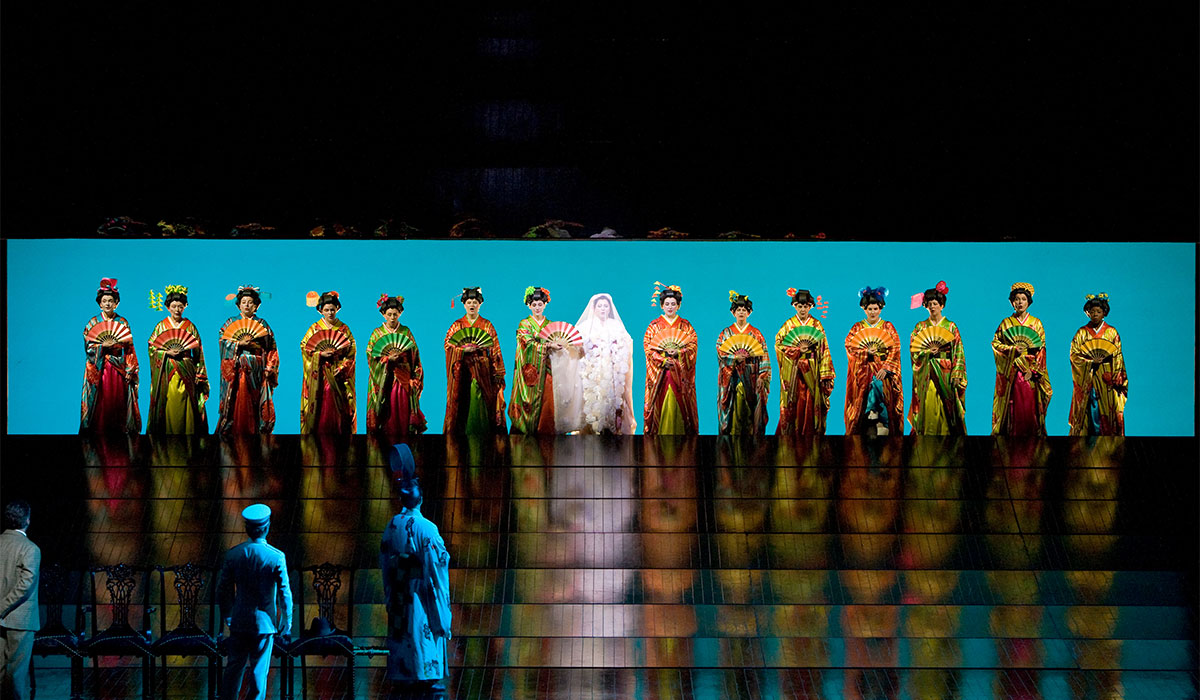
A scene from Anthony Minghella’s production of Madama Butterfly / Metropolitan Opera

More specifically, a wedding kimono. Like a specter rising from the grave, the gossamer veils that clothe Cio-Cio-San in a milky moonglow is breathtaking. Without fail, I’m enchanted by the first appearance of the geisha climbing up the stairs with her wedding party. With the decision easily made, it was time for the research…

And there was plenty of it !

The aforementioned Minghella production has been a crowd-pleasing staple at the Met since 2006 with a plethora of sopranos playing the title role, from Patricia Racette to Kristine Opolais (who sung the part in 2016), to Hui He, singing in the 2019 Live in HD performance. A simple image search provided up close detailing of the white satin kimono and its sash.

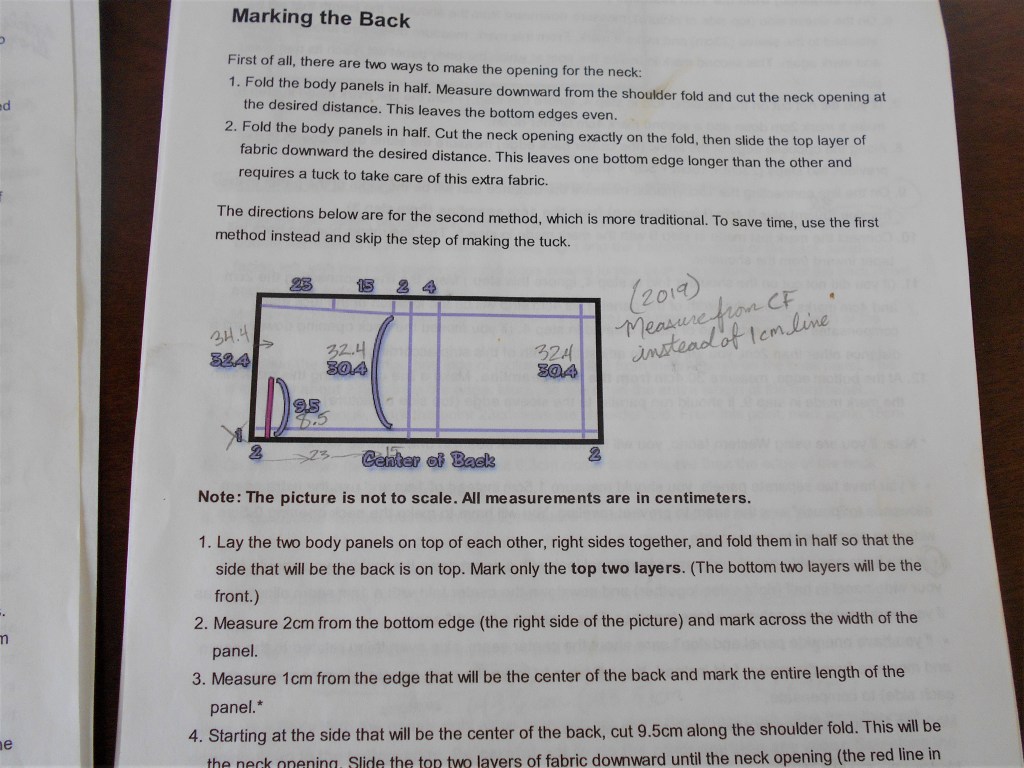
With the success of my tropical print yukata, I didn’t see any reason why I shouldn’t use the same pattern instructions, which worked so well in 2016. Look no further than this helpful site: http://www-personal.umich.edu/~weyrbrat/Japan/yukata/ I have all the pages printed out and stored in a zip top bag for future uses. The instructions are vivid, realistic, and accurate and equip sewers to create their own authentic yukata (or kimono) from scratch. Since I wasn’t aiming to create a historically/culturally accurate garment, I made my own adjustments to the notes and measurements that I wrote down in 2016.

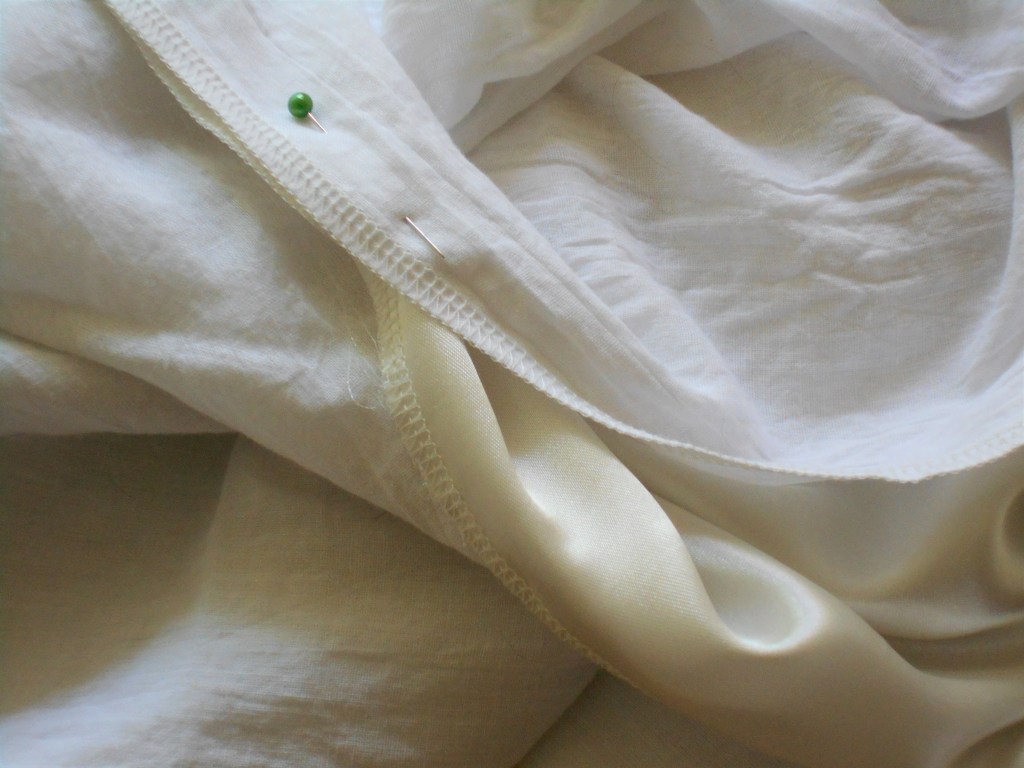
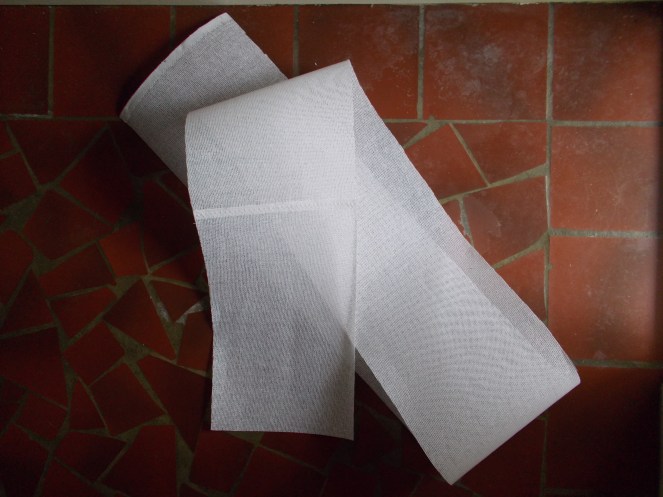
If there was one thing I learned during my time as a Valkyrie, it’s that polyester linings can act as saunas to my skin. Nobody wants sweat rolling down their back and besides, the silvery white charmeuse satin I bought was just a bit too see-through for my liking. It needed a lining ─ and a cotton one at that ! Cotton voile was the perfect choice.

Cotton voile lining and charmeuse satin serged together
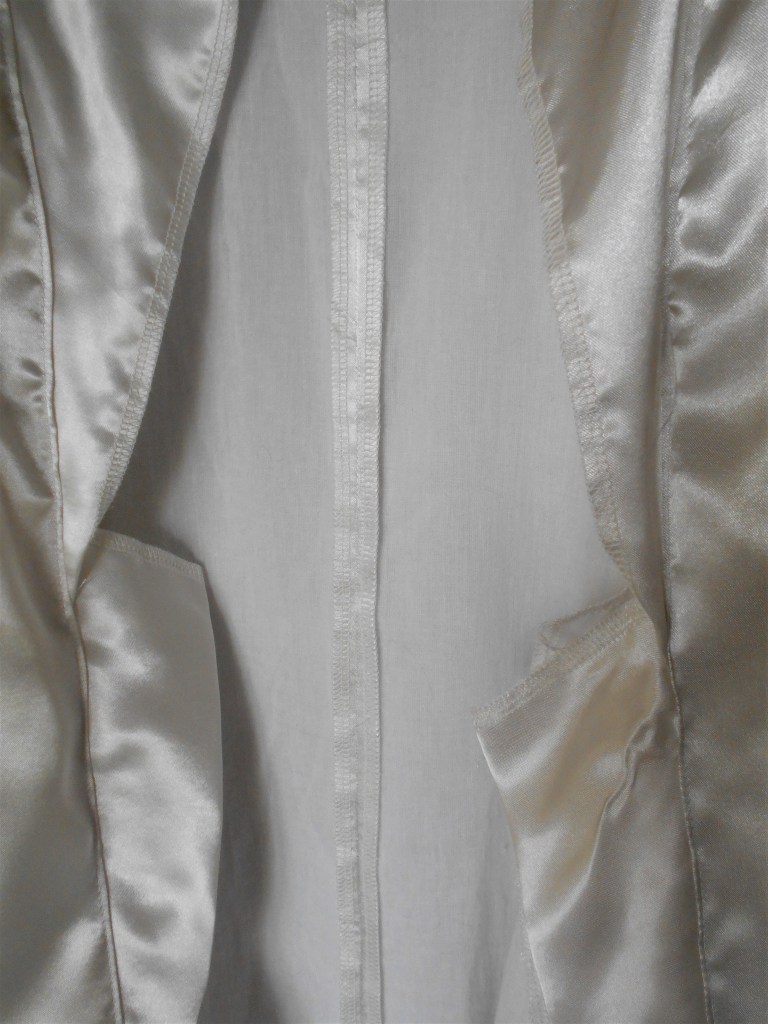
The inside of the kimono ─ much cleaner seams than last time !

The construction of the kimono was easy enough, following the instructions as before, and now it was time to focus on the more thought-provoking elements of the costume… the sash and decorations !

The Belt

Theater costumes fascinate me. Not only are they beautiful to look upon, but they also possess the most ingenious tricks for rapid removal without compromising the overall style. Surely, there must be staunchly guarded secrets on how best to employ the illusion.
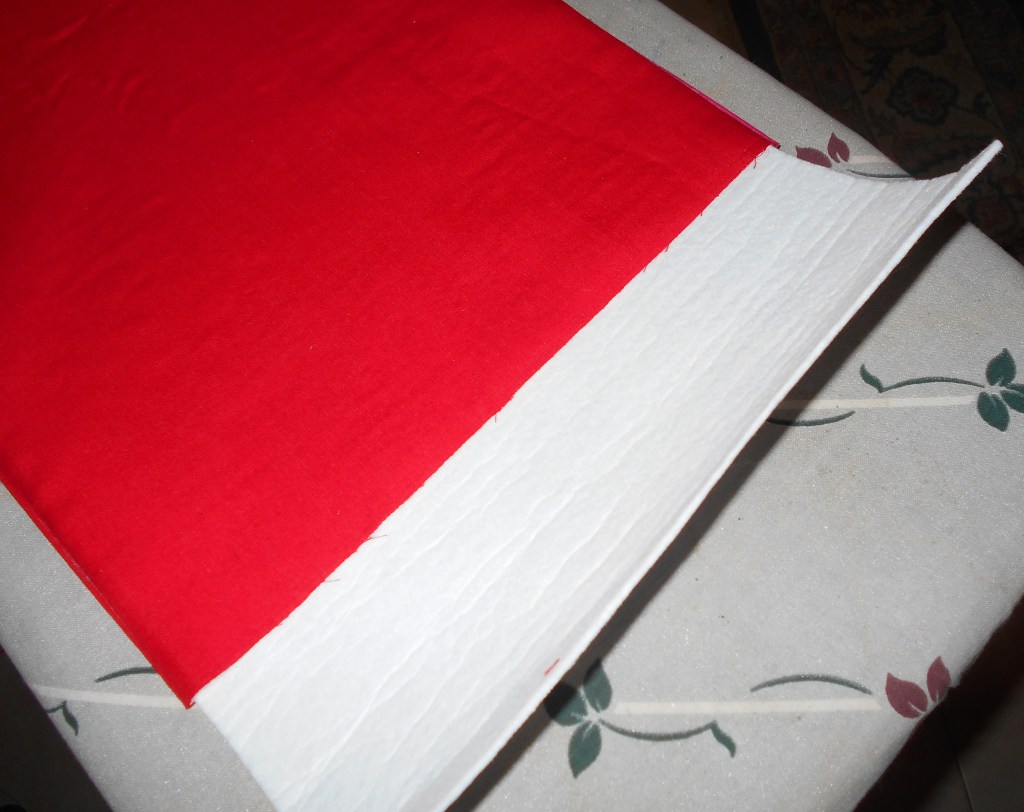
Instead of cutting a 30′ long strip of fabric and folding it over and over again, I imagined the belt being like a corset with the folded “knot” at the back being analogous to a modesty panel. And so I cut two wide rectangles and fused the the face layer with strips of double sided interfacing since there would be gathered drapes applied to the front.

The lower half of the front of the belt ironed in place while the top half remains unfinished

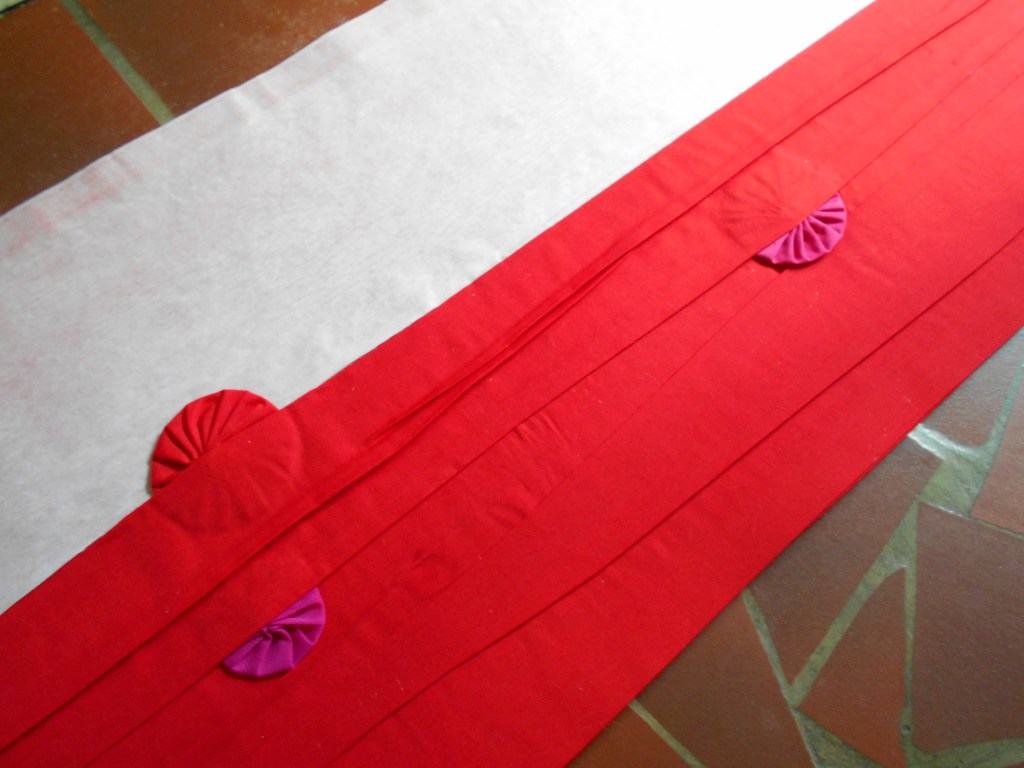
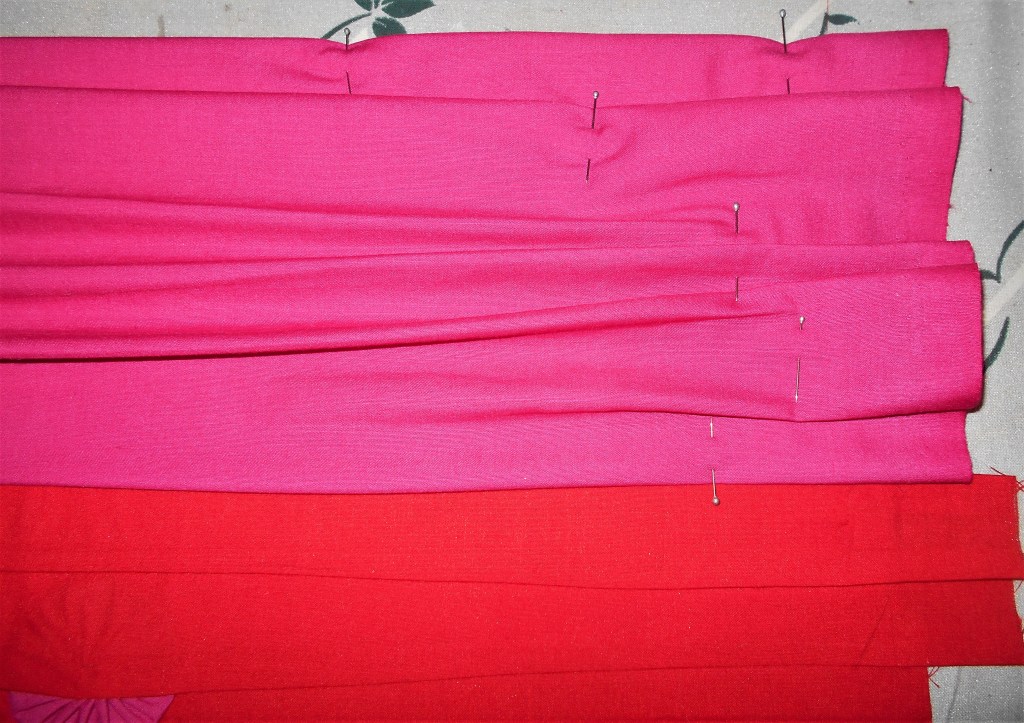
Have you ever wondered how random drapes are made ? It’s simple and a lot of fun ! Cut a strip of fabric that is at least twice the height of the area that needs to be draped. For example, each horizontal half of my belt measured about 15 cm (for a total width of ~30 cm, top to bottom) so I cut pieces of fabric that were over 30 cm each and stretched the swath side to side, placing pins where the folds and creases looked appealing to me.

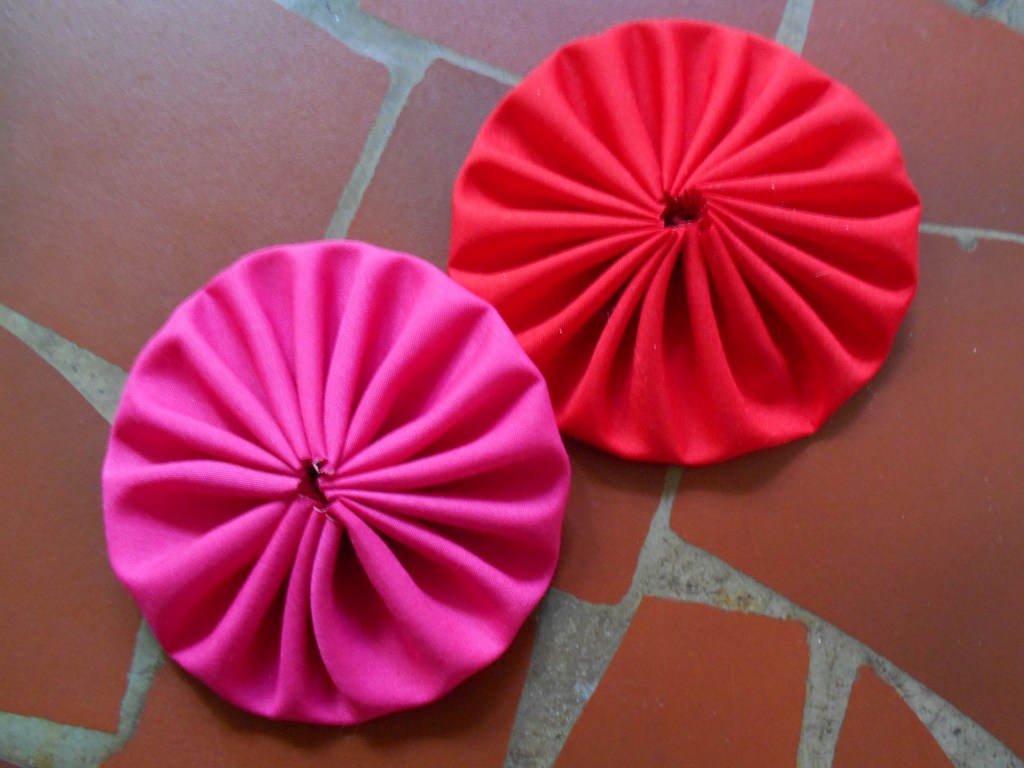
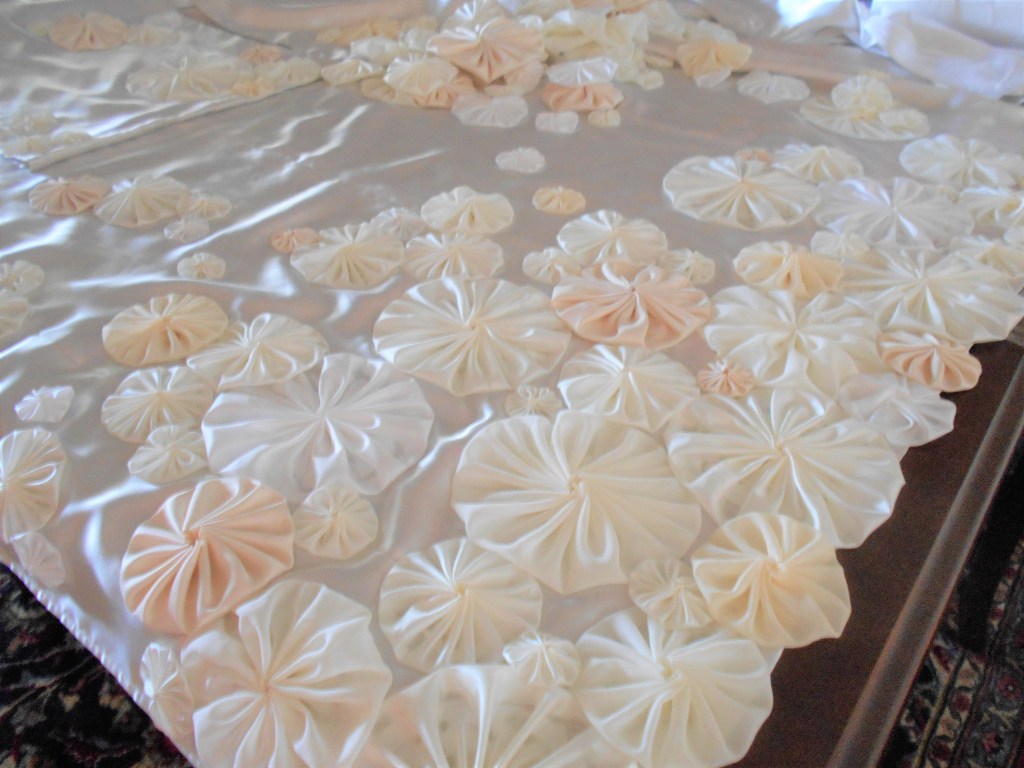
Once satisfied, it was time to steam press the folds that were pinned to the fusible web and then, voilà ! Secured drapes ! “Ah, but what are those round starburst “gears” peeking out from beneath the folds ?” you question. Those are called yo-yos, commonly made by quilters and used for handicrafts and decorations.

While they may not be the exact folded form of origami used on costume designer Han Feng’s stunning wedding kimono, I thought the shapes looked very similar to the humble yo-yo and therefore, I began the long and fiddly process of hot knife cutting and hand sewing the yo-yos into their recognized shape. I made hundreds of them !

Pillowy chiffon, shiny satin, bright broadcloth ─ from tiny to giant ─ mingled in a colorful array worthy of the distinction of ‘art’ on their own.

But back to the belt…

With the front portion complete, the lined belt needed to be stuffed with a stiffener so that it wouldn’t crease when sitting. First trying a thick felt, the result was undesirable. What would be stiff, yet pliable…??? Aha ! I remembered the leftover strip of buckram from the ball gown skirt for Manon and raced to find it. It was perfect ! I love when I can reuse materials for different projects.

The leftover buckram from Manon

The thick piece of felt, however, was not without its own fulfillment─ I still needed something stiff for the inside of the faux knot/modesty panel and it was used for this purpose.

Sliding the stiff white felt into the long stretch of fabric for the back “knot”

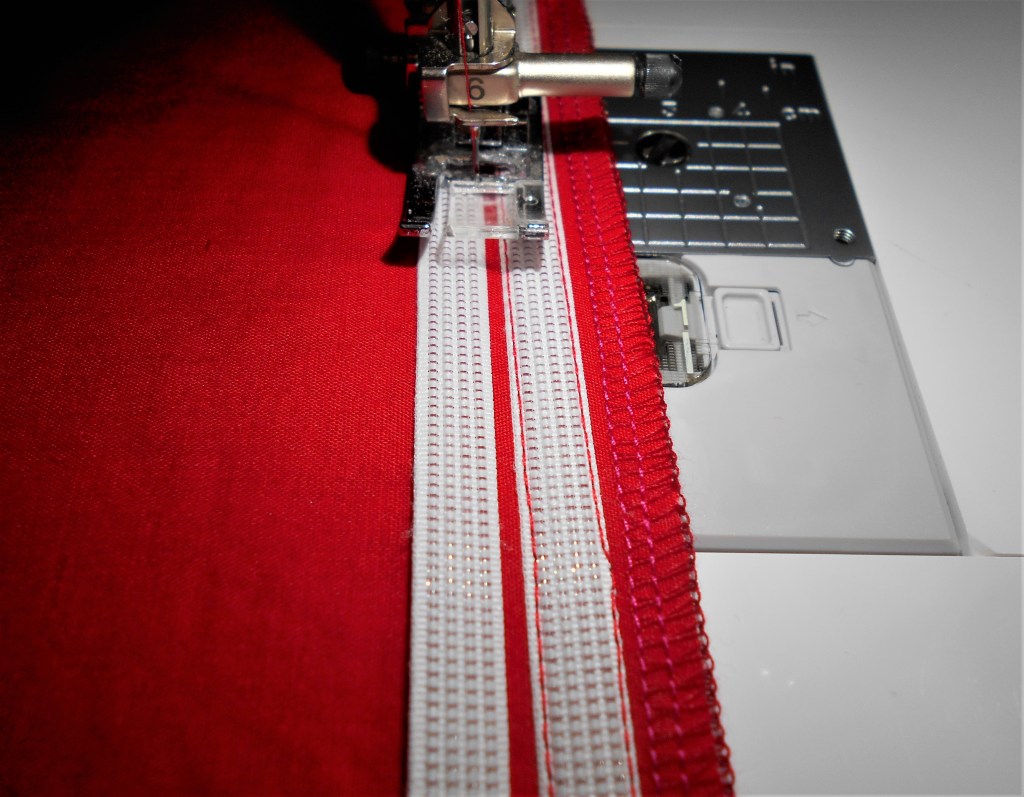
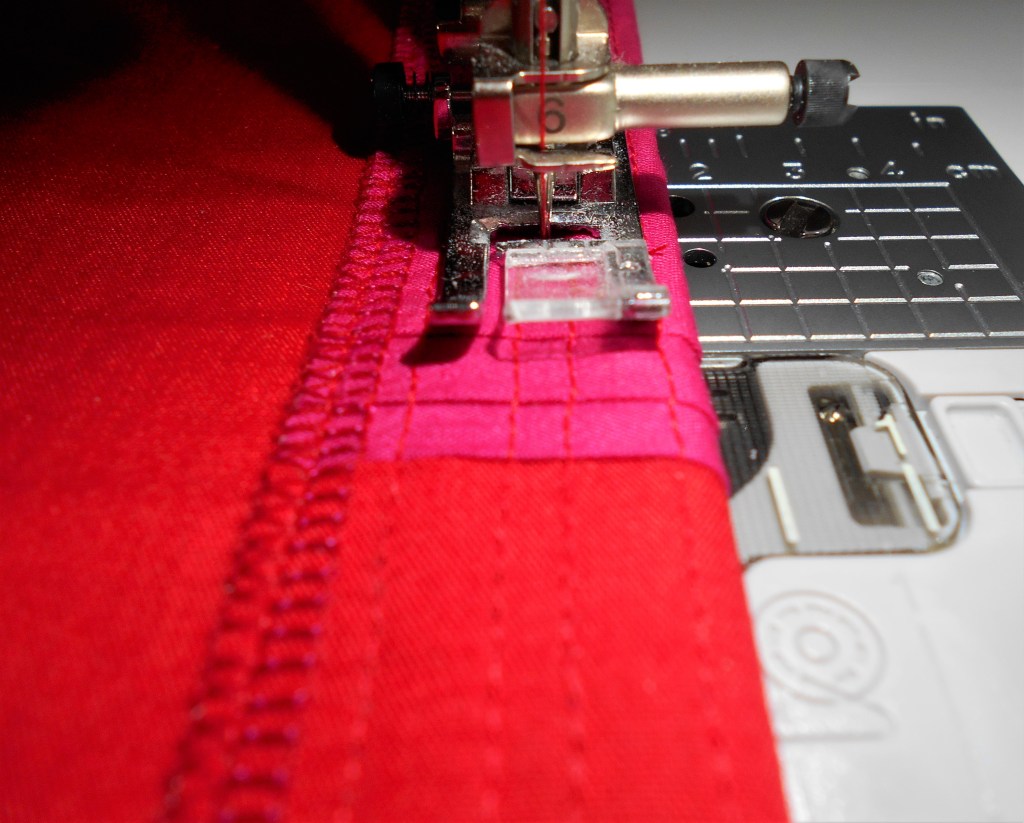
Two additional panels were made as part of the belt’s meeting closure; their back edges were stitched with Rigilene boning…

…then folded over and stitched in between the bones.

And here’s what the face side looked like afterwards:

Time to punch the grommets ! The belt was nearly complete !

Decoration

My deadline nearing, the wearisome work had begun. While I find it appalling to glue fabric onto clothes, Time sometimes forces me to bend on my tenets. There were many detailed photos on the web of Butterfly’s kimono and belt, but this picture was my guiding diagram when deciding how to arrange the yo-yos:

Maria Zichak as Suzuki and Ana María Martínez as Madame Butterfly / Metropolitan Opera

And so, I glued, and glued, and glued some more… I used two bottles of craft glue on those yo-yos and finally adhered the last one early Friday evening ─ the night before the opera ! Whew !

Progress made, but a mounded pile of yo-yos still to go…

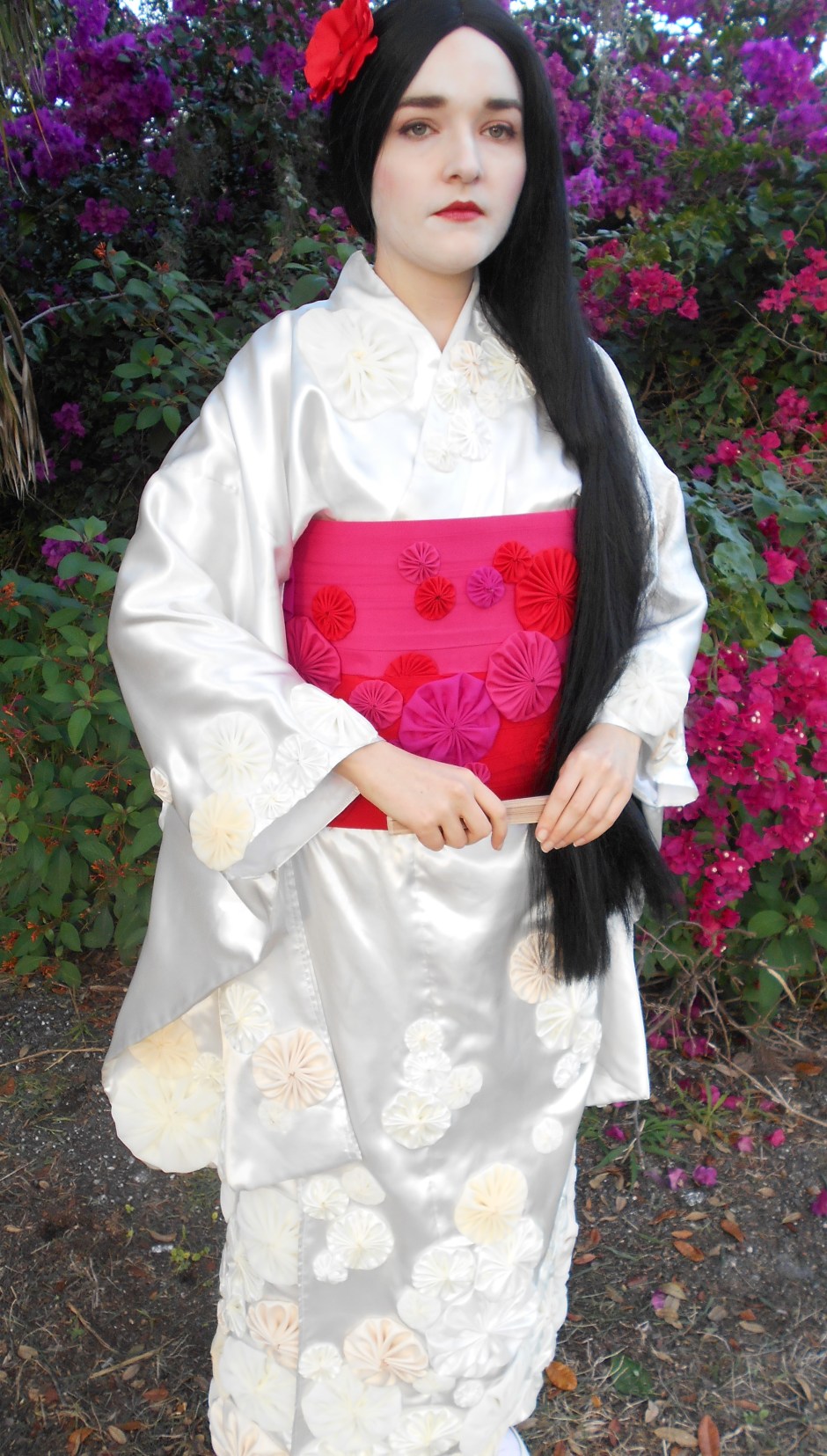
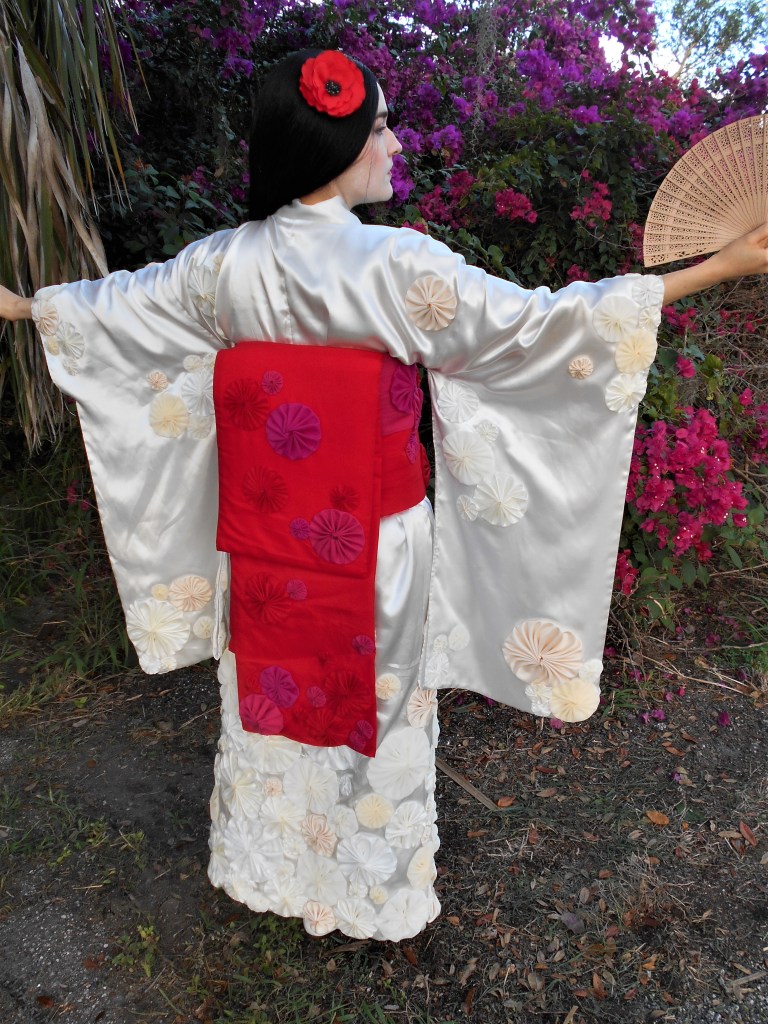
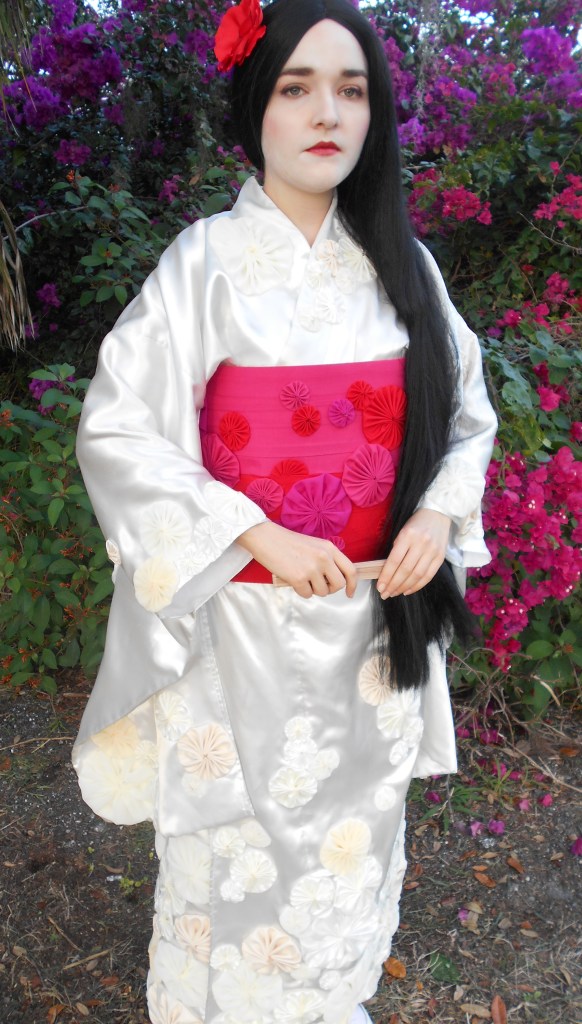
The glue dried with not a moment to spare and the following morning, I suited up in my silky kimono, applied a waxy whiteface, donned a long black wig, and clipped on a red poppy.

I just love that little wooden fan ! Its intricately cut panels remind me of ancient Far East traditionalism… Thank you, Aunt Countess !

The back of the belt held up well despite the futility of the sewn snaps I added onto the overhang. Never doubt the power of a few safety pins, my friends !

I bought the wig and the poppy clip from sellers on eBay and Etsy, respectively…

As much as I desired for the length of the sleeves to be much longer (and therefore, traditional, in that sense), there comes a point of practicality and whether or not I would be comfortable with the ends of my sleeves dragging in the dirt… grazing the dusty pavement of the parking lot… trailing along in the bathroom… NO !!!! Measurements are critical, and determining an appropriate length for the sleeves was no different.

Spreading my “wings”

Who would have guessed that the simple yukata I endeavoured to sew with nothing but gumption and the will to succeed would have bloomed into a passion of sewing costumes for cinematic opera productions ? For all the memories I’ve accrued over the years, I have Madame Butterfly to thank.

Toi, Toi, Toi,

Mary Martha

Madama Butterfly (2019)

Arguably the most heartbreaking of all operas, Madama Butterfly fully represents one of the key reasons why I love opera so much: it unearths emotions in me that I rarely feel otherwise. One cannot help but be mortally affected by the tragedy of the teenaged geisha as she bestows complete faith in a foreigner she has never laid eyes upon to be her wedded husband. Characteristically of Puccini, the score sweeps with valor and brings forth some of opera’s most emblazoned moments, culminating in the painfully hopeful aria “Un bel dì”, which nearly brings tears to my eyes.

Hui He singing an excerpt from “Un bel dì” / Metropolitan Opera

Although I had seen this same Anthony Minghella production in 2016, I couldn’t resist going back a second time when it returned to theaters. In a dramatic twist, a relatively unknown tenor, Bruce Sledge, jumped into the leading role of Pinkerton with just 2 days notice and stunned ─ at least, vocally. His acting was heinous, but it was to be expected with hardly any rehearsal time. I would love to see him again when he has more time to prepare. His potential was tremendous !

Bruce Sledge as Lieutenant B.F. Pinkerton in Madama Butterfly / Metropolitan Opera

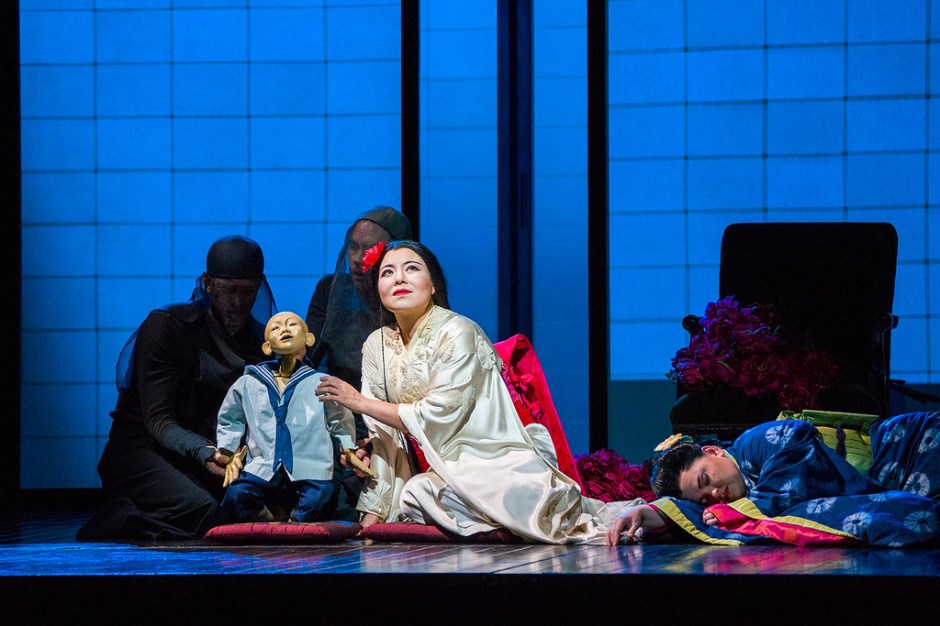
One of the fundamentals of the much-adored Minghella production is the use of traditional Japanese Bunraku puppets, most notably as Butterfly’s 3-year-old son. While it’s mesmerizing to watch three veiled men in the shadows maneuver the head, hands, and feet of the wooden child, I felt that some of the attention to detail in regards to the physicality of the puppet had diminished since seeing the 2016 performance: the child toddled not as often as before and relied more frequently on being held by his mother.

Hui He as Cio-Cio-San in Madama Butterfly / Metropolitan Opera

This was just one detail that aided in the feeling of something being amiss. Although I can’t quite put my finger on it, this particular performance lacked a chemistry and fire that is so needed for a convincing Butterfly. Still, I enjoyed the opera ─ and the visually stunning production ─ nonetheless. It is Puccini, after all.

A scene from Madama Butterfly / Metropolitan Opera

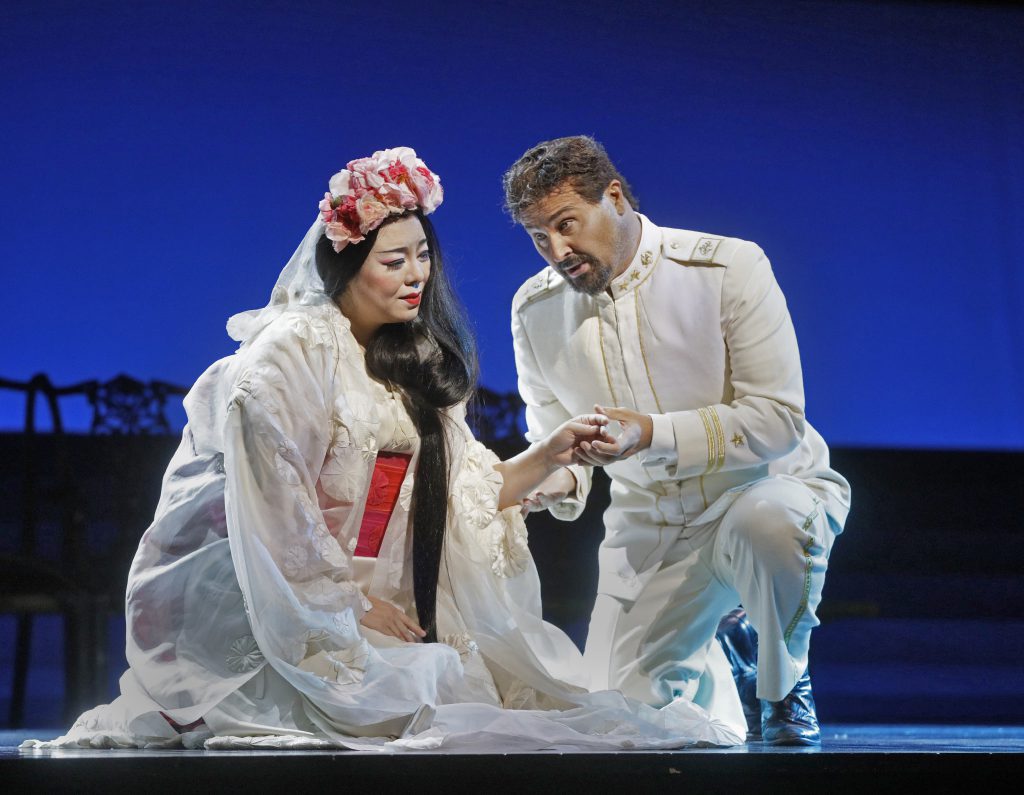
She’s a geisha, yes. But more significantly, Cio-Cio-San is Madame Butterfly─ as in, a married woman. The centrifugal moment of the opera, which triggers all the dominoes to fall, is the marriage ceremony between Butterfly and Pinkerton. Climbing up the glossy stage while accompanied by her wedding party in bright regalia and corrugated fans, the silken white figure of Cio-Cio-San is a breathtaking sight to behold. This was exactly the look I wished to emulate with my costume.

Hui He as Madame Butterfly (seen here with Roberto Armonica) / Metropolitan Opera

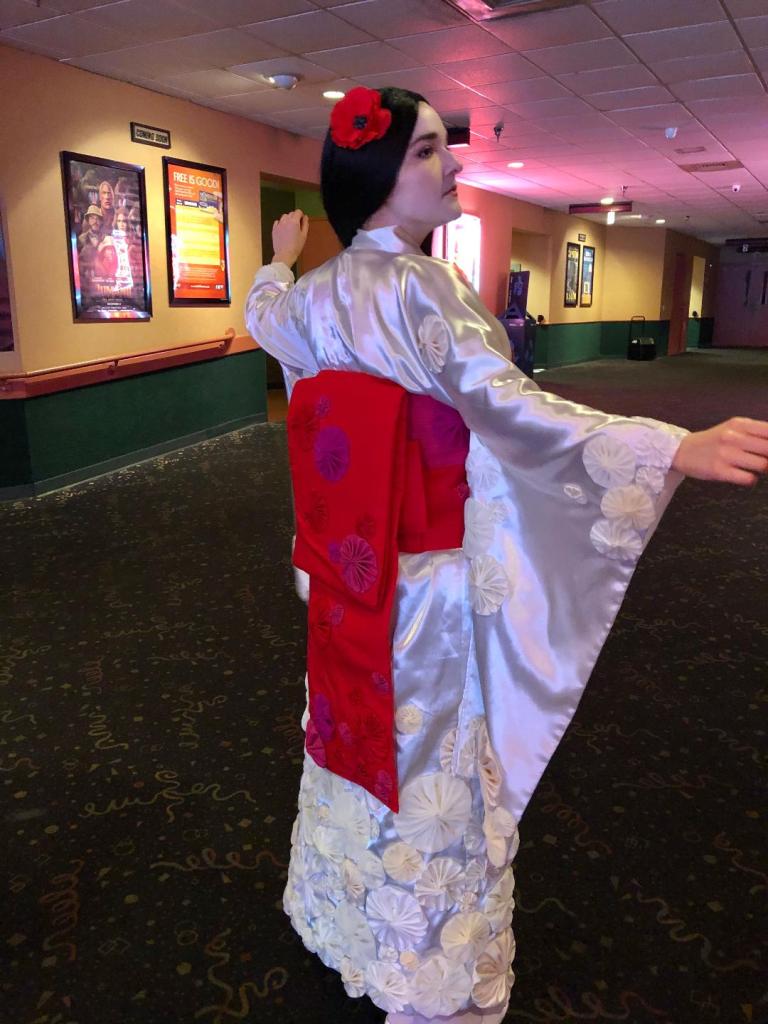
With exactly a month before the opera, I commenced work on a replica kimono that I hoped would give credence to the character. An abounding bevy of varying satin “yo-yos” were cut and hand sewn together as the key ornamentation of the robe, which was quite comfortable since it was lined in a thin cotton voile. The logistical challenge of creating the obi (sash) and faux drum knot was another story, but for now we’ll just say it was adequate for its brief stint at the theater. My lovely friend, Judy, captured a photo of the back of the outfit during intermission.

Raven black wig, red poppy affixed, and yards of silvery white satin summoned to mind the ancestral artistry of the Met’s Minghella Madame…

Hui He as Cio-Cio-San in Madama Butterfly / Metropolitan Opera

With properly applied white face, a dab of rouge, and ruby red lipstick, I felt every bit the geisha for Cio-Cio-San’s wedding day. The pantomime was complete !

While the marriage between Butterfly and Pinkerton resulted in undue catastrophe, the afternoon at the opera was a carefree delight. Should you ever be proposed with the choice of attending a heartrending performance of Madama Butterfly, there should be only one reply in return… I do !

Toi, Toi, Toi,

Mary Martha

For more information on how I created Cio-Cio-San’s signature wedding kimono, please check out my tutorial post !

Cast and Credits:

Madama Butterfly ─ Giacomo Puccini (1904)
Live in HD air date: November 9, 2019

Cast:
Cio-Cio-San ─ Hui He
Pinkerton ─ Bruce Sledge*
Suzuki ─ Elizabeth DeShong
Sharpless ─ Paulo Szot

*Replaced Andrea Carè

Credits:
Conductor ─ Pier Giorgio Morandi
Production ─ Anthony Minghella
Director/Choreographer ─ Carolyn Choa
Set Designer ─ Michael Levine
Costume Designer ─ Han Feng
Lighting Designer ─ Peter Mumford
Puppetry ─ Blind Summit Theatre
Live in HD Director ─ Habib Azar
Host ─ Christine Goerke

Manon Lescaut

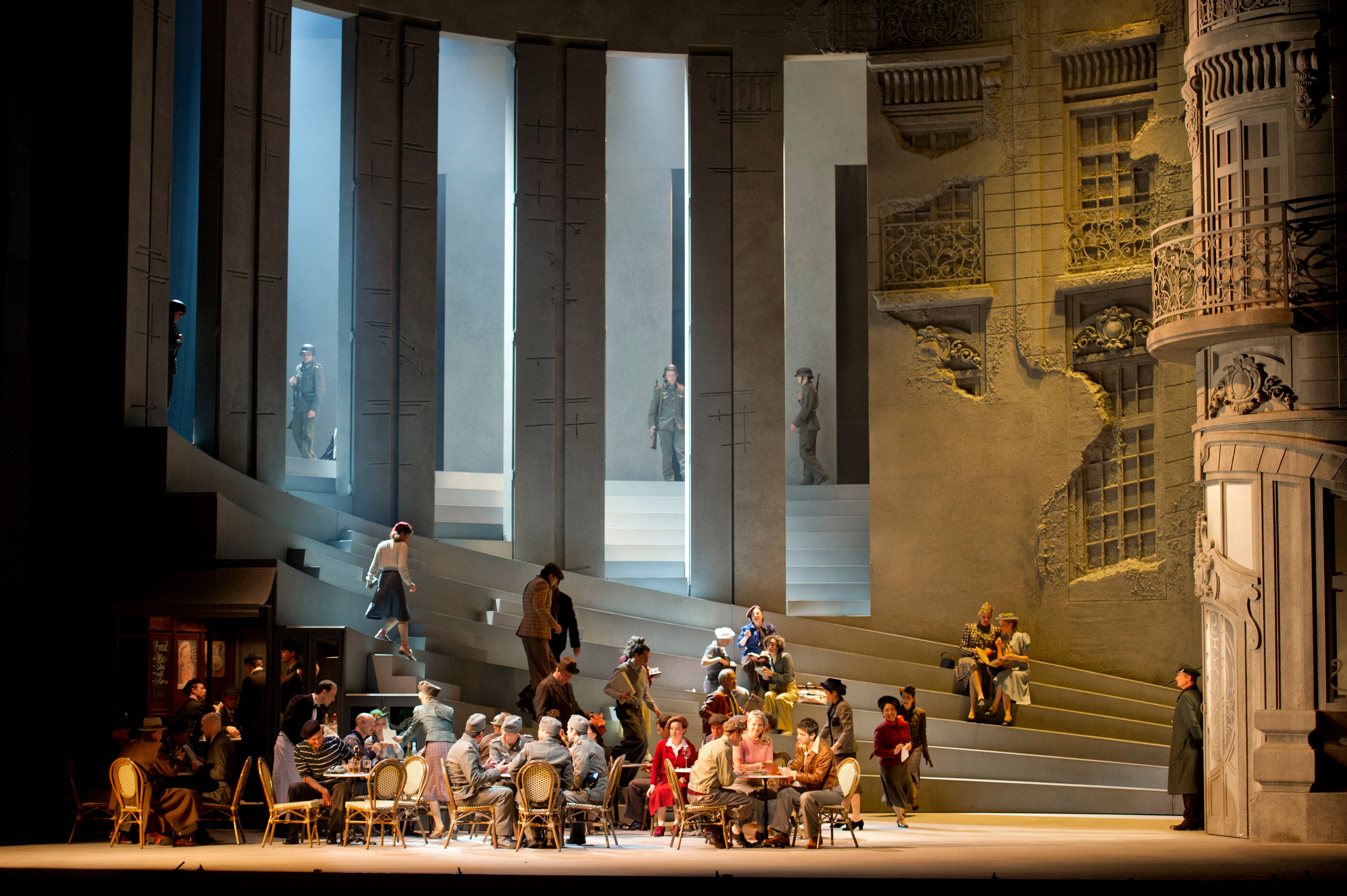
With an updated setting of occupied Paris during WWII, the Met’s volatile new production of Puccini’s Manon Lescaut brought out the glamour, darkness, and moral ambiguity of film noir. And just as with most Hollywood movies of the 1940’s, drama mottled every facet of Abbé Prevost’s salacious story.
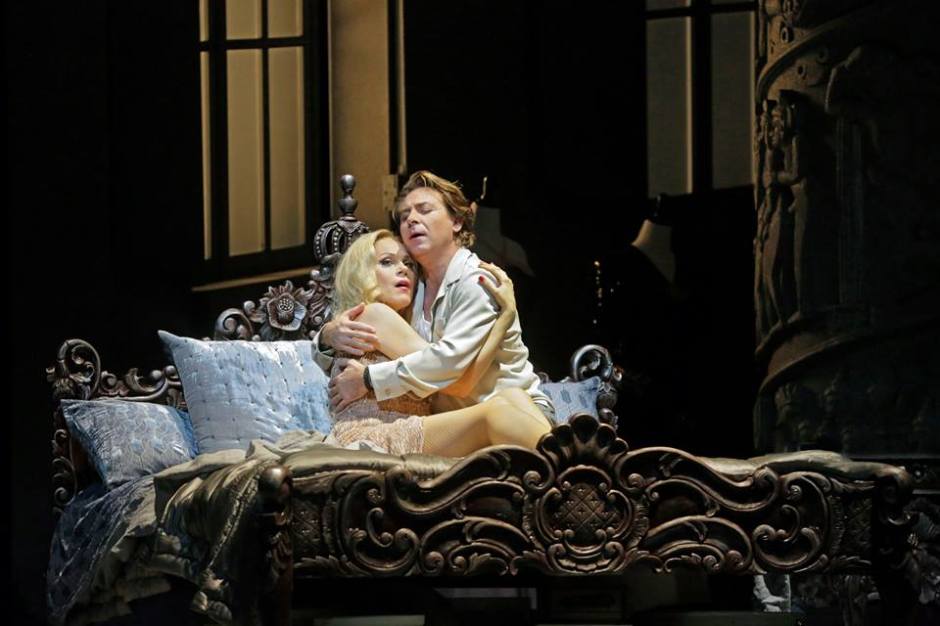
But the most unforeseen action occurred off stage when Roberto Alagna stepped into the leading role of des Grieux with only 16 days to learn the part by memory. His alacrity paid off; he sounded terrific ! He also paired well with the statuesque Kristine Opolais, who, being of an above average height, exchanged her pumps for flats to better suit the abbreviated height of her fill-in des Grieux. How strange it felt to my eye to see a woman in flats in the 1940’s…

Roberto Alagna as des Grieux and Kristine Opolais as Manon Lescaut / Metropolitan Opera

Also confounding my visual perceptions were the distorted sets of Richard Eyre’s production. The swooping stairs that spanned across the stage made me fearful for the chorus members having to maneuver them. However, practice makes perfect and no false steps were made. Whew !

A scene from Sir Richard Eyre’s Manon Lescaut / Metropolitan Opera

While glamour is always a good thing, the overwhelming theme of illicit sex in Manon Lescaut was rather repugnant to me: the throngs of much older men scheming to entrap a young, innocent woman was not my idea of romance. Coupled by the dark overtones of the tumultuous setting, the feeling I had while watching Manon Lescaut was that of bitter cold and dampness ─ I wanted to crawl into a corner and wait for things to pass over ! As such, the opera ended in shambles.

The final scene of Manon Lescaut / Metropolitan Opera

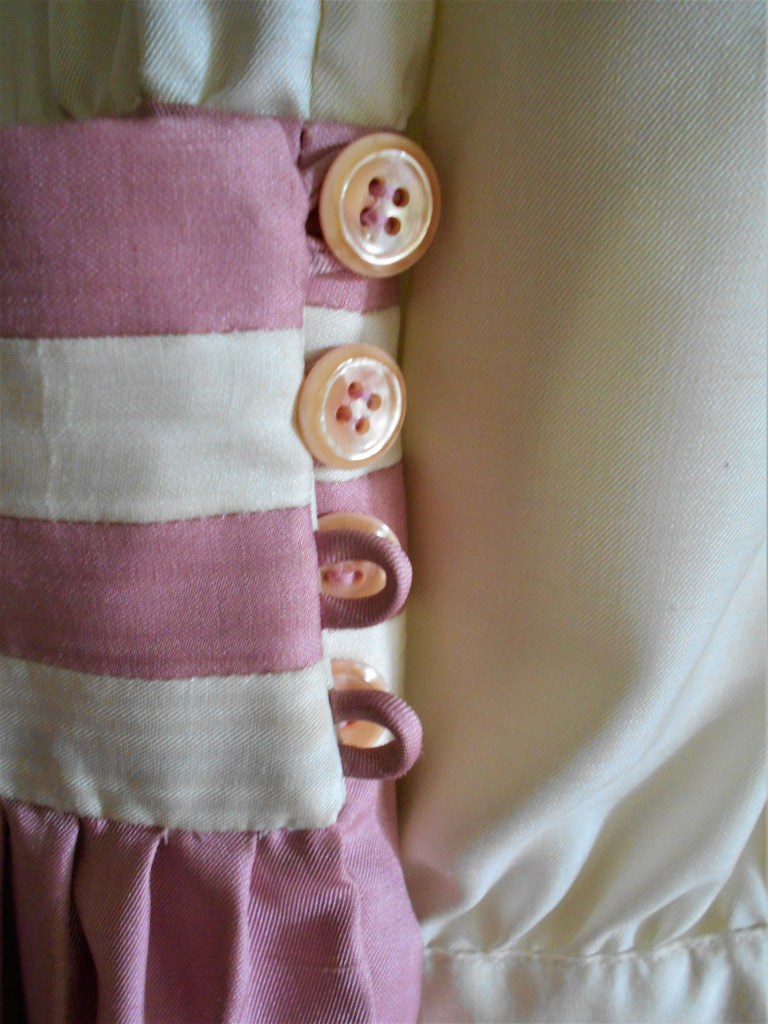
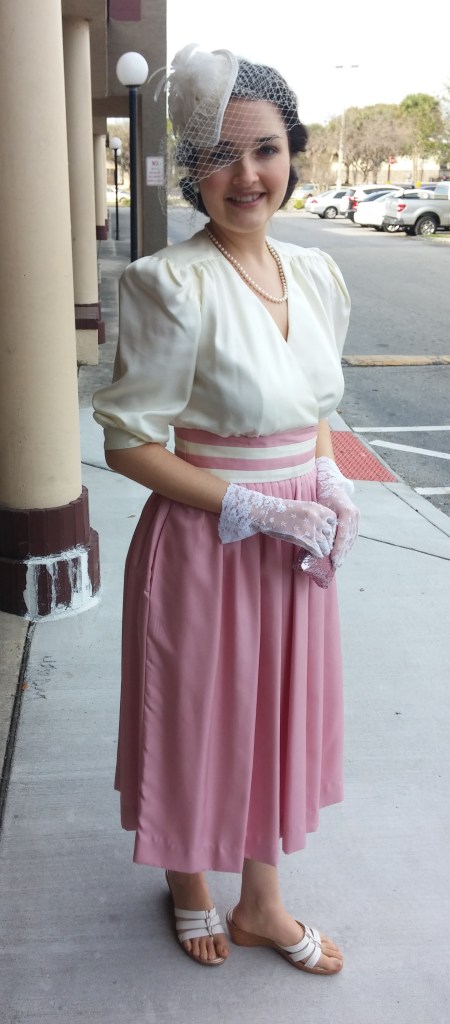
No, I didn’t care for Manon Lescaut. However, there was a silver lining to the new production and that was the swishy skirts and tilted millinery of 1940’s fashion ! If there’s one thing I enjoy more than others, it’s historical fashion and having the chance to experience a different period of clothing and mannerism. Of course, much research goes into my outfits when there’s a specific look I need to emulate, but fortunately I found just the ticket in one of my mother’s old dresses. Since I was a child, I have loved the pink and cream striped dress that has hung in the closet for years and one day when I plucked up the nerve to try it on for size, it fit ! The button loop closures at the waist are my favorite detail.

Pearls were a must as well as an elegant chignon, but I needed something more to aid in the cause… a hat was the likely choice. Thankfully, I was able to borrow a darling fascinator complete with birdcage veil ─ it was perfect for my desired look ! Without it, I wouldn’t have felt near the woman of the 40’s as I did while peeking through its tiny mesh windows. Now if only I had had a decent pair of pumps…

Thank you, Aunt Belinda !

I may not care whether I see Manon Lescaut ever again, but I do wish another occasion would arise for feminine fashion of the Forties !

Toi, Toi, Toi,

Mary Martha

Cast and Credits:

Manon Lescaut ─ Giacomo Puccini (1893)
Live in HD air date: March 5, 2016

Cast:
Manon Lescaut ─ Kristine Opolais
Des Grieux ─ Roberto Alagna
Lescaut ─ Massimo Cavalletti
Geronte ─ Brindley Sherratt

Credits:
Conductor ─ Fabio Luisi
Production ─ Sir Richard Eyre
Set Designer ─ Rob Howell
Costume Designer ─ Fotini Dimou
Lighting Designer ─ Peter Mumford
Choreographer ─ Sara Erde
Live in HD Director ─ Gary Halvorson
Host ─ Deborah Voigt

Così fan tutte

“All women are like that…” so says the cynical Don Alfonso to his naïve friends as he demonstrates the fickleness of the fair sex… But is the assumption ─ that women are bound to stray from their lovers if given the chance ─ an accurate claim ?

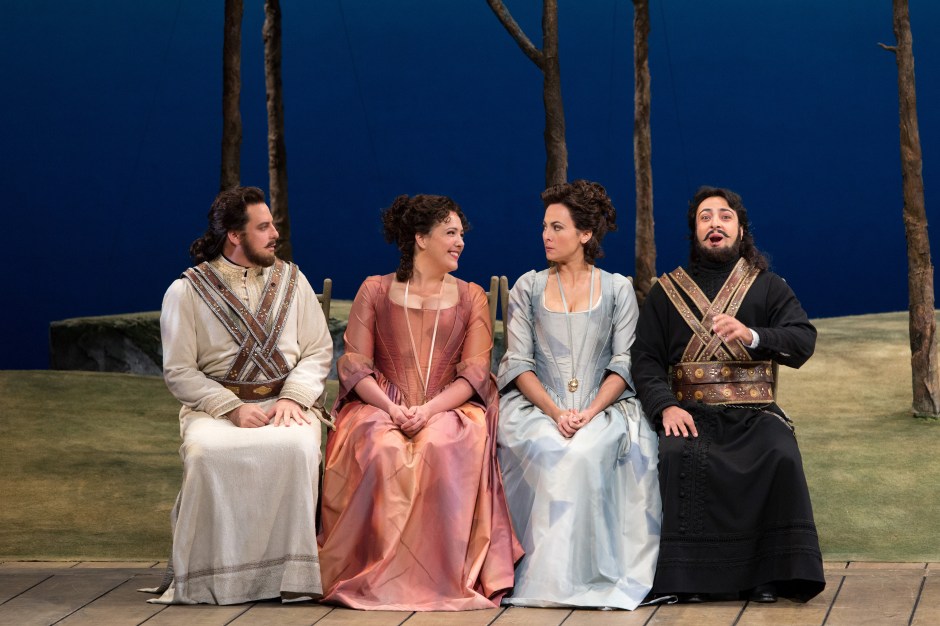
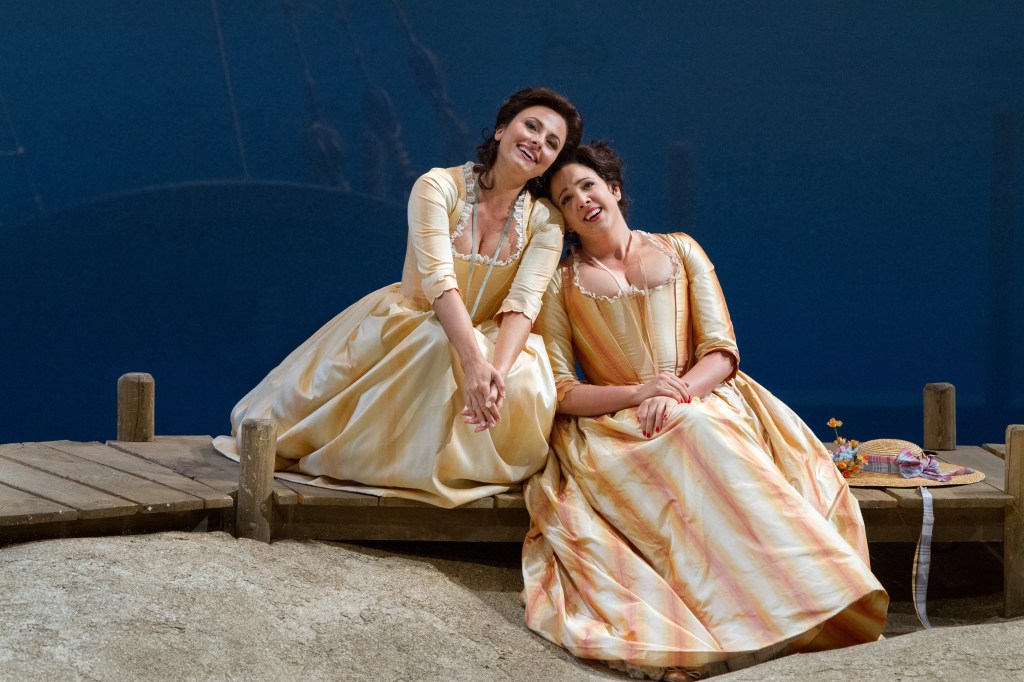
While sometimes considered outdated for modern society, Mozart’s piquant comedy about the test of fidelity through trickery was nothing but a delight to me. Lesley Koenig’s picturesque production was understated and elegant and the cast was just as pretty, especially the two lovestruck sisters, Fiordiligi and Dorabella, played by Susanna Phillips and Isabel Leonard. With their dark brown hair and fair complexions, it wasn’t a stretch to believe them to be blood relatives.

Isabel Leonard as Dorabella and Susanna Phillips as Fiordiligi in Così fan tutte / Metropolitan Opera

Their fiancés were adorable. Ferrando and Guglielmo (such strange names in this opera ─ Fiordiligi, Guglielmo…) were so smitten with the sisters that their giggles and giddiness reminded me of teenage boys with their first crush. Even while disguised as Arab sheikhs their bubbling enthusiasm for their sweethearts couldn’t be stifled.

Danielle de Niese as Despina, Matthew Polenzani as Ferrando, Rodion Pogossov as Guglielmo, and Maurizio Muraro as Don Alfonso in Così fan tutte / Metropolitan Opera

The thalassic score accompanied the harmonious singing like a sigh floating on a breeze and the lighthearted moments of comedy were balanced with some introspective seriousness. If I had one complaint about Così, it’s that it’s a tad too long: I walked out of the theater just after 11 p.m. from a 7 p.m. start time. However, the decision to travel over an hour and a half to catch the summer encore of Così fan tutte was well worth the late evening drive.

A scene from Così fan tutte / Metropolitan Opera

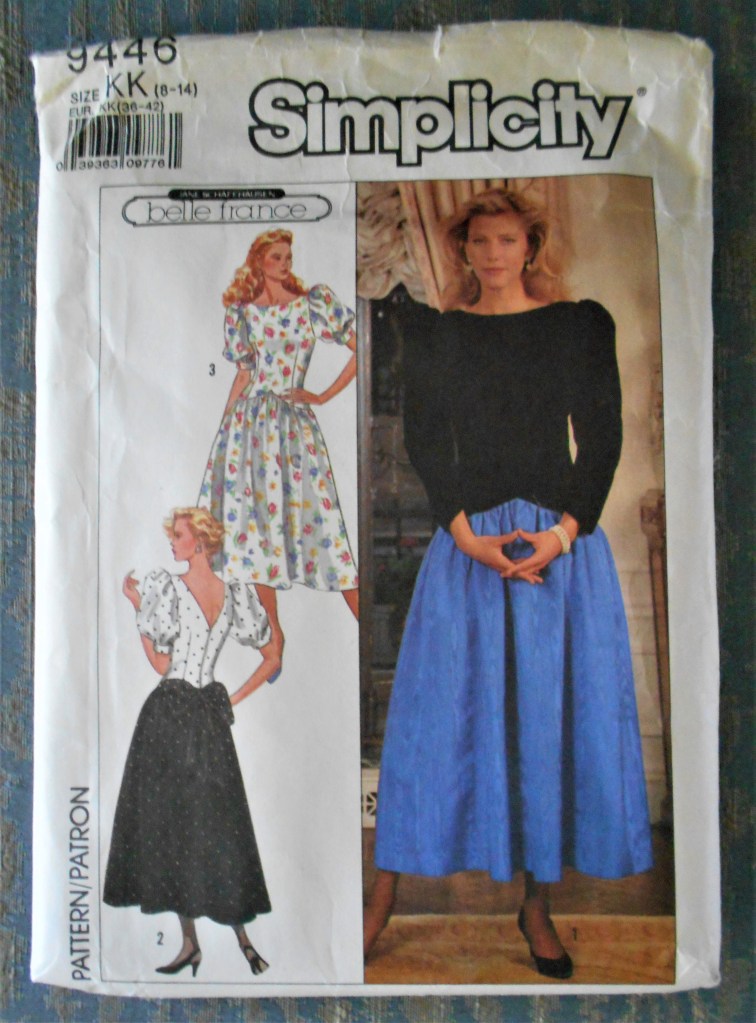
Since Così is a cute, zany opera, I thought a dress of a similar description would be the perfect outfit for the summer encore. Best of all, I didn’t have to look beyond my mother’s closet for the answer. Like me, my mother used to sew many of her clothes and thankfully she has kept nearly all of her dresses and jumpers from the 1970’s and 80’s. One of my favorites is the black and white polka dot dress with dropped waist and puff sleeves that fits me well. I even found the original pattern in the worn, bulging cardboard pattern box… Dress #2 at the bottom of the envelope was obviously the intended look my mother desired…

Simplicity 9446 circa 1989

Keeping it classy with pearls, long gloves, and a ladylike chignon, I was decked out for the escapades of Mozart’s Battle of the Sexes.

The opera’s finale was a happy one and the men married their betrothed. But back to the all important question: were the women faithful to their fiancés ? No. Did I care ? Hardly ! All’s well that ends well ─ the opera was too charming not to forgive and forget.

Toi, Toi, Toi,

Mary Martha

Cast and Credits:

Così fan tutte ─ Wolfgang Amadeus Mozart (1790)
Live in HD air date: April 26, 2014
(Encore seen: July 21, 2016)

Cast:
Ferrando ─ Matthew Polenzani
Guglielmo ─ Rodion Pogossov
Fiordiligi ─ Susanna Phillips
Dorabella ─ Isabel Leonard
Don Alfonso ─ Maurizio Muraro
Despina ─ Danielle de Niese

Credits:
Conductor ─ James Levine
Production ─ Lesley Koenig
Set and Costume Designer ─ Michael Yeargan
Lighting Designer ─ Duane Schuler
Stage Director ─ Robin Guarino
Live in HD Director ─ Gary Halvorson
Host ─ Renée Fleming