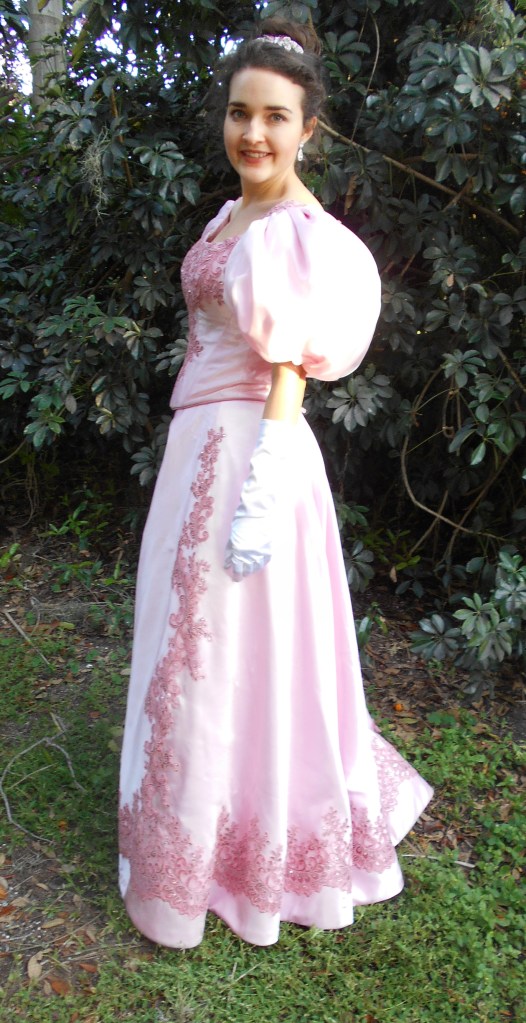
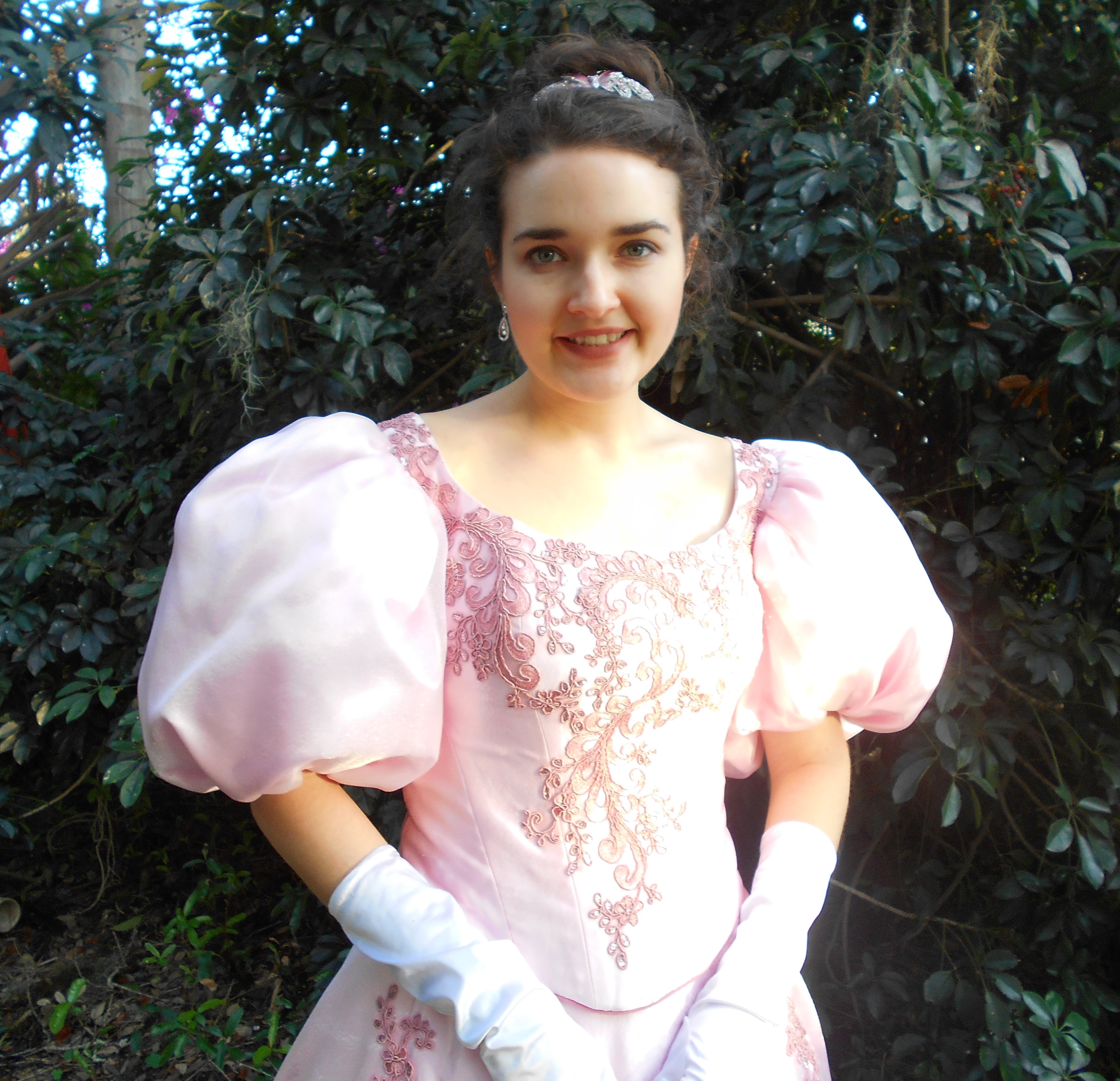
The Making of Manon: the 1890's ball gown

When pondering a new project, I always search for that one piece of inspiration to set the creative gears into motion. It can be a pair of shoes with just the right decoration for mimicking on a collar, or a necklace from ages past that would look perfect with a historical replica gown. For Manon, that trinket of musing was this pink and silver butterfly barrette:
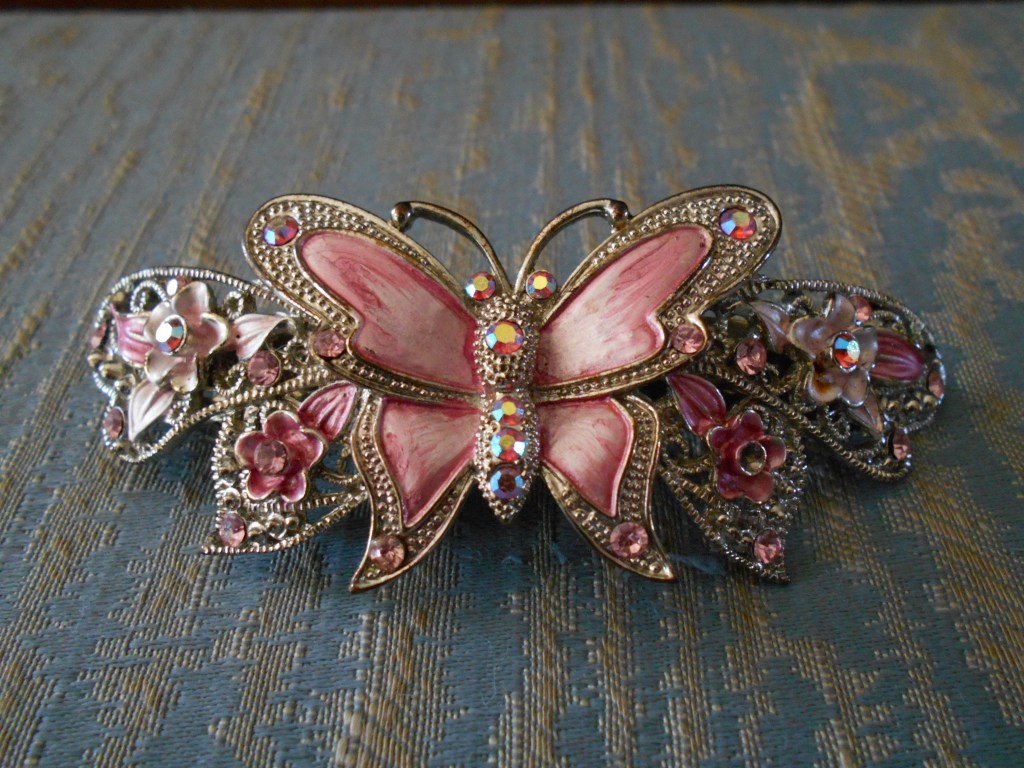
Pale, frosted pink with touches of mauve and iridescent rhinestones gave me great ideas for the color scheme of my Belle Époque outfit. Determining whether I would create a walking suit, day dress, or evening/ball gown became the main challenge as I vacillated between contrary designs like a pendulum swinging from a string. Ultimately, a ball gown seemed like a safe choice since I knew that it would be rather simple in construction and wouldn’t limit my comfort or mobility the way a spectacularly broad daytime hat would against the back of a movie theater seat (I have experience in these matters, as surely you can tell). I did, however, sketch a design in the vein of one of Laurent Pelly’s signature looks from the opera:
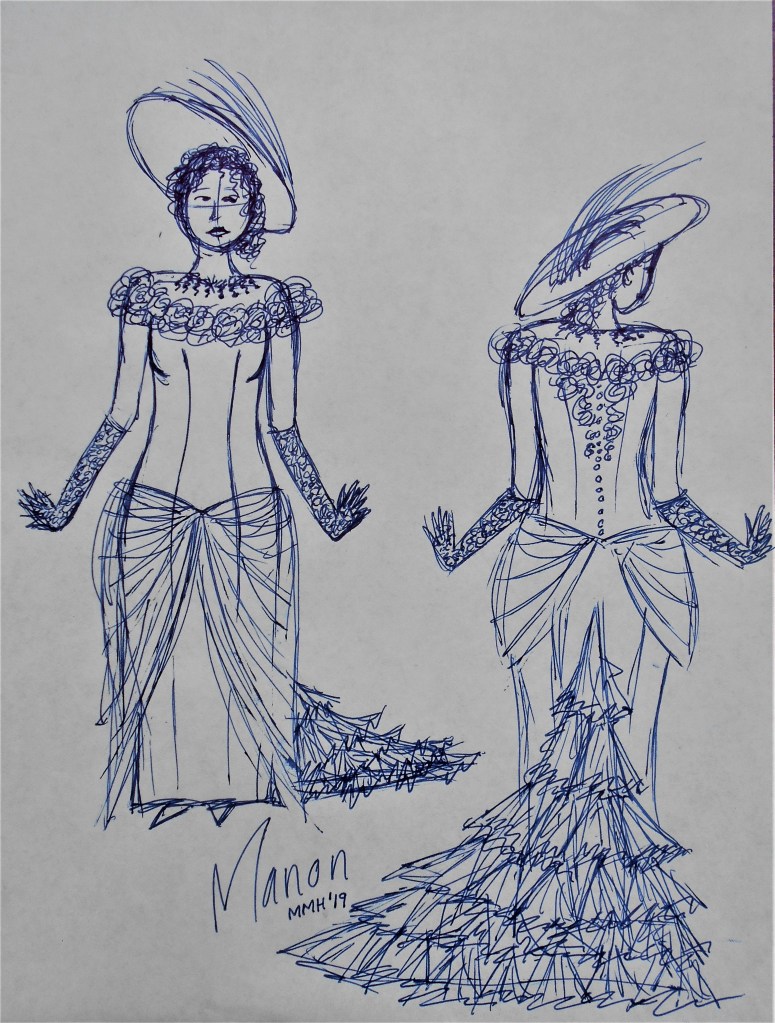
Manon / Metropolitan Opera

Once the decision was made in favor of the ball gown, I settled on the 1890’s for my gown’s impersonation since La Belle Époque (The Beautiful Age) spans well over 40 years (roughly 1871-1914 by generous standards) with varying fashions in each decade. Now to narrow down the style of the neckline, sleeves, and skirt…

The gowns of the decade were bedecked in fancy laces, expensive jewels, and lavish ornamentation. Most noticeably were the enormous puff sleeves and long evening gloves worn by the ladies.

The decoration of the gores on the skirts was also in vogue.

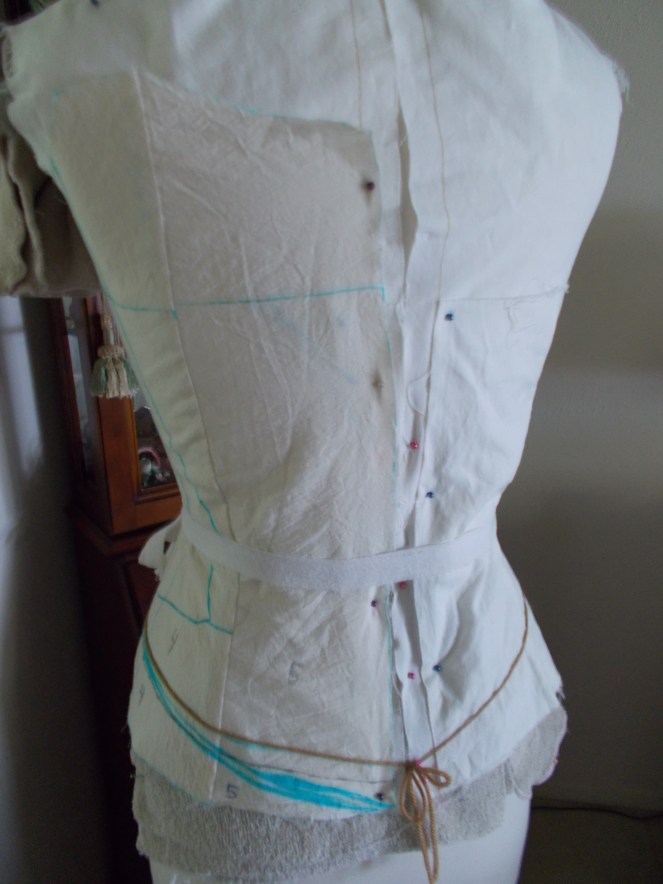
As for me, I wanted a trademark 1890’s style, which meant a separate, softly pointed bodice and gored fan skirt trailing behind ─ both cut from pale pink crepe back satin and decorated in contrasting rosy mauve corded lace. Making a mock-up was the first order of business. I designed my bodice to have shoulder straps that opened wide onto the chest and a pointed bottom at the front and back, which was characteristic for the time period.
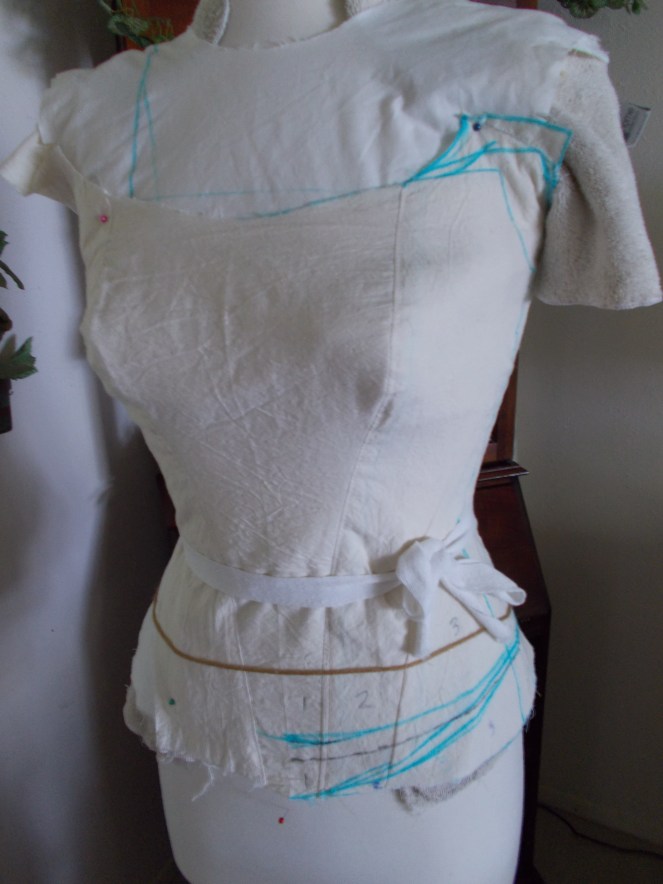
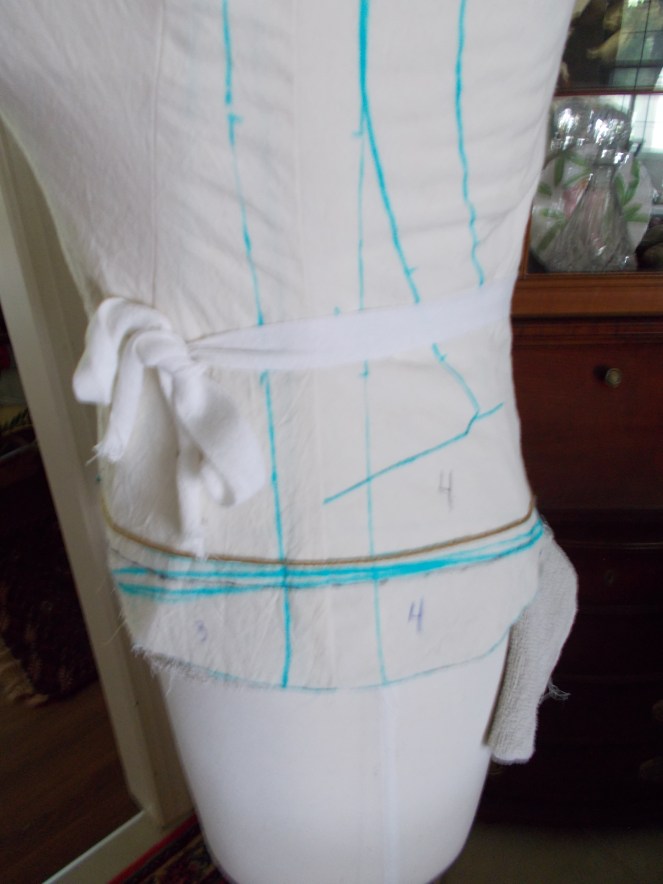
Once the bottom edge was modeled to my satisfaction, I cut along the line and had my new patterns pieces, which were then laid out onto interfaced cotton lining fabric.

Covered Rigilene bones were sewn onto the front princess seams in addition to one bone down the middle of the face side of the lining while other bones were sewn onto the bust portion of the bodice to give it shape and support.
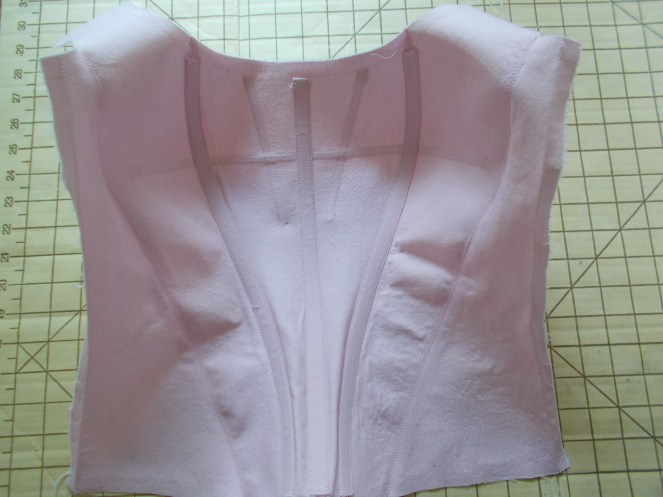
Onto the back !

A minuscule waist was at the forefront of the iconic 1890’s silhouette. While the broad design features of bouffant sleeves and sweeping skirt hems aided in the appearance of a tiny waist, I wanted to be sure that I did my best to achieve the proper look and decided to make a built-in corset in the bodice. The attached lacing panels are shown below. Each panel has two sides: one for the lining (cotton) and the other for the side facing the back (satin).

Next came the skirt…

Doing my best to keep the gown fairly accurate, historically speaking, I made a pattern using measurement instructions given in Janet Arnold’s Patterns of Fashions 2, an invaluable resource for fashion historians and sewing enthusiasts alike. Seam allowances were added and then the paper pattern was pinned to folded layers of crepe back satin (face), lining fabric, and interfacing to save time on the cutting process.

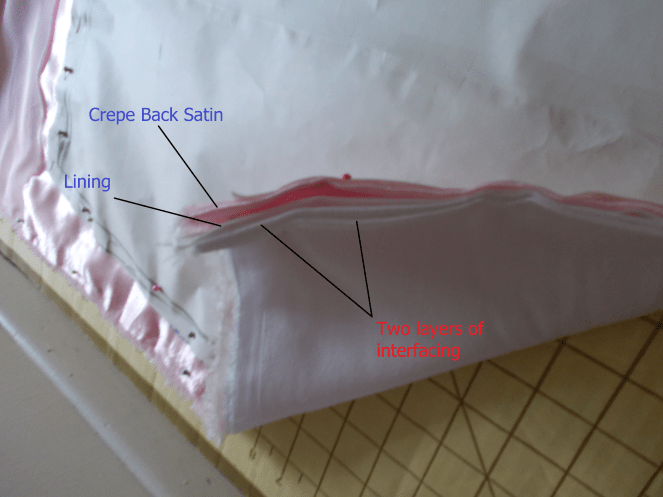
The interfacing was fused to the wrong sides of the face and lining fabrics and set aside for later…

After sewing together all the pieces of the bodice, pressing the seams, and stitching quilt batting onto the bust to cover the exposed bones, it was time for a fitting !
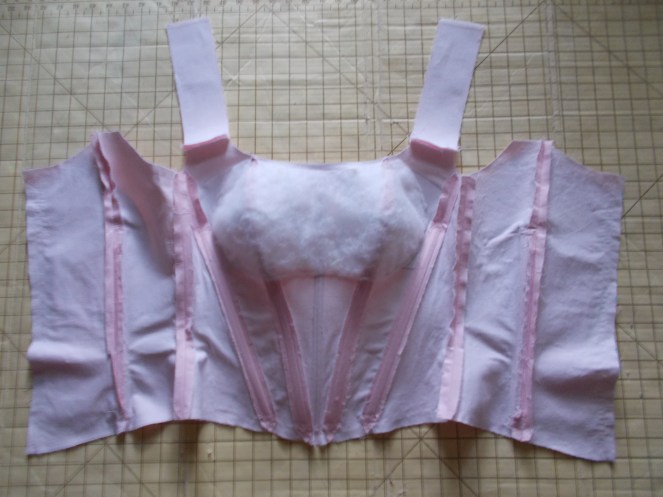
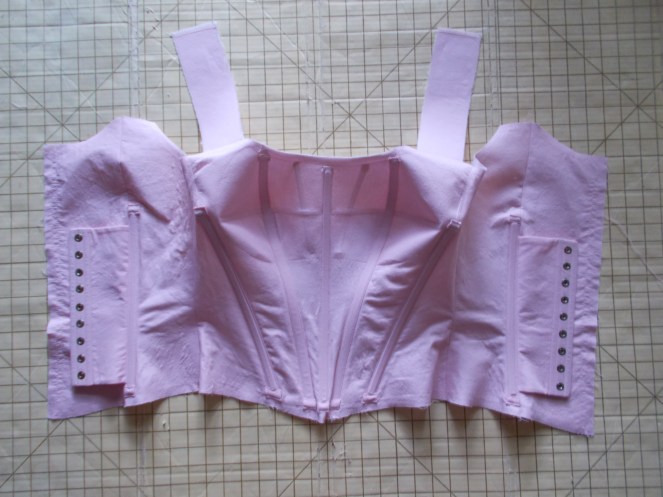
The fitting indicated that the armscyes needed to be cut down slightly since it was jabbing into my underarm area in a most uncomfortable way. (Later on I would cut down the armhole even more since it was still bothersome.)
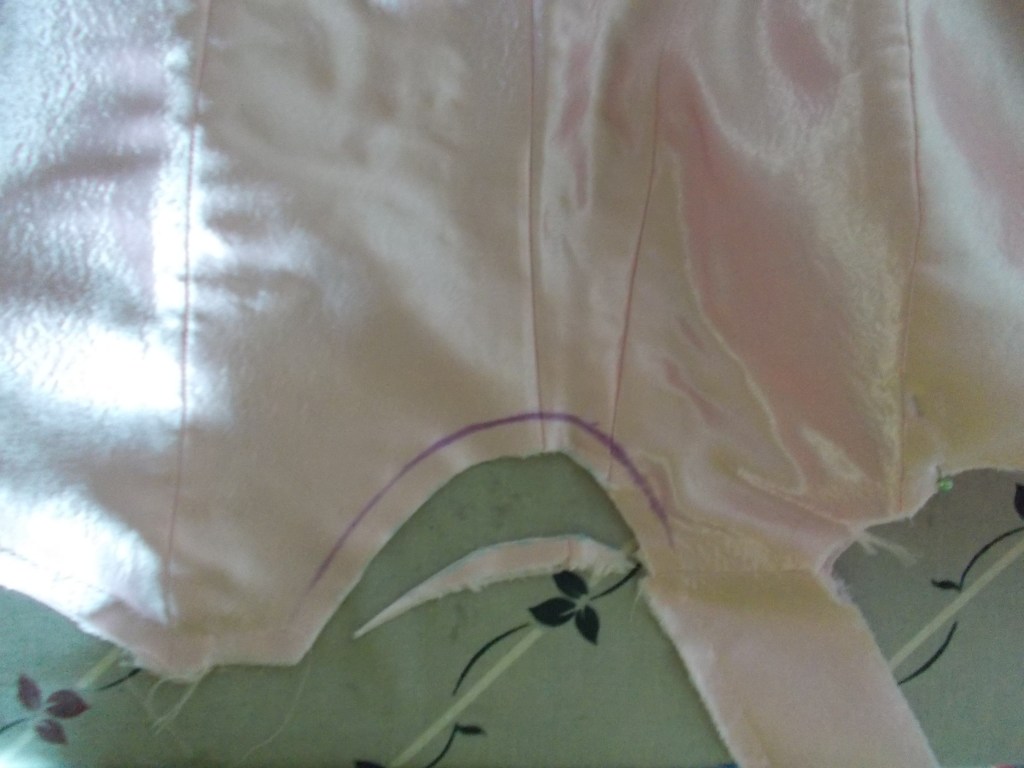
A portion of the armscye cut down.

Let’s get back to the skirt…

As per Patterns of Fashion 2, the hems of the fancy skirts in the 1890’s were interlined with buckram in order to keep them stiff and stand out and away from the wearer. This was essential in creating the proper figure that I wanted to achieve so I bought 1 yard of heavyweight buckram and cut it into strips based on the equation of the circumference of the skirt divided by the width of the buckram. If I remember correctly, I think I ended up with 8 strips that were 56-57″ long (the width of the buckram) and about 7¼” tall. Sewing the strips together gave me one long strip of stiffener.
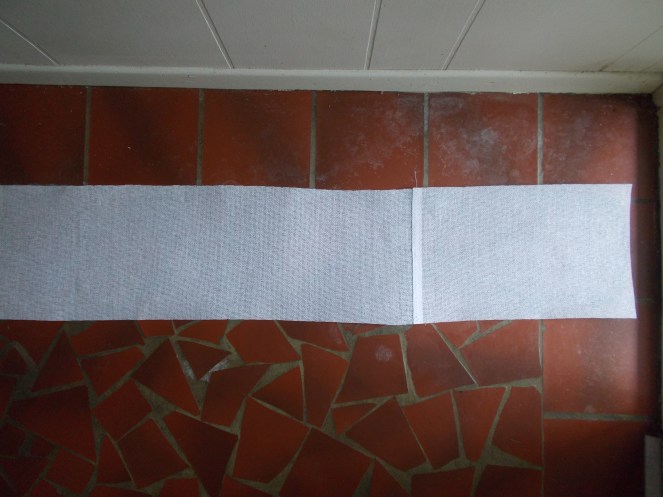
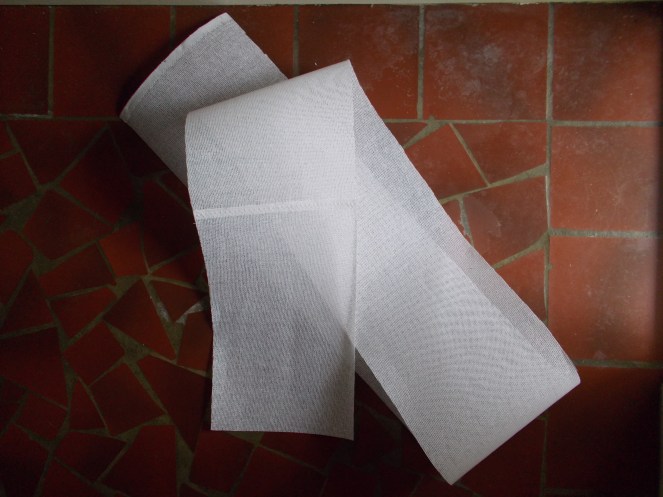
The edge closest to the hem was sewn on first. Then to compensate for the decreasing skirt circumference higher up, I made long cuts into the buckram along the top edge (and shorter ones along the bottom) to help bend the stiff mesh into a circular shape.
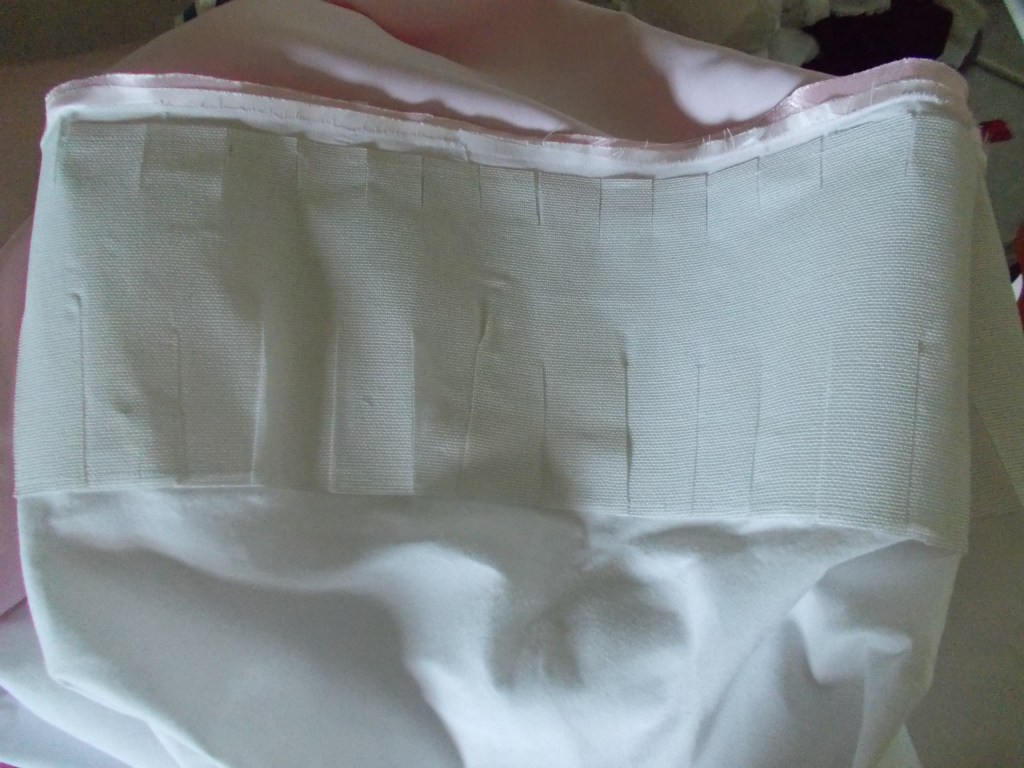
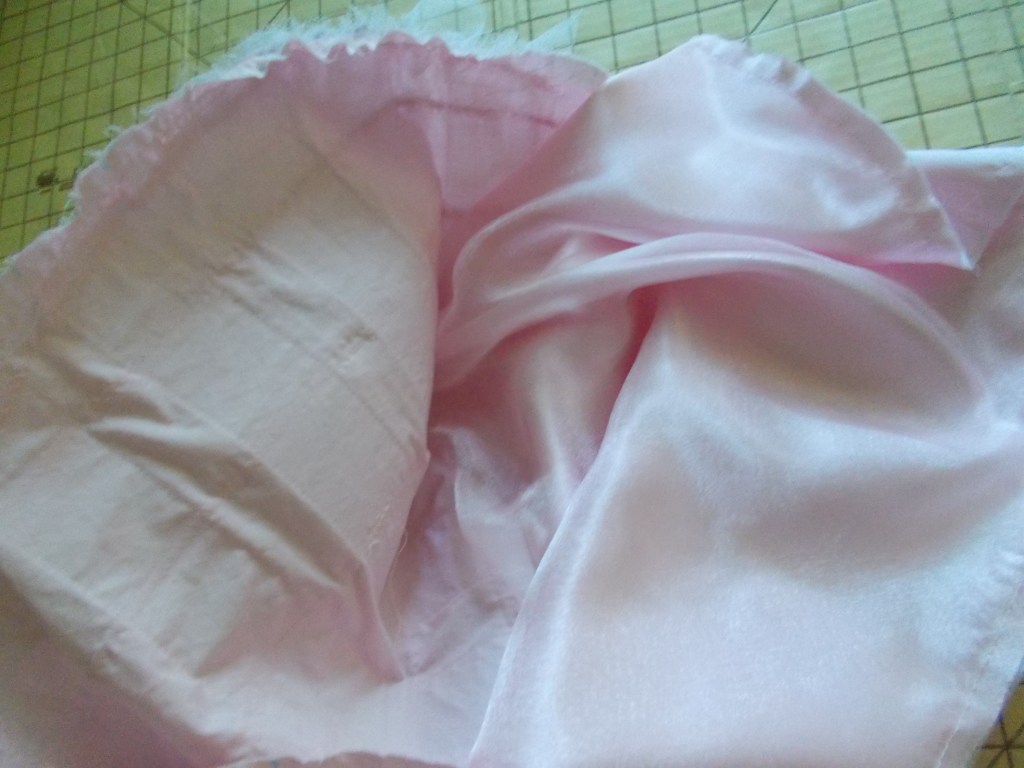
Below shows how the interlining looks from the inside. There are two lines of stitching for the buckram (top and bottom) and then the pink outer face fabric was turned to the right side and the seam allowance topstitched to the inside.

All was pressed and ready to be pleated at the back. A simple waistband was added to the top, hooks and eyes were sewn to the band, and the skirt was ready for decoration ! Lovely, isn’t she ?
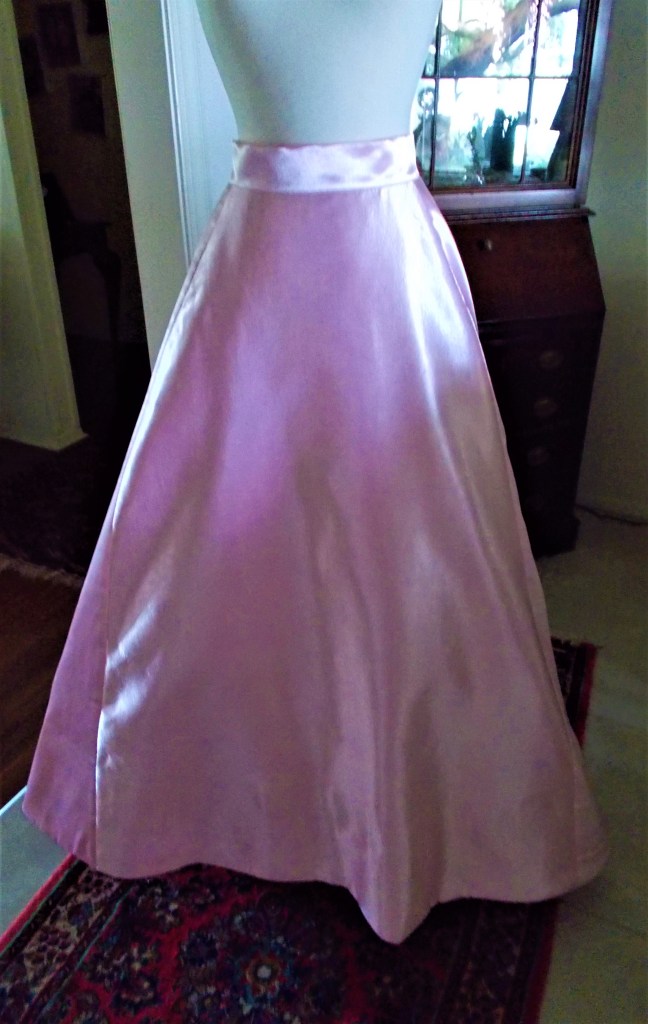
Calculating that it would take over 5 yards of lace trim for the bottom hem of the skirt, I purchased 3 yards of a sequined corded lace with double scalloped borders in the rosy mauve hue that would serve as the accent color, just like in the butterfly hair clip. Of course, the two selvedges of scallops gave me close to 6 yards of trim, which I snipped off and pinned their lengths in place onto the skirt.

Now, just between us, I glued the bottom border of lace onto the skirt with a clear fabric glue. I had no other choice ! If it’s early June, then I’m most likely going to hand sew the lace. But with only a month before the October opera and a bevy of other projects waiting half finished on my ironing board…well… Toss me the bottle of glue ! I did hand sew the rest of the lace, however, including the motifs along the two seams of the front gore, which took 3 hours EACH to complete. Yes, the glue saved me !
The skirt was complete (other than hanger straps, which I added later) and then it was onto the sleeves ─ the massive, puff sleeves.

The Sleeves

Perfecting the fit of a sleeve has always been an elusive task for me. They’re either too tight, too lopsided at the top, or just plain unsightly. Sometimes, I want to give up. Since I didn’t want a failure with my 1890’s ball gown sleeves (they were, after all, consuming almost a yard of fabric each), I counted off the number of squares on a layout in Patterns of Fashion 2 and my sleeve block turned out great with only a few tweaks. Below is my sleeve pattern with markings for the front, back, and shoulder seam. However, in the process of sewing and attaching, these factors were not so important and I ditched the idea of lining up the points with those on the bodice straps. You’ll see why in a minute…

Three layers of the sleeve pattern were cut:

  1. cotton lining
  2. interfaced crepe back satin
  3. crystal organza

After staystitching the edges, strips of horsehair braid were vertically sewn along the wide section of each sleeve at evenly spaced intervals. This provided a structured “oompf” and ensured that the sleeves would not droop. Next came a row of ruffled crinoline to begin building the “fluff” in the sleeve.

And then more rows of crinoline, and more, and more until the sleeve looked like this:
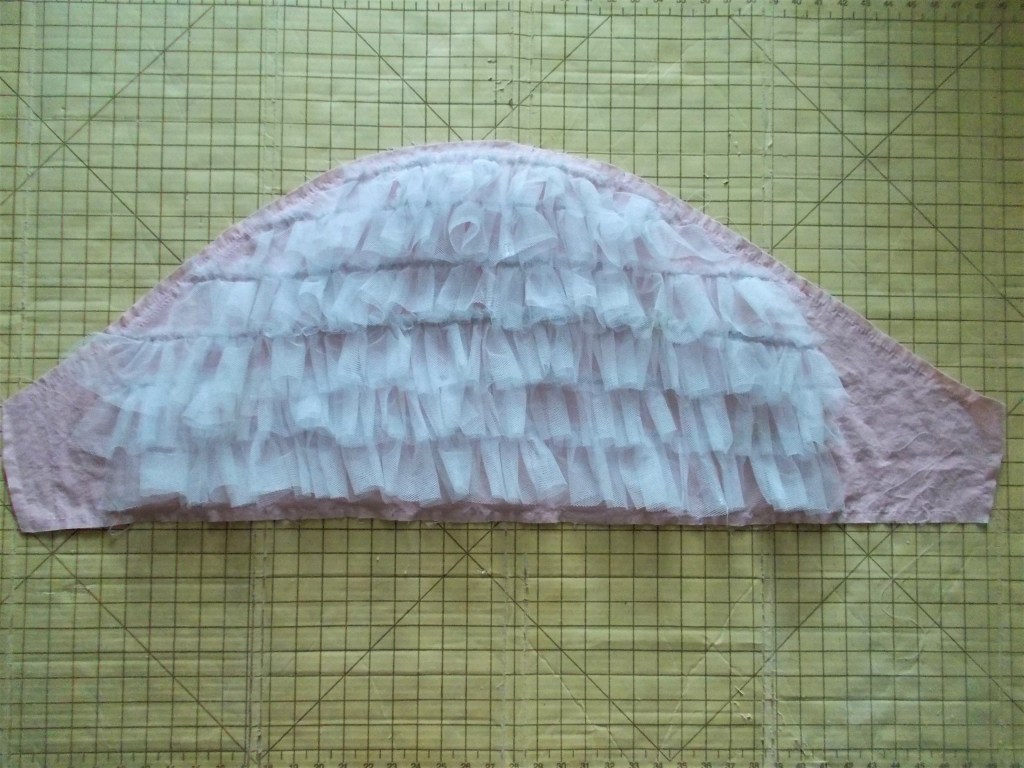
It almost looks like a pink and white lamb ! Baahhh !

Time to join the layers together…

…and gather the tops and bottoms.

And this is where things got tricky. Because it’s infinitely easier to gather and serge at the same time, I opted to use my serger to knock two balls out of the park after striking out with machine gathering ─ no matter how careful I was to not pull too hard on the thread tails, snap ! A thread would break. Frustration set in. Finally, it dawned on me to gather the sleeves on a cord so I went back to the serger and tried this trick. Guided by the red arrows, you will catch a glimpse of the white cotton crochet cord.
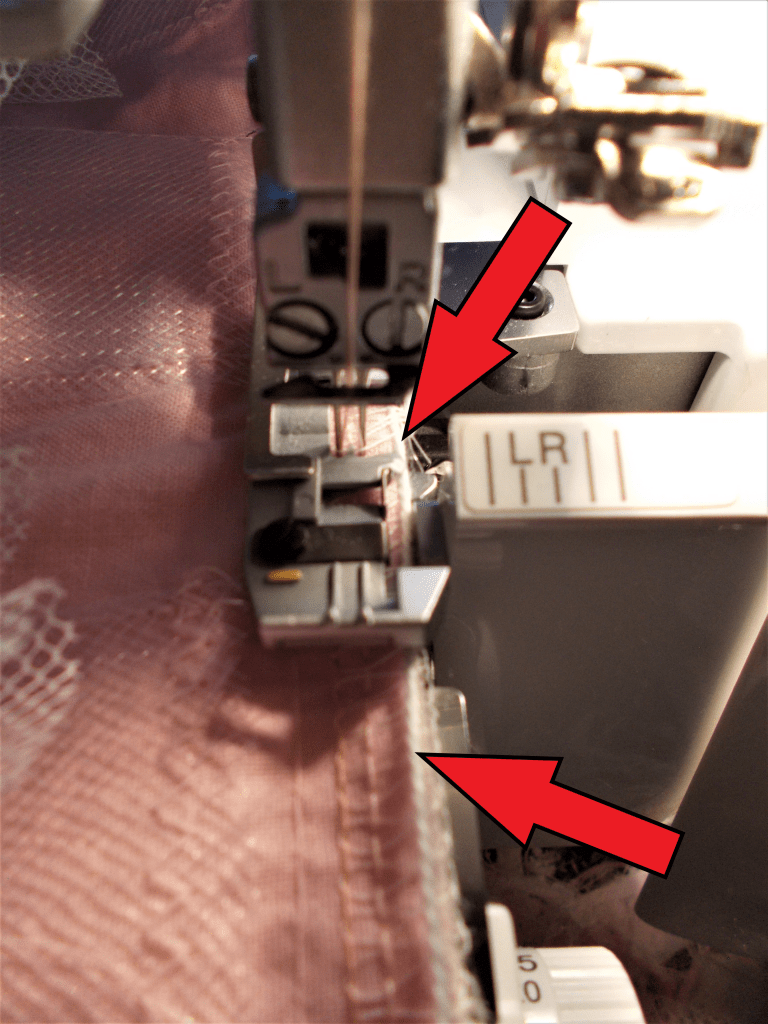
Eureka ! It worked ! From there, the sleeves gathered with remarkable ease.

And here’s what the bodice looked like after the sleeves were fitted to the straps. Sparkly, shiny, and fit for a princess, wouldn’t you say ? Time for a fitting !

A disaster: The inner support materials of the sleeves proved to be much too heavy for the wide set shoulder straps and as a result, the bodice became an “off the shoulder” style, which was not my intended look. I tried using lingerie tape under the straps to help them stay in place, but the copious amounts of horsehair and crinoline won out every time. Back to the drawing board…
The seam ripper and I have a very close relationship and it was in action again with this project. I picked apart the sleeve layers, removed half of the horsehair strips, and reduced the number of crinoline ruffles before serging together the layers ─ again. Thankfully, my fear of having droopy sleeves due to a reduction of inner support was unrealized and once reassembled, they still possessed that iconic “poof” with no signs of droop. They remind me of swim floaties worn on the arms of children who are learning to swim.

A fitting was carried out and STILL the straps were falling down, just not as quickly as before. Only one thing could be done to salvage my hopes of keeping the straps on my shoulders and that was to somehow shorten the length of the strap. This was done by pinching together a back portion of each strap and sewing it down by hand. It sufficed, but wasn’t pretty. Fortunately, the corded lace sewn onto the bodice covered any obvious imperfections.
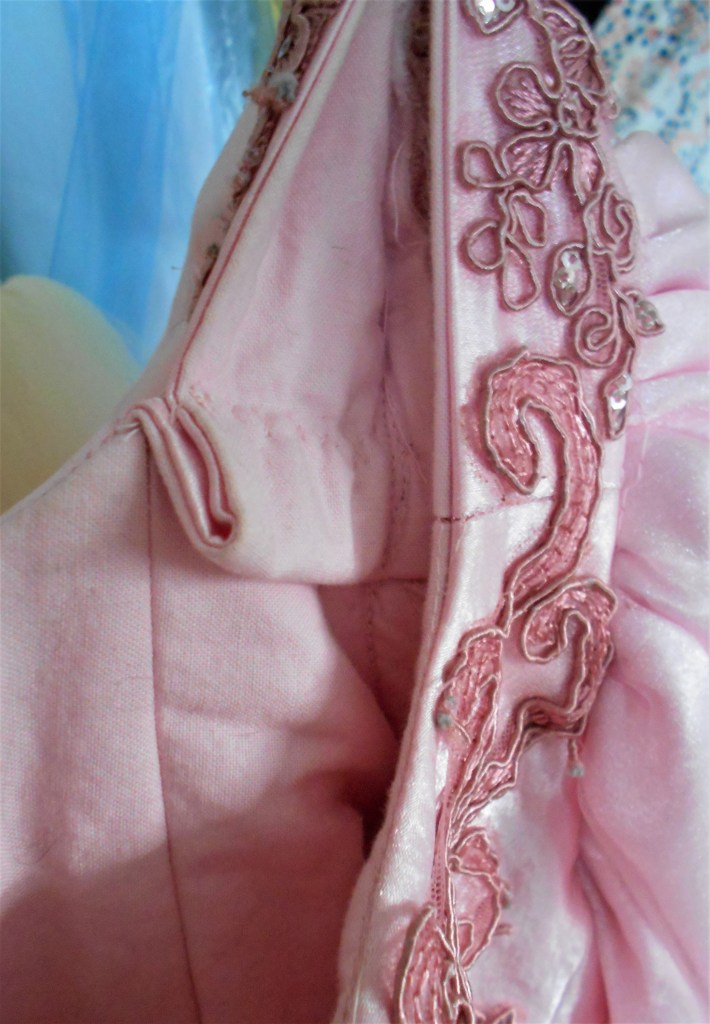
Pinched portion of back shoulder strap sewn down by hand stitches

Completing the look was the beautiful rosy mauve lace I bought online from a Los Angeles fabric store. Snipping out varied motifs was necessary, but tedious at times, and don’t get me started on how much of a brain buster it was to match mirrored pieces ! I think I scrutinized each scroll of the lace pattern until I couldn’t see straight ! But, the devil is in the details and it paid off in the final outcome.
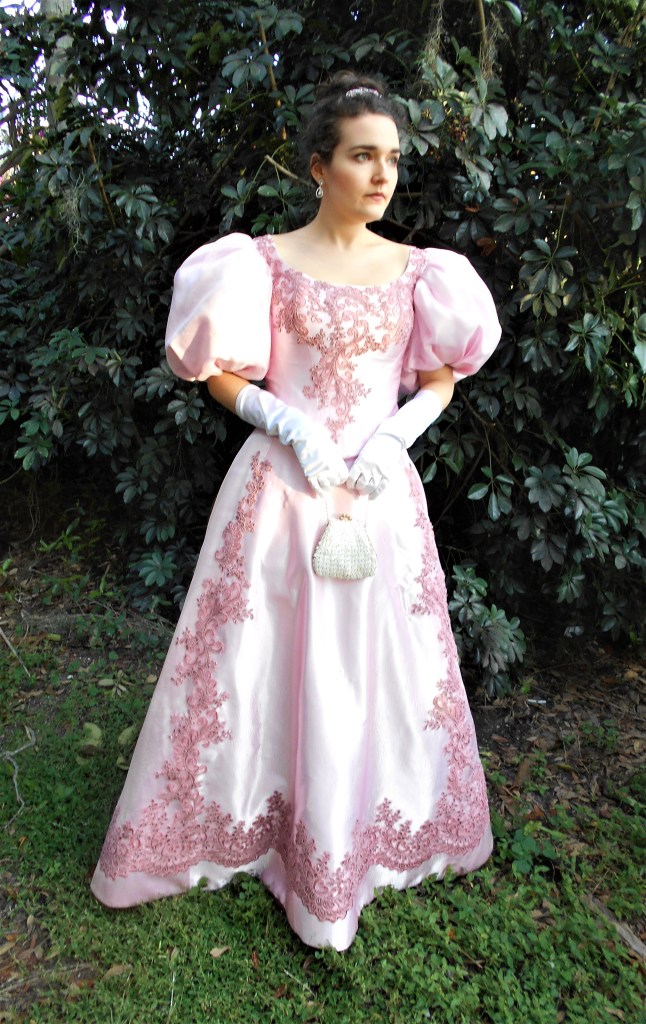
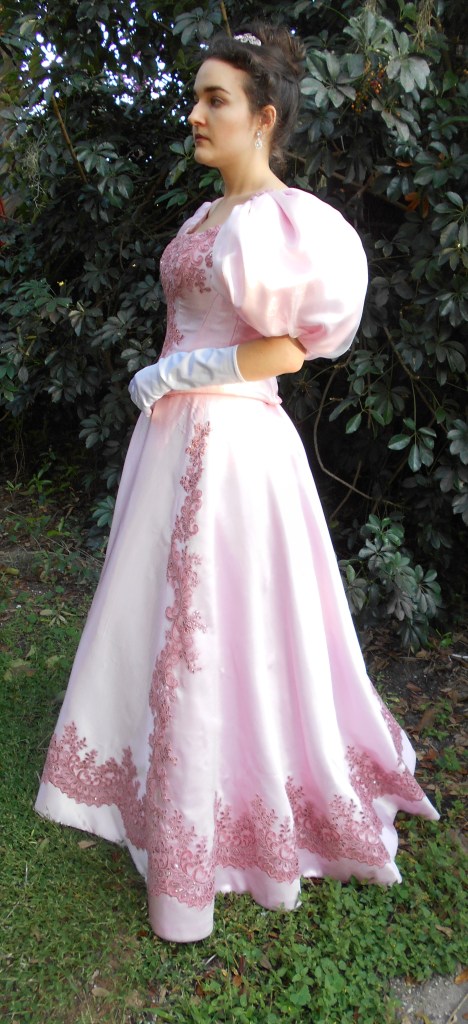
C’est très chic, n’est-ce pas ?

With the final touch of the butterfly clip ─ the source of my inspiration ─ perched atop my updo, I felt like I had stepped back in time to the grand days of Paris in the 1890’s. The dress gave me fits during construction, but not at the opera ! It was a dream to wear. Now, if only I had a Chevalier des Grieux on my arm and a fancy ball to attend…

Toi, Toi, Toi,

Mary Martha

Aida

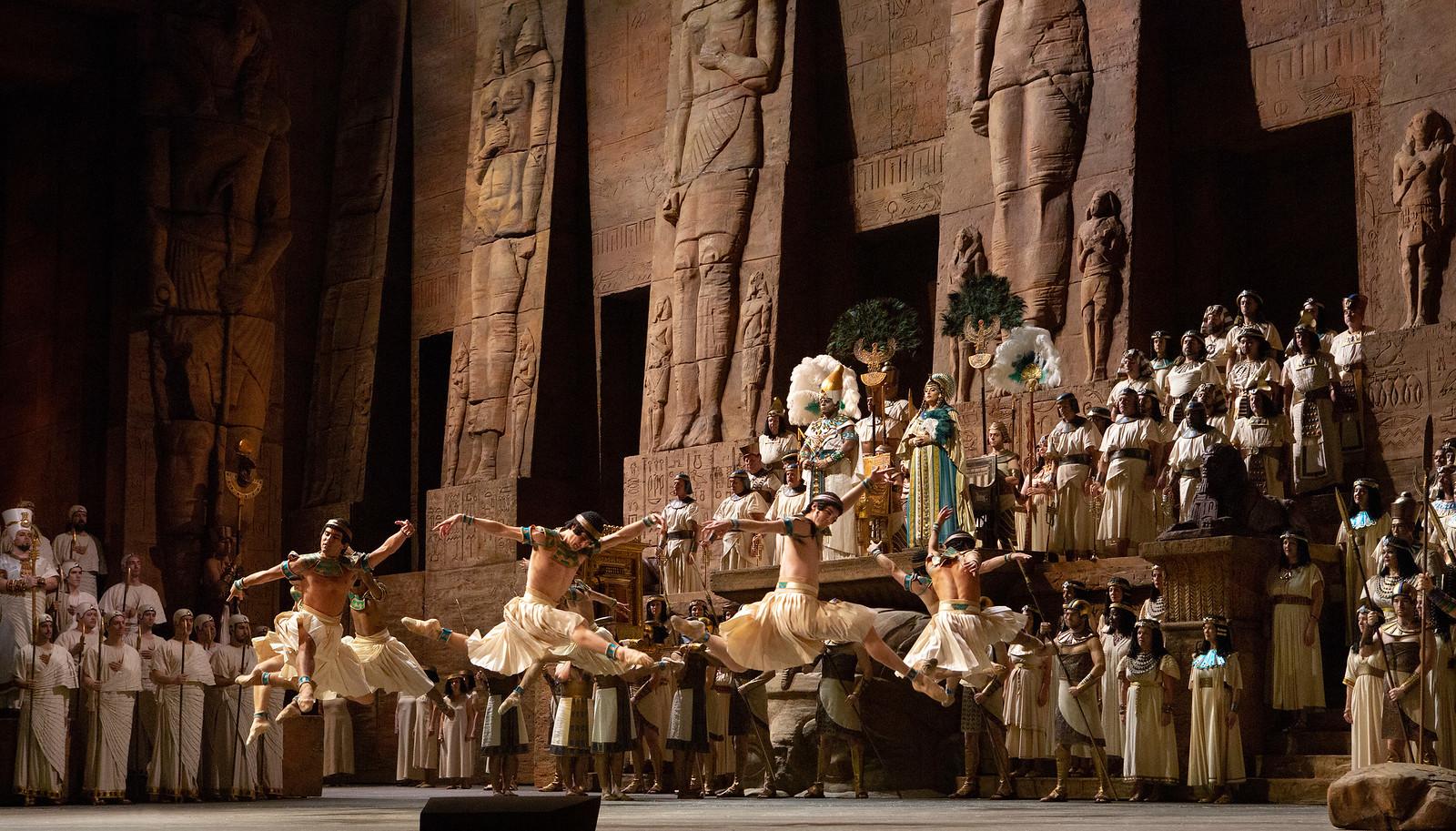
Aida is a grand opera. There are horses. There are ballet numbers. There are massive sets and ornate costumes. And what could be grander than having Anna Netrebko headline the Met’s 2018-2019 Live in HD season opener ?

A scene from Verdi’s Aida / Metropolitan Opera

I’ll be the first one to admit that Aida has never interested me. Whether it be the mercilessly hot desert locale of Egypt or the tension of two women fighting over one man (I infinitely prefer two disparate, but equally impassioned, suitors sparring over one fair maiden in my ideal operatic amorous affair), the opera has never been a very important “must see” for me except for its fame alone.

But this was Anna Netrebko’s Met role debut as Aida… how was I to miss that ????

Anna Netrebko as Aida / Metropolitan Opera

We all knew that Netrebko would be lauded as the star of this opera. More surprisingly, she had arguably one of the toughest battles of her career up against her mezzo-soprano rival, Anita Rachvelishvili’s fearsome Amneris. Hailing from Georgia (and I don’t mean the state), Rachvelishvili prowled the stage like a lioness eyeing her prey. Gripped and enraged, her stentorian voice roared during the showdown scene with Netrebko upon learning of her slave’s concealed love for the warrior, Radamès. I ate it up like a meaty dish of stew, salivating for more. It was the highlight of the opera for me.

Anna Netrebko as Aida and Anita Rachvelishvili as Amneris / Metropolitan Opera

The opera fizzled to a slow burn after the early fireworks between Netrebko and Rachvelishvili. Was my opinion changed after seeing Aida for myself ? Not particularly. Oh, well… There is a possibility of my future attendance, but only if Anna and Anita are cast in the starring roles ! Another toe-to-toe contest of prodigious prowess would be worth the sullen bore of the plot.

Anna Netrebko and Anita Rachvelishvili in Aida / Metropolitan Opera

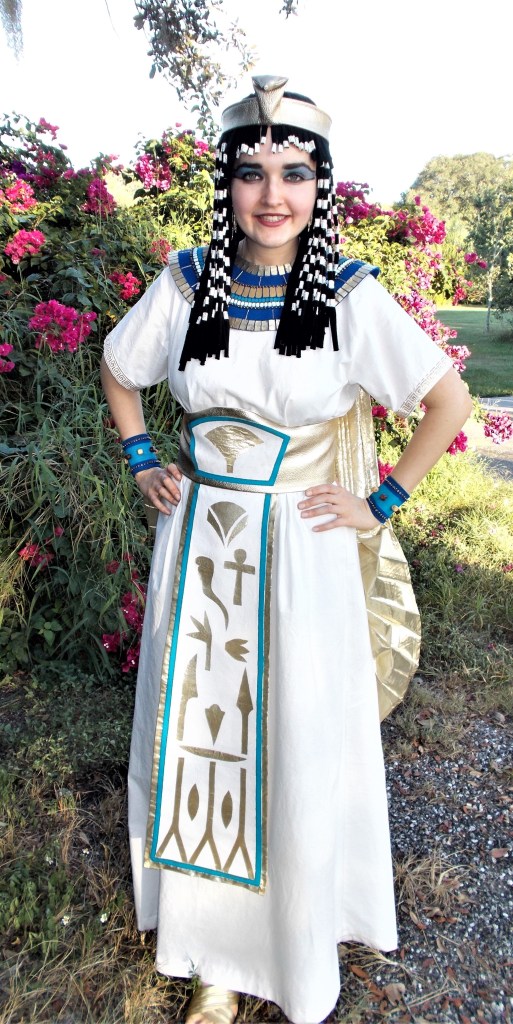
Due to a previous project which swallowed up my sewing schedule unexpectedly (ahem, Dalila), I had under a month to conceive, curate, and craft my costume for Aida. I doubt I’ll ever do that again. Since the Met’s production has been around for over 30 years, the pictorial research wasn’t difficult. While the obvious choice would have been to masquerade as the titular Ethiopian slave/princess, I was more drawn to her glitzy Egyptian rival, Amneris, and began my work on mimicking the character’s garb, almost as if I was to be her doppelgänger.

Anita Rachvelishvili as Amneris in Aida / Metropolitan Opera

The outfit came together in the nick of time and was a fun way to immerse myself in the ancient Egyptian culture. Though I based my costume off of pictures from the opera, I still engaged in my usual research for historically-based operas.

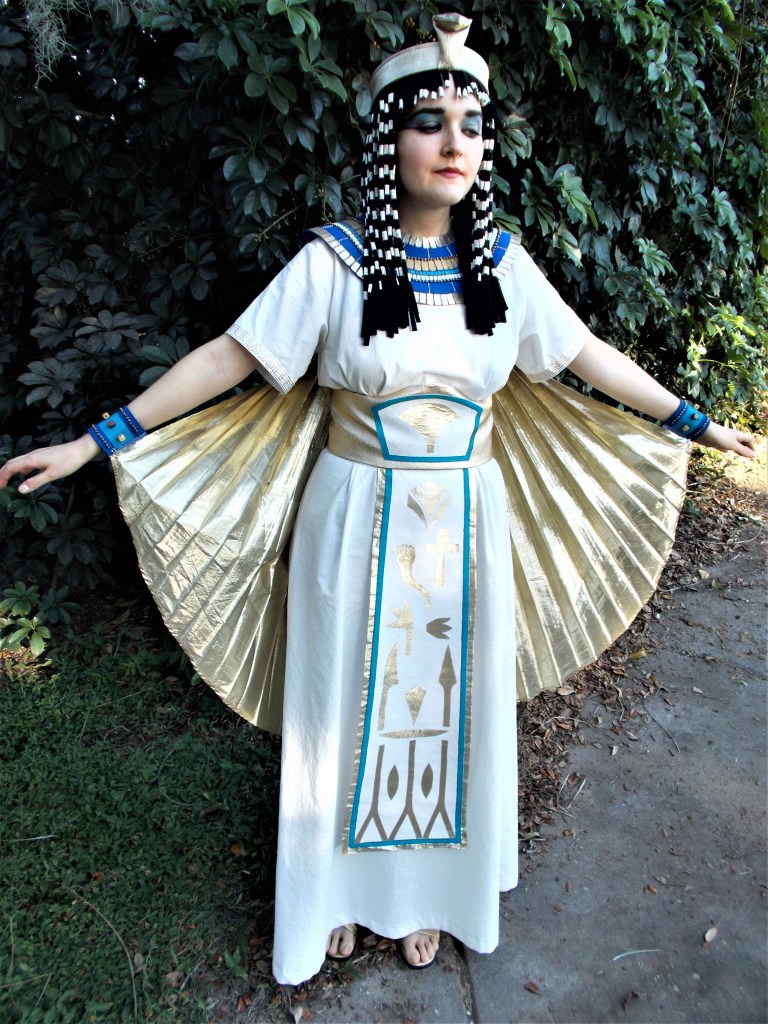
The lamé cape was my favorite part… as well as the patrons of the theater ! I was repeatedly asked to spread its golden folds to reveal its full glamour.

Later in the month, I wore this same costume for Halloween as it was perfectly acceptable for Cleopatra. While the flocks and droves easily recognized me as the most famous Queen of the Nile, I wonder how many of them knew of the other great Egyptian Royal… the one in Verdi’s grand opera… Amneris !

Toi, Toi, Toi,

Mary Martha
Curious about how I crafted my Egyptian ensemble in such a hasty dash ? Read my tutorial post detailing the creation of my lookalike costume ! https://costumeclosetcouture.com/2020/06/16/amneris-%e2%94%80-from-broadcloth-to-egyptian-glamour-in-under-a-month/

Cast and Credits:

Aida ─ Giuseppe Verdi (1871)
Live in HD air date: October 6, 2018

Cast:
Aida ─ Anna Netrebko
Amneris ─ Anita Rachvelishvili
Radamès ─ Aleksandrs Antonenko
Amonasro ─ Quinn Kelsey
Ramfis ─ Dmitry Belosselskiy
The King ─ Ryan Speedo Green

Credits:
Conductor ─ Nicola Luisotti
Production ─ Sonja Frisell
Set Designer ─ Gianni Quaranta
Costume Designer ─ Dada Saligeri
Lighting Designer ─ Gil Wechsler
Choreographer ─ Alexei Ratmansky
Live in HD Director ─ Gary Halvorson
Host ─ Isabel Leonard

Les Pêcheurs de Perles

Set in a modern day Ceylon, the Met’s new revival of Bizet’s Les Pêcheurs de Perles was a delightfully exotic romance of uncharacteristic story standards. Penny Woolcock’s production perfectly mingled the secular with the sacred, the grime with the gilt, and enchanted me from start to finish.
The shanty fishing village with its rickety cardboard and tin hovels added a realistic element to the production as did the mix of costumes on the chorus members: while some were dressed in filthy baseball caps and torn overshirts, others bedecked themselves in saris and turbans, just as Southeast Asian tradition dictates.

A scene from Bizet’s Les Pêcheurs de Perles / Metropolitan Opera

This opera was a beautiful escape from start to finish. The music perfumed the theater and left a trailing scent as the curtain descended. I especially loved the enchanting tenor/baritone duet, “Au fond du temple saint”.

Matthew Polenzani and Mariusz Kwiecien sing an excerpt from “Au fond du temple saint” / Metropolitan Opera

While the romance of The Pearl Fishers may have started as a typical opera love triangle, the ending was anything but conventional: the man who kept his promise and was faithful to his honor lost everything and the traitorous one, escaping death with the defiled priestess, made out like a bandit. All elements combined, I loved this opera so much that I went to see the encore showing the following Wednesday.

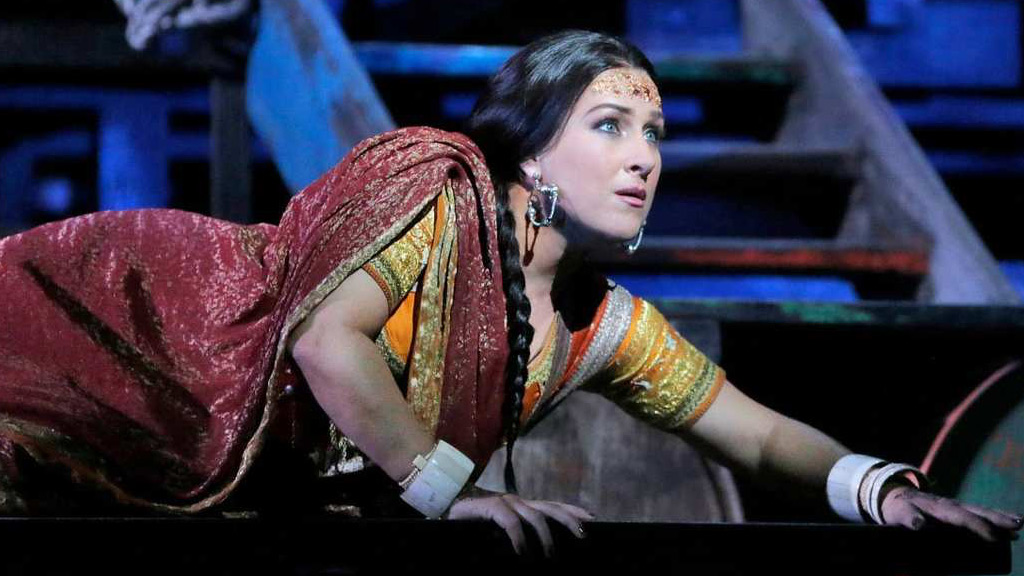
Diana Damrau as Leïla in Les Pêcheurs de Perles / Metropolitan Opera

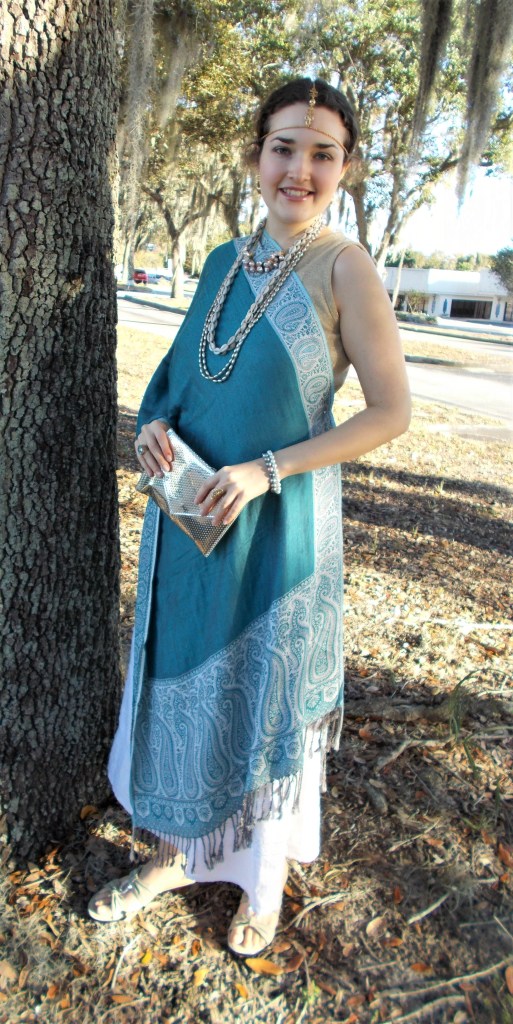
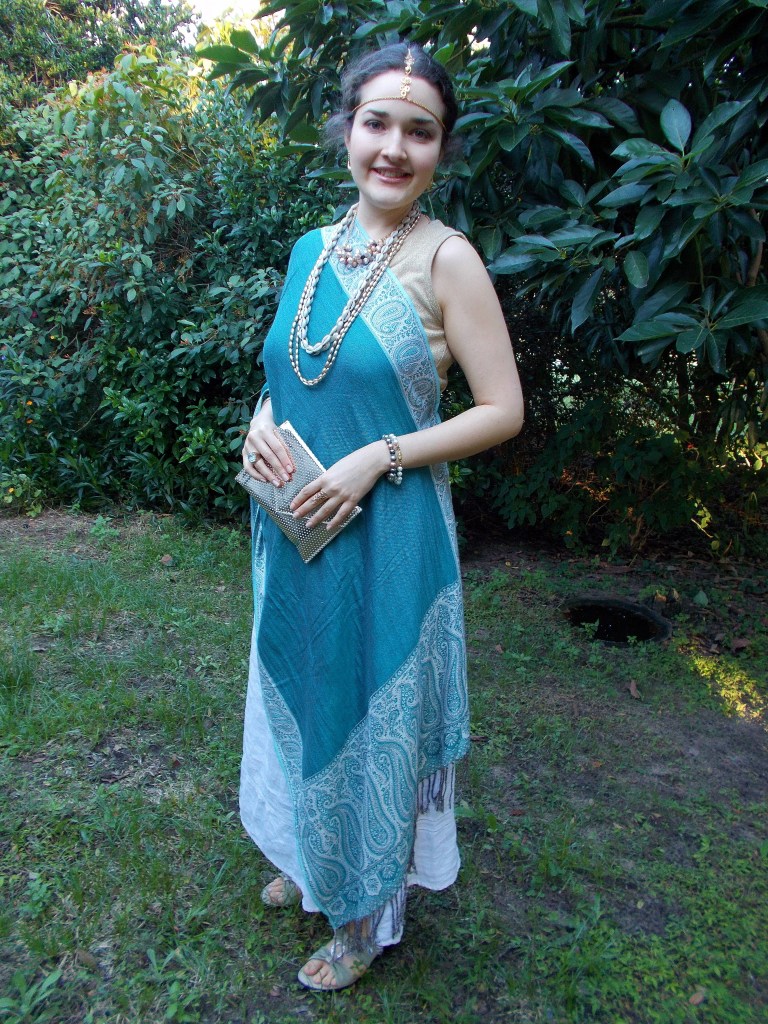
My outfit is one crafted from my closet. Modeling in front of my bedroom mirror, I experimented with different scarves and skirts to come up with an Indian subcontinent look.
Layer upon layer the outfit built itself into a makeshift “sari” that was instantly recognizable by its onlookers. (Weeks after The Pearl Fishers encore, I once again stepped into the far off theater location for the encore showing of Turandot. There I was greeted with inquisitive queries from strangers of vague familiarity: “Were you the one dressed as the Indian the last time ?”)

Of course, I knew I needed to accessorize with gobs of pearls in every shape and size, but also rings of topaz and bangles of gold. The crowning touch was my matha patti headpiece, which was reworked from a cheap, broken necklace.

I think my favorite aspects of this outfit are the ones that came from far away lands ─ the teal and aqua fringed pashmina wrap was bartered at a local market in Afghanistan while the cowrie shell necklace traveled from Tanzania (thank you, Uncle Kim, for the precious gifts !). Just think ─ the shells around my neck came from the Indian Ocean, just like the pearls in the opera !

Toi, Toi, Toi,

Mary Martha
Cast and Credits:

Les Pêcheurs de Perles ─ Georges Bizet (1863)
Live in HD air date: January 16, 2016

Cast:
Leïla ─ Diana Damrau
Nadir ─ Matthew Polenzani
Zurga ─ Mariusz Kwiecien
Nourabad ─ Nicolas Testé

Credits:
Conductor ─ Gianandrea Noseda
Production ─ Penny Woolcock
Set Designer ─ David Bird
Costume Designer ─ Kevin Pollard
Lighting Designer ─ Jen Schriever
Projection Design ─ Fifty Nine Productions
Live in HD Director ─ Matthew Diamond
Host ─ Patricia Racette

Manon

The score of Manon is a sensual pleasure for the ears… It’s a pity that I wasn’t more enthused about opera from the get-go ! But after my repelling experience with Puccini’s Manon Lescaut in 2016, I was tepid to take on the French version of the same tale. However, I sought to give the Massenet piece a fair shake ─ and it’s a good thing I did !

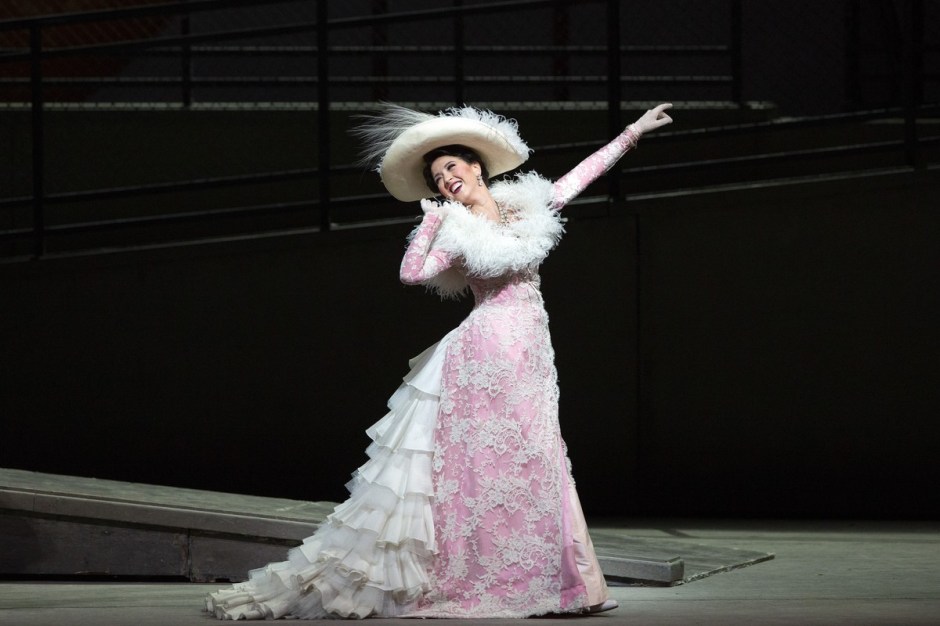
Lisette Oropesa as Manon / Metropolitan Opera

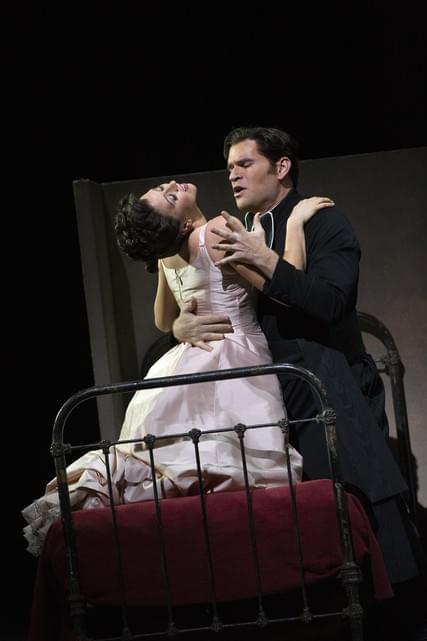
With charms tantamount to a Cartier necklace, Lisette Oropesa and Michael Fabiano lit up the stage with their untamable chemistry. It flowed and never ebbed, even in spite Manon’s tastes for frivolous Parisian luxuries. I confess that the blush on my cheeks turned redder than beets during the smouldering peak of Manon and des Grieux’s passion… atop a battered bed in the open sanctuary of a church. Awkward.

Lisette Oropesa as Manon and Michael Fabiano as des Grieux / Metropolitan Opera

While the screen was seared by the heat of the lovers, I had my eye on the historical aspects of the opera, namely, the costumes.

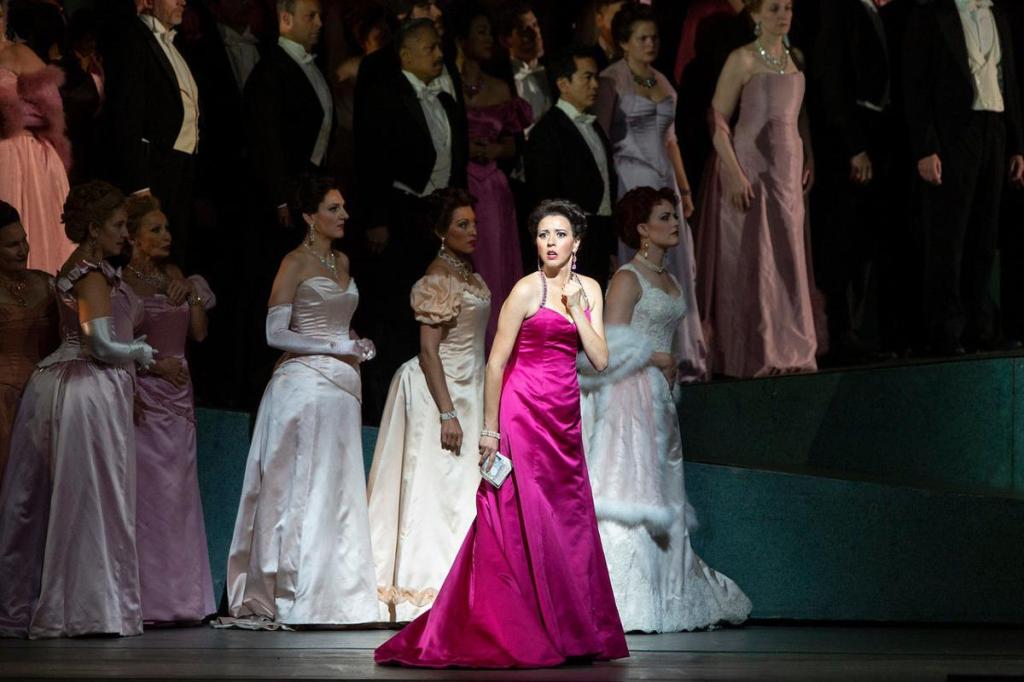
Although Manon is originally set in the Parisian courts of the 18th century, the Met’s current Laurent Pelly production has switched the setting to the late 19th century, or “La Belle Époque” as it is called among fashion historians. While rich with possibilities for sumptuous gowns, the costumes for this particular production looked a tad… “polyester”… and were all over the place in terms of isolating a specific decade: I noticed armored cuirasse bodices and fluffy bustles ─ indicative of the 1880’s ─ to gored skirts and enormous feathered hats, synonymous to the early Edwardian period of the 1900’s. There were even contemporary gowns of no historical basis. The myriad of differing modes of dress spanning 30+ years made for a lack of continuity as well as identity in the production. Was it traditional ? Was it modern ? The answer remained obscure.

Lisette Oropesa in Manon / Metropolitan Opera

Knowing that Laurent Pelly productions are filled with whimsy and topsy-turvy lineages, I didn’t aim to directly copy any one single costume from the opera since I knew, in taking that tack, the possibilities for future wear would be slim to none.
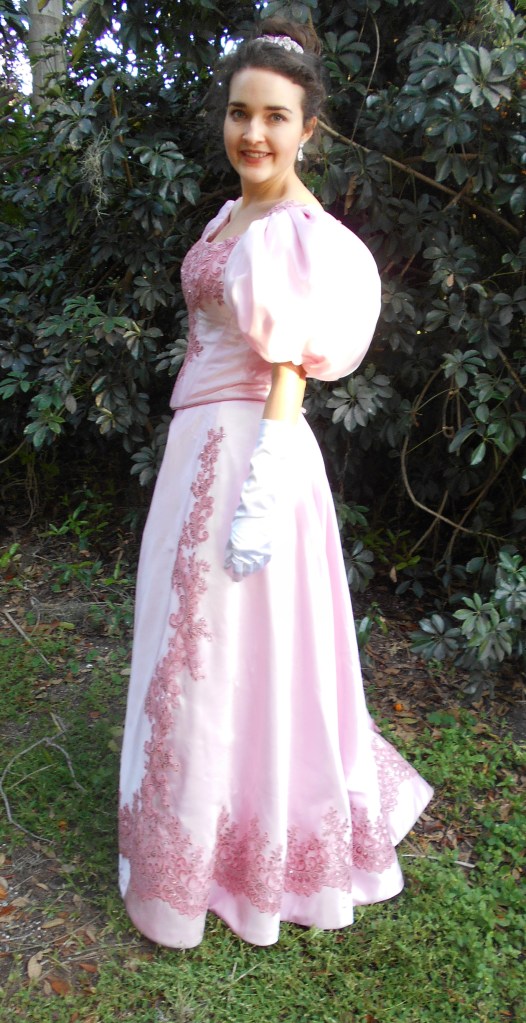
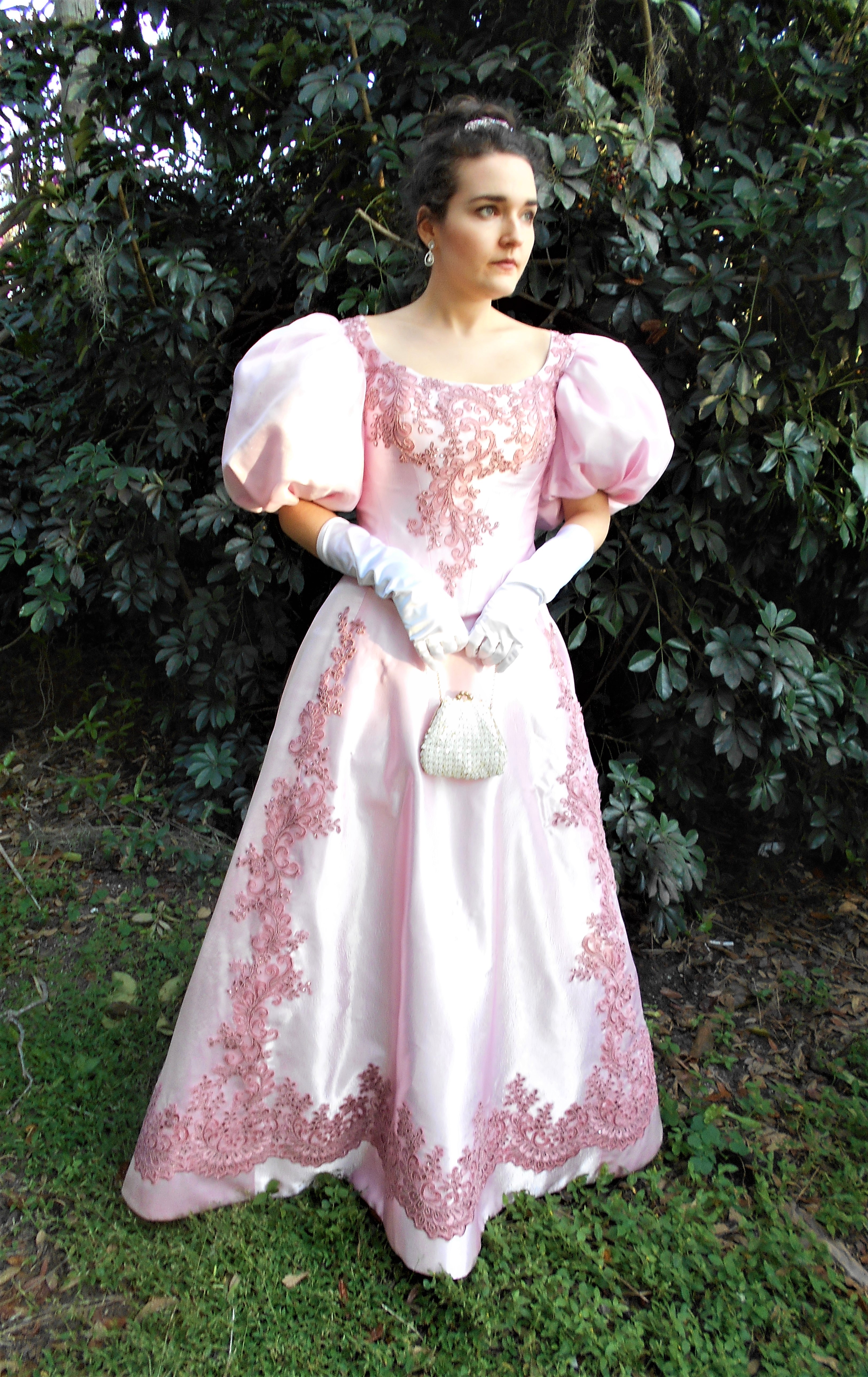
Coming to the decision was tough, but I eventually opted to create an 1890’s ball gown inspired by the mauve, pink, and silver butterfly clip perched in my hair.

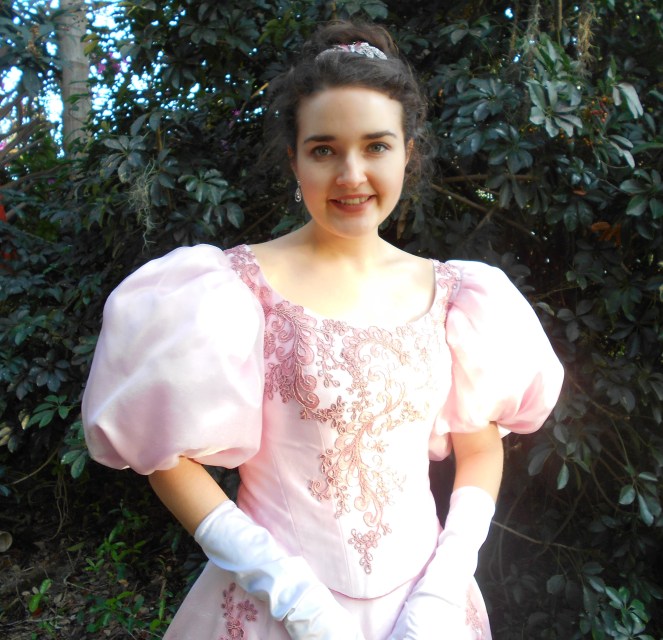
The puff sleeves were enormous and reminded me of spun cotton candy…

With lace hand sewn onto the bodice and front gores of the skirt, this costume had couture qualities about it.

Paris, here I come ! I remember walking (or waltzing ?) into the theater that sunny late October afternoon and observing the gentleman ticket taker rendered speechless as he approached the podium. While approbation is never my motivation, it’s always a pleasure to receive remarks about the enjoyment elicited in others and their gratitude for what the craft adds to the Live in HD simulcasts.

Toi, Toi, Toi,

Mary Martha

For more information on how I created my “pretty in pink” 1890’s ball gown from start to finish, check out my tutorial post: https://costumeclosetcouture.com/2020/04/21/the-making-of-manon-the-1890s-ball-gown/

Cast and Credits:

Manon ─ Jules Massenet (1884)
Live in HD air date: October 26, 2019

Cast:
Manon ─ Lisette Oropesa
Chevalier des Grieux ─ Michael Fabiano
Guillot de Morfontaine ─ Carlo Bosi
Lescaut ─ Arthur Ruciński
de Brétigny ─ Brett Polegato
Comte des Grieux ─ Kwangchul Youn

Credits:
Conductor ─ Maurizio Benini
Production ─ Laurent Pelly
Set Designer ─ Chantal Thomas
Costume Designer ─ Laurent Pelly
Lighting Designer ─ Joël Adam
Choreographer ─ Lionel Hoche
Associate Director ─ Christian Räth
Live in HD Director ─ Gary Halvorson
Host ─ Nadine Sierra