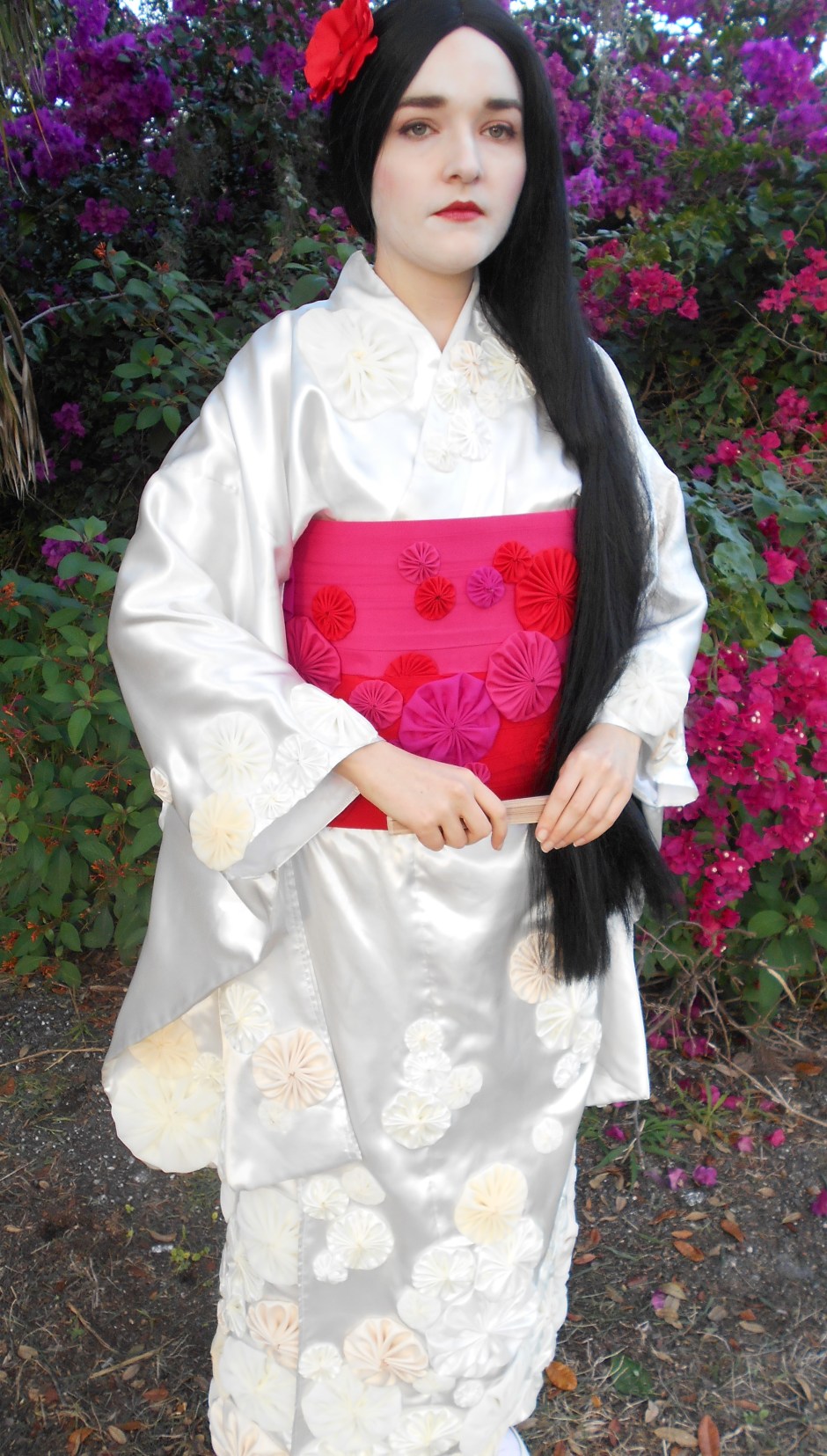
Becoming Butterfly: the white satin yo-yo kimono

Madame Butterfly represents a “full-circle moment” for me: it was in 2016 that I taught myself to sew when I didn’t have anything in my closets to wear to the movie theater performance of the opera. Seeking anything that gave the impression of an Asian aesthetic, I wound up sewing a cotton yukata, which was the genesis of my sewing passion. New doors had been flung wide open !
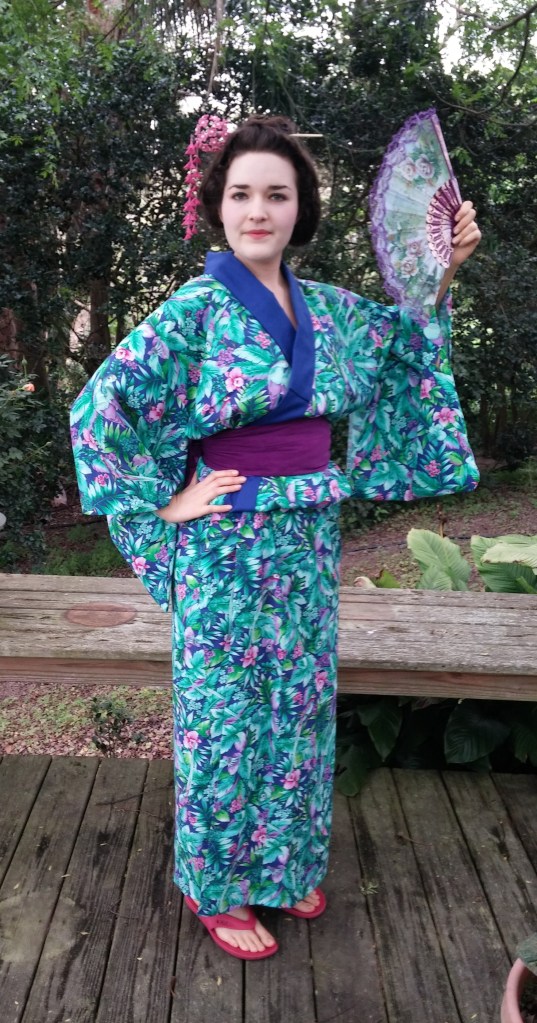
Madama Butterfly (2016)

But it wasn’t a cakewalk. Despite the rather traditional manner in which the yukata was fashioned (save the contrasting collar ─ I ran out of tropical fabric !), my interior seams were horrendous ! Because of my previous ignorance of how to properly work a sewing machine, the bobbin threads are bunched and looped into chaotic cocoons, a sign of incorrect tension in hindsight. Although I was ashamed of how slipshod the inside of the yukata turned out, the disappointment was replaced by triumph as I overheard the whispers of a little girl to her mother about the “kimono lady” that silently slipped by in the theater. Priceless !
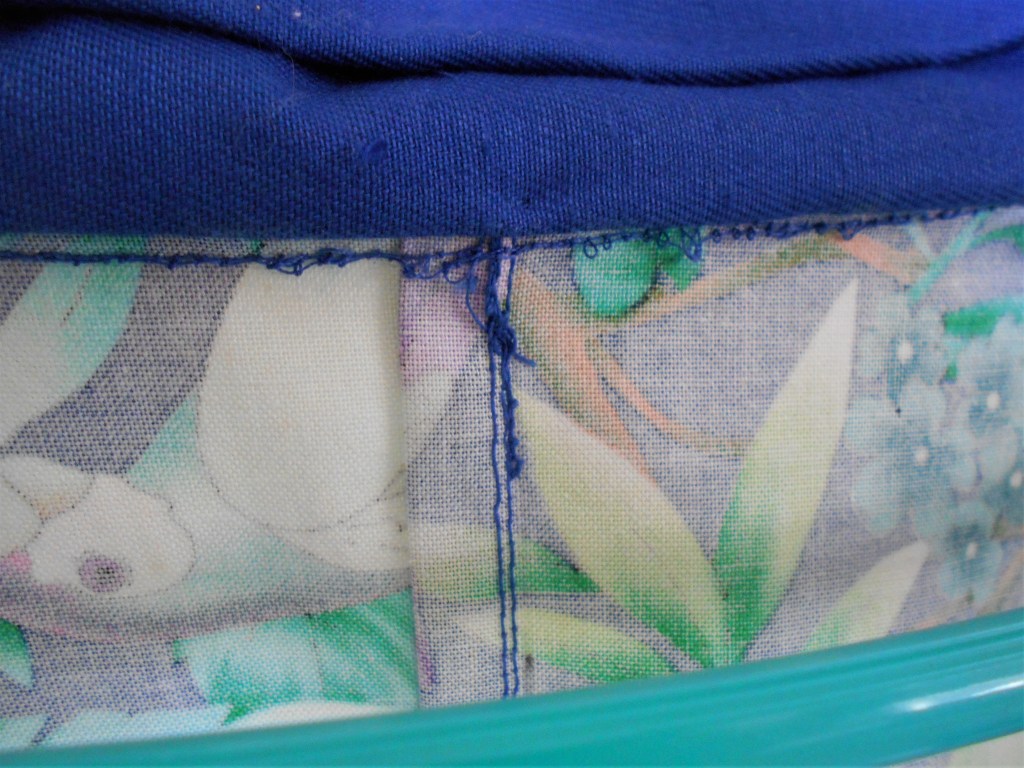
The novice’s stitches

Over three years later, Puccini’s immortal opera returned to the Live in HD schedule for the 2019-2020 season. I knew I had to go. However, since my sewing skills had improved exponentially, I wanted to create something that was more suited to the Anthony Minghella production’s styling of Cio-Cio-San. A wedding gown was in the works…
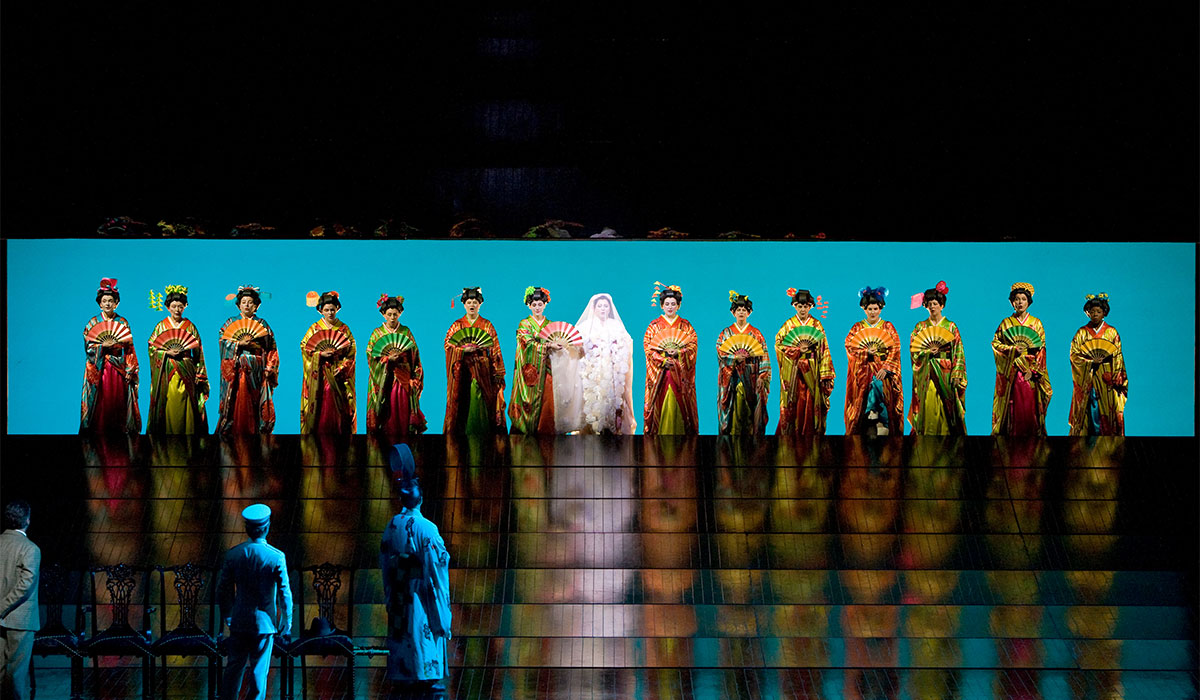
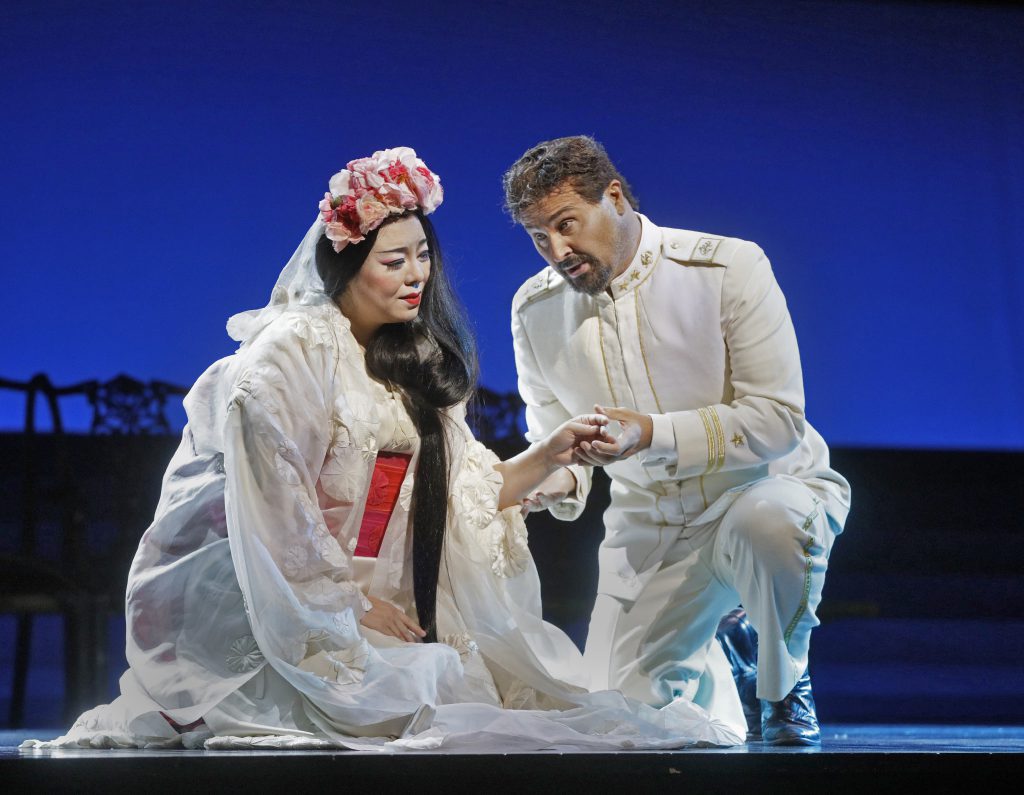
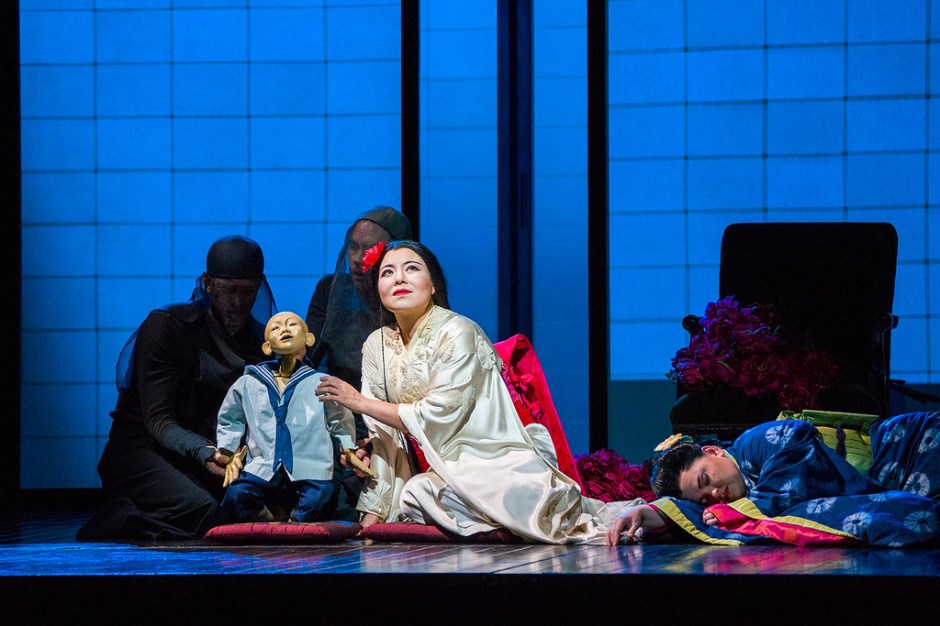
A scene from Anthony Minghella’s production of Madama Butterfly / Metropolitan Opera

More specifically, a wedding kimono. Like a specter rising from the grave, the gossamer veils that clothe Cio-Cio-San in a milky moonglow is breathtaking. Without fail, I’m enchanted by the first appearance of the geisha climbing up the stairs with her wedding party. With the decision easily made, it was time for the research…

And there was plenty of it !

The aforementioned Minghella production has been a crowd-pleasing staple at the Met since 2006 with a plethora of sopranos playing the title role, from Patricia Racette to Kristine Opolais (who sung the part in 2016), to Hui He, singing in the 2019 Live in HD performance. A simple image search provided up close detailing of the white satin kimono and its sash.

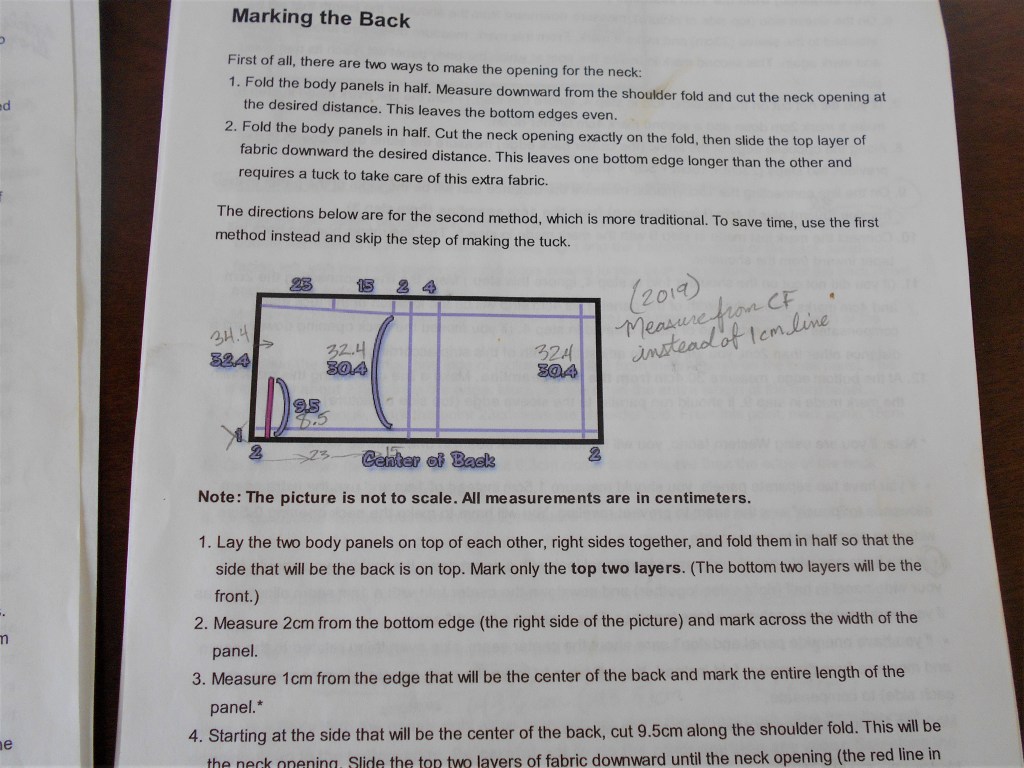
With the success of my tropical print yukata, I didn’t see any reason why I shouldn’t use the same pattern instructions, which worked so well in 2016. Look no further than this helpful site: http://www-personal.umich.edu/~weyrbrat/Japan/yukata/ I have all the pages printed out and stored in a zip top bag for future uses. The instructions are vivid, realistic, and accurate and equip sewers to create their own authentic yukata (or kimono) from scratch. Since I wasn’t aiming to create a historically/culturally accurate garment, I made my own adjustments to the notes and measurements that I wrote down in 2016.
If there was one thing I learned during my time as a Valkyrie, it’s that polyester linings can act as saunas to my skin. Nobody wants sweat rolling down their back and besides, the silvery white charmeuse satin I bought was just a bit too see-through for my liking. It needed a lining ─ and a cotton one at that ! Cotton voile was the perfect choice.
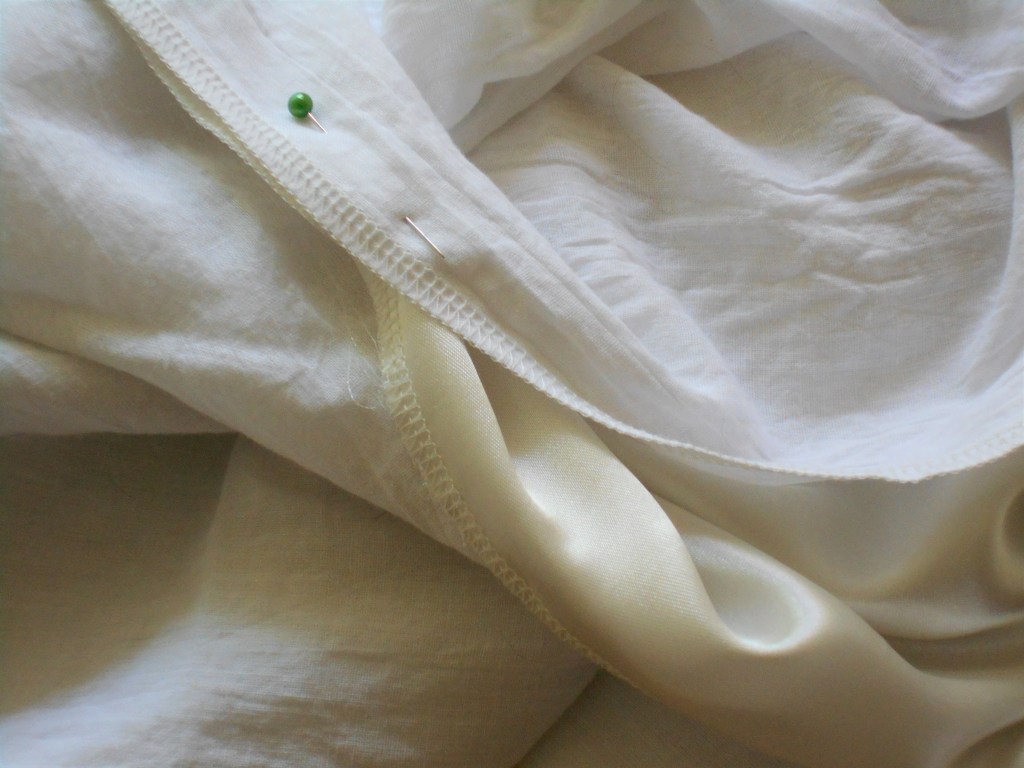
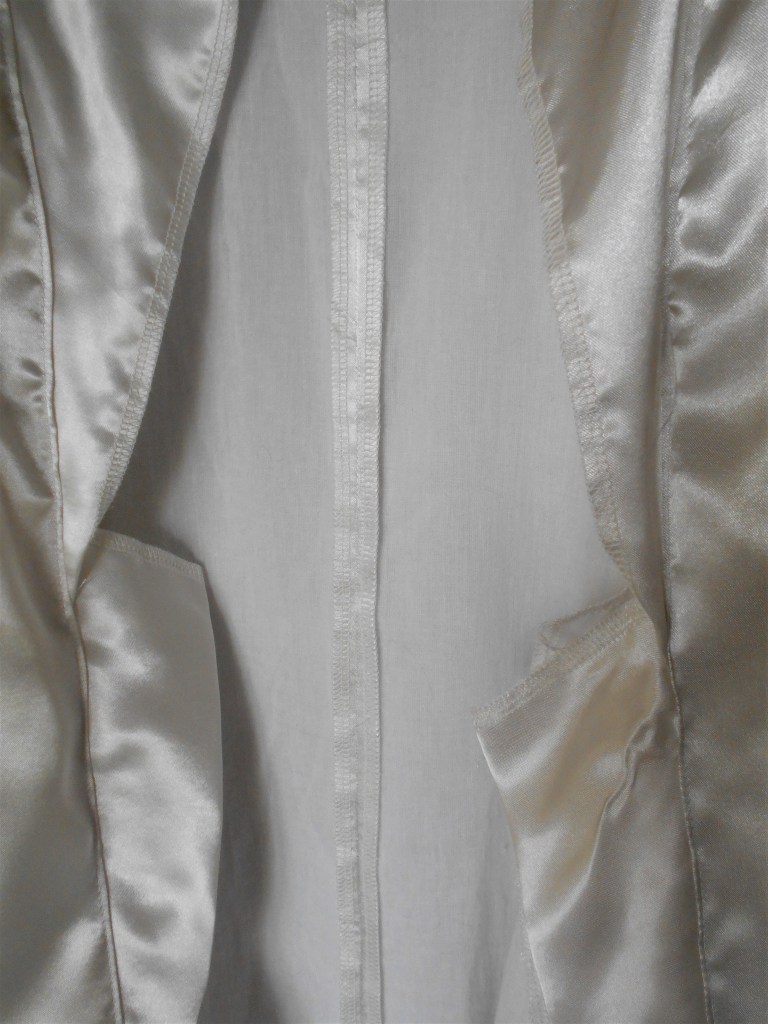
Cotton voile lining and charmeuse satin serged together
The inside of the kimono ─ much cleaner seams than last time !

The construction of the kimono was easy enough, following the instructions as before, and now it was time to focus on the more thought-provoking elements of the costume… the sash and decorations !

The Belt

Theater costumes fascinate me. Not only are they beautiful to look upon, but they also possess the most ingenious tricks for rapid removal without compromising the overall style. Surely, there must be staunchly guarded secrets on how best to employ the illusion.
Instead of cutting a 30′ long strip of fabric and folding it over and over again, I imagined the belt being like a corset with the folded “knot” at the back being analogous to a modesty panel. And so I cut two wide rectangles and fused the the face layer with strips of double sided interfacing since there would be gathered drapes applied to the front.
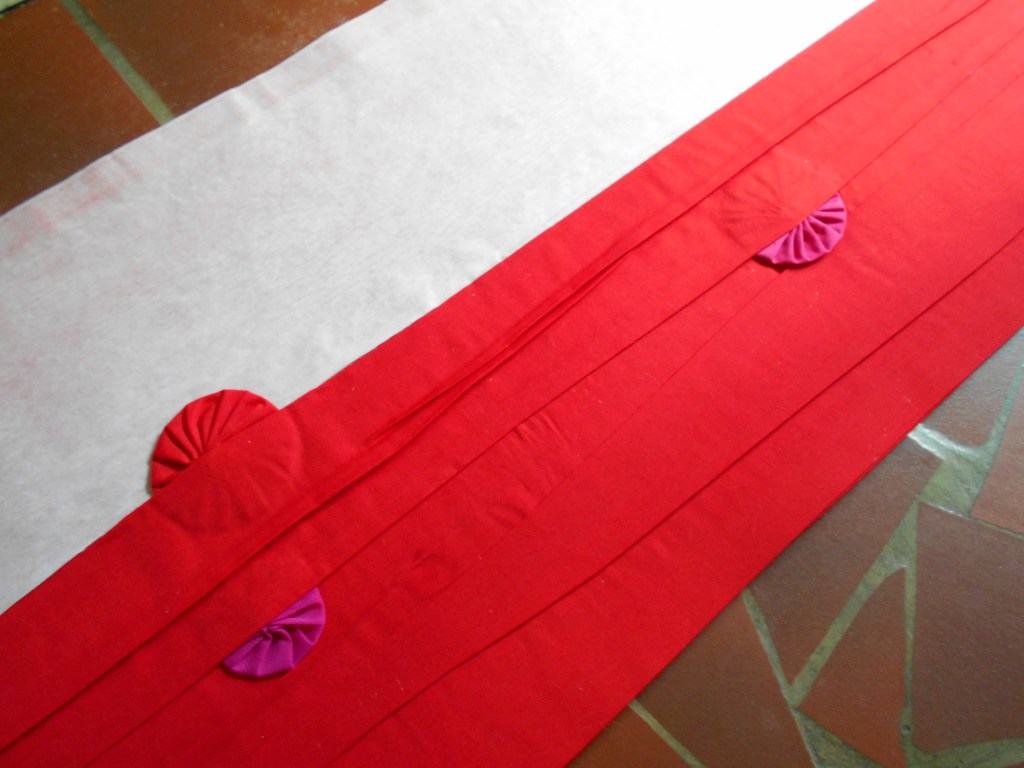
The lower half of the front of the belt ironed in place while the top half remains unfinished

Have you ever wondered how random drapes are made ? It’s simple and a lot of fun ! Cut a strip of fabric that is at least twice the height of the area that needs to be draped. For example, each horizontal half of my belt measured about 15 cm (for a total width of ~30 cm, top to bottom) so I cut pieces of fabric that were over 30 cm each and stretched the swath side to side, placing pins where the folds and creases looked appealing to me.
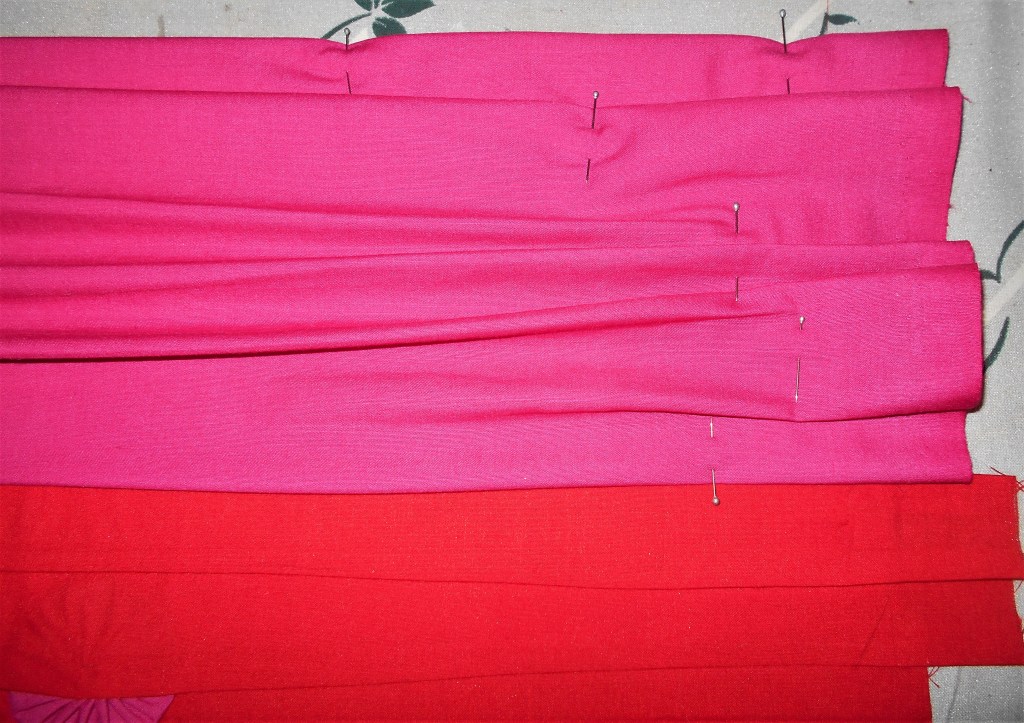
Once satisfied, it was time to steam press the folds that were pinned to the fusible web and then, voilà ! Secured drapes ! “Ah, but what are those round starburst “gears” peeking out from beneath the folds ?” you question. Those are called yo-yos, commonly made by quilters and used for handicrafts and decorations.
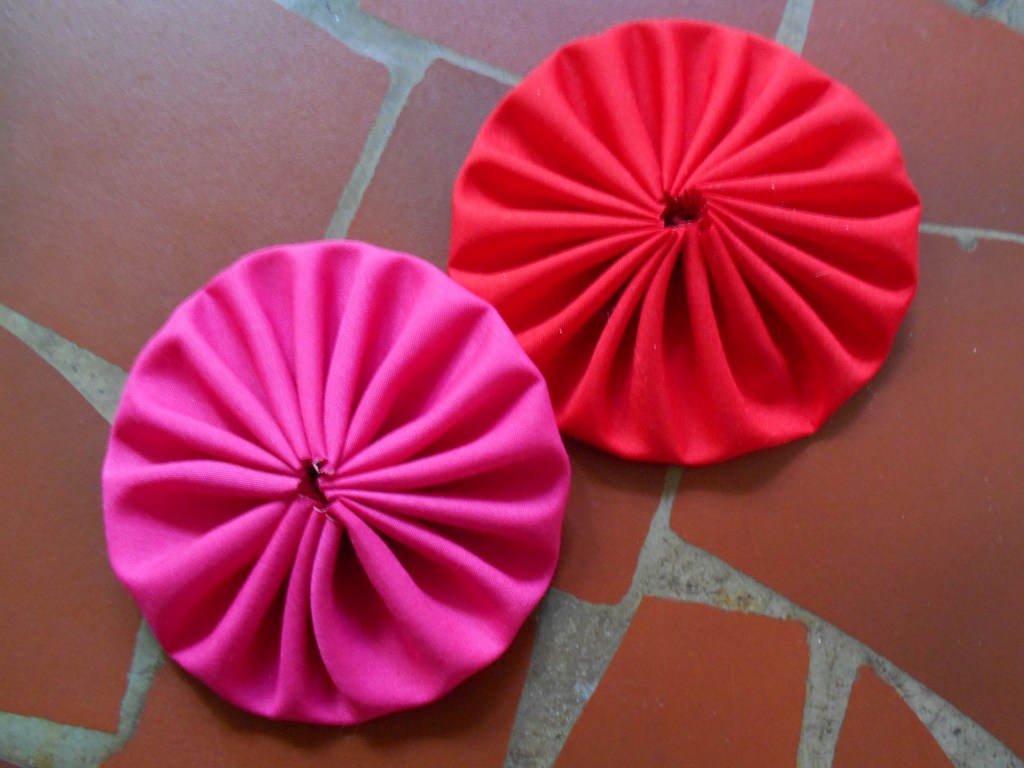
While they may not be the exact folded form of origami used on costume designer Han Feng’s stunning wedding kimono, I thought the shapes looked very similar to the humble yo-yo and therefore, I began the long and fiddly process of hot knife cutting and hand sewing the yo-yos into their recognized shape. I made hundreds of them !

Pillowy chiffon, shiny satin, bright broadcloth ─ from tiny to giant ─ mingled in a colorful array worthy of the distinction of ‘art’ on their own.

But back to the belt…

With the front portion complete, the lined belt needed to be stuffed with a stiffener so that it wouldn’t crease when sitting. First trying a thick felt, the result was undesirable. What would be stiff, yet pliable…??? Aha ! I remembered the leftover strip of buckram from the ball gown skirt for Manon and raced to find it. It was perfect ! I love when I can reuse materials for different projects.
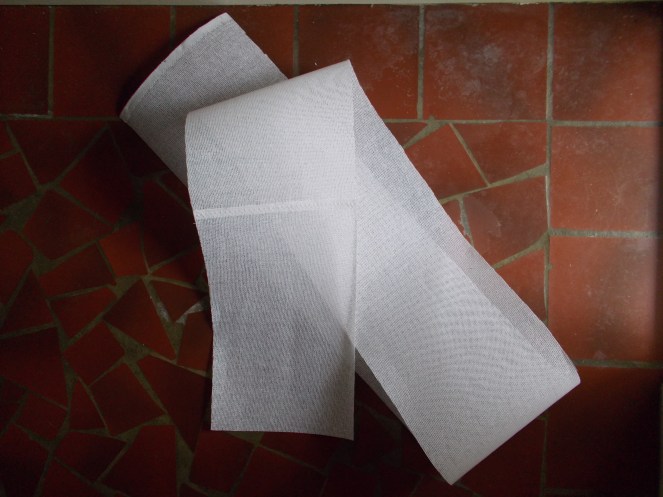
The leftover buckram from Manon

The thick piece of felt, however, was not without its own fulfillment─ I still needed something stiff for the inside of the faux knot/modesty panel and it was used for this purpose.
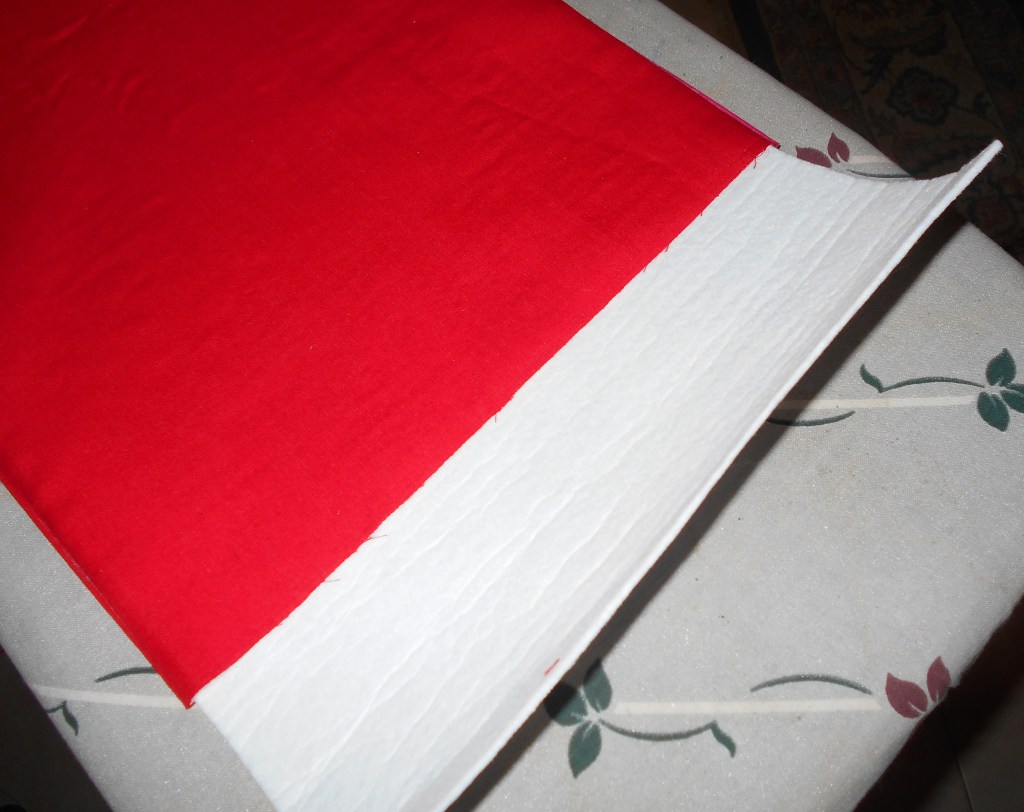
Sliding the stiff white felt into the long stretch of fabric for the back “knot”

Two additional panels were made as part of the belt’s meeting closure; their back edges were stitched with Rigilene boning…
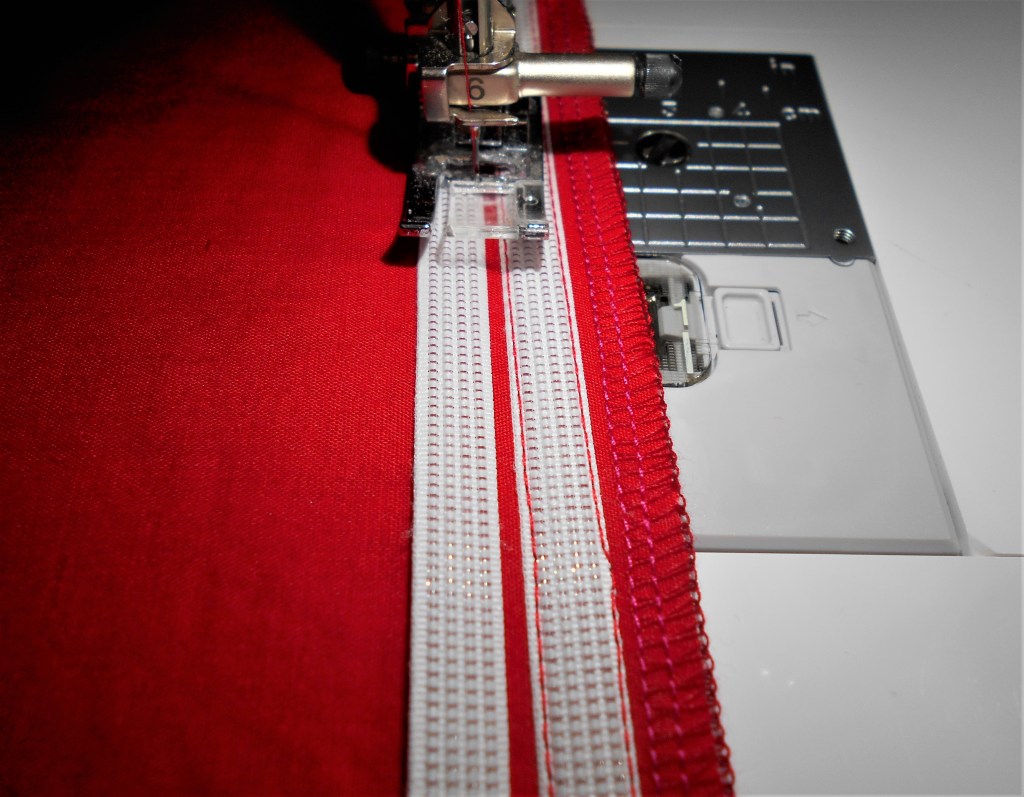
…then folded over and stitched in between the bones.
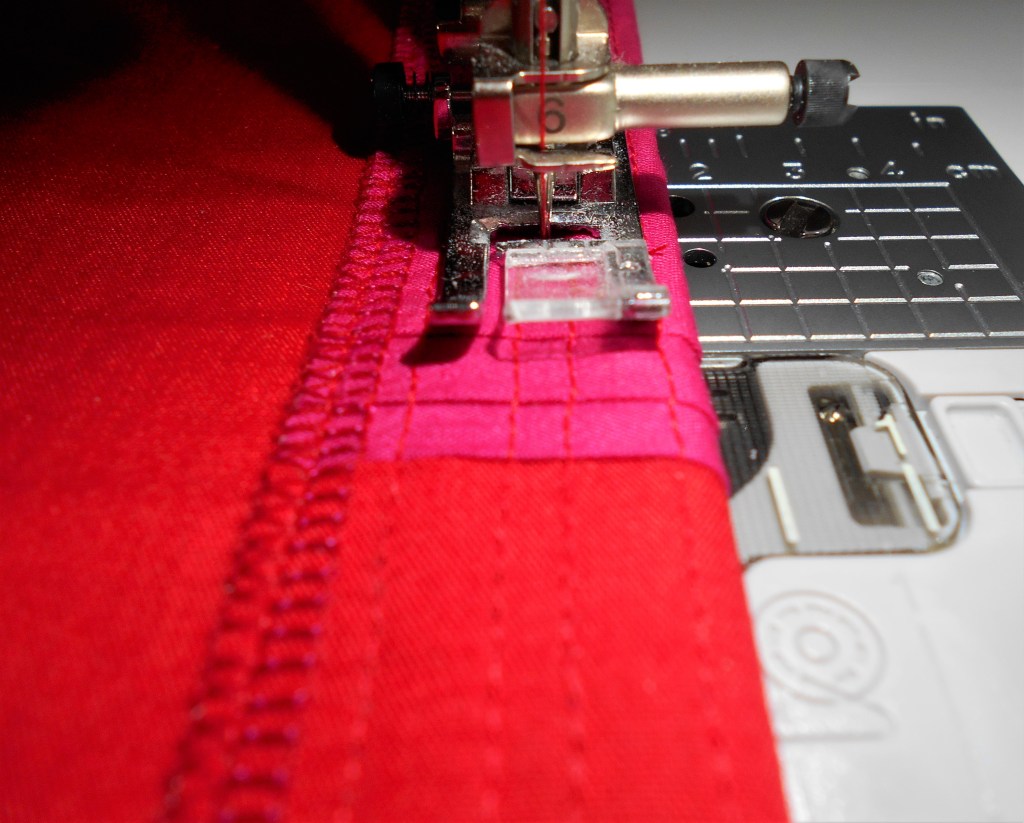
And here’s what the face side looked like afterwards:

Time to punch the grommets ! The belt was nearly complete !

Decoration

My deadline nearing, the wearisome work had begun. While I find it appalling to glue fabric onto clothes, Time sometimes forces me to bend on my tenets. There were many detailed photos on the web of Butterfly’s kimono and belt, but this picture was my guiding diagram when deciding how to arrange the yo-yos:

Maria Zichak as Suzuki and Ana María Martínez as Madame Butterfly / Metropolitan Opera

And so, I glued, and glued, and glued some more… I used two bottles of craft glue on those yo-yos and finally adhered the last one early Friday evening ─ the night before the opera ! Whew !
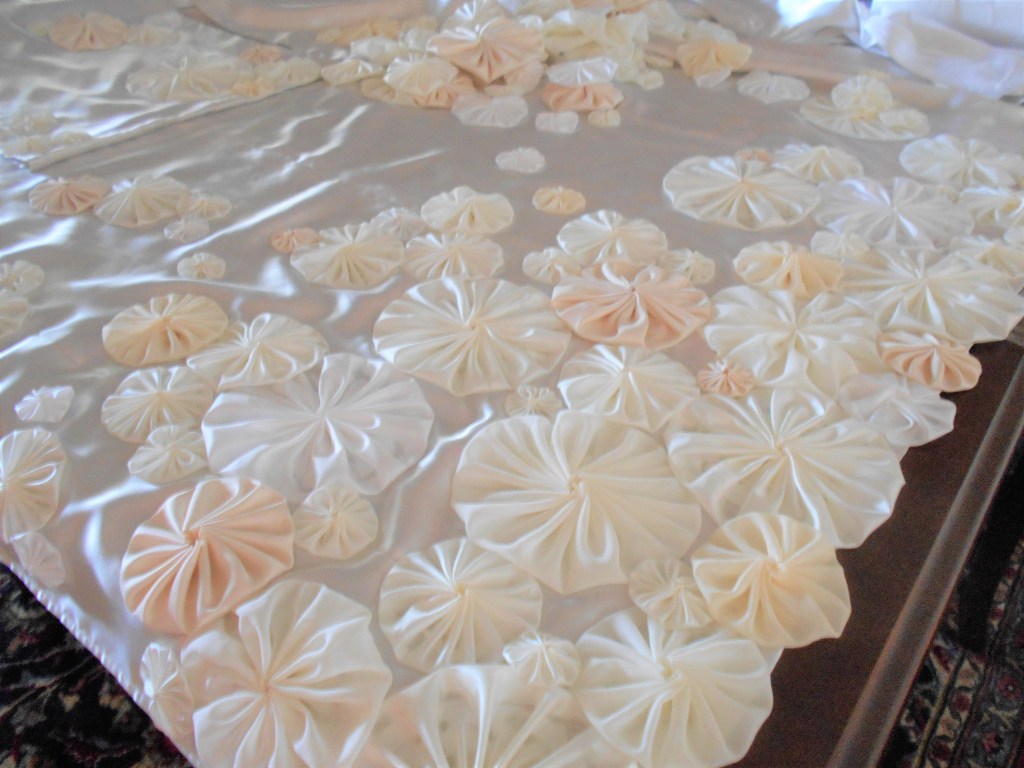
Progress made, but a mounded pile of yo-yos still to go…

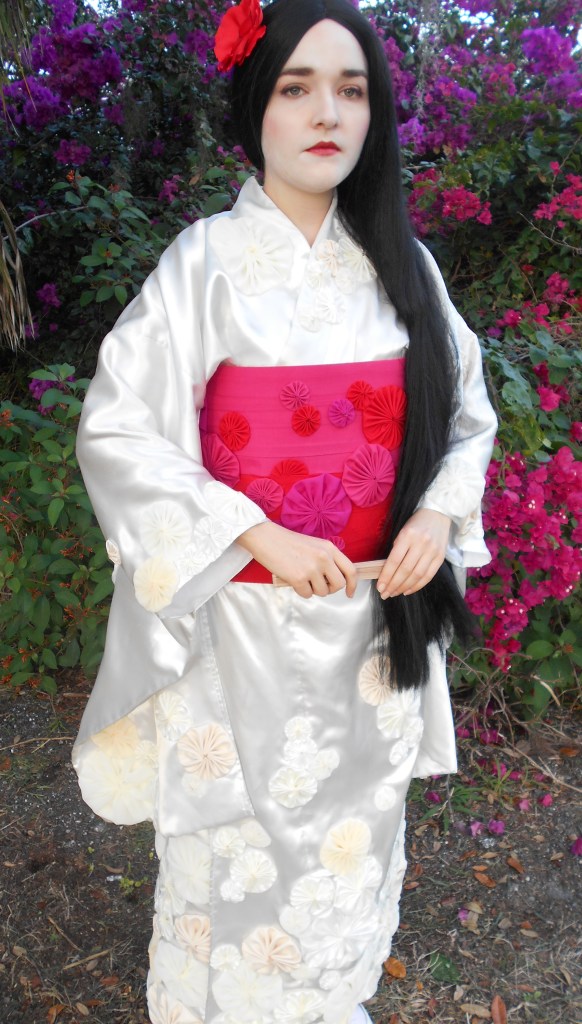
The glue dried with not a moment to spare and the following morning, I suited up in my silky kimono, applied a waxy whiteface, donned a long black wig, and clipped on a red poppy.

I just love that little wooden fan ! Its intricately cut panels remind me of ancient Far East traditionalism… Thank you, Aunt Countess !

The back of the belt held up well despite the futility of the sewn snaps I added onto the overhang. Never doubt the power of a few safety pins, my friends !

I bought the wig and the poppy clip from sellers on eBay and Etsy, respectively…

As much as I desired for the length of the sleeves to be much longer (and therefore, traditional, in that sense), there comes a point of practicality and whether or not I would be comfortable with the ends of my sleeves dragging in the dirt… grazing the dusty pavement of the parking lot… trailing along in the bathroom… NO !!!! Measurements are critical, and determining an appropriate length for the sleeves was no different.
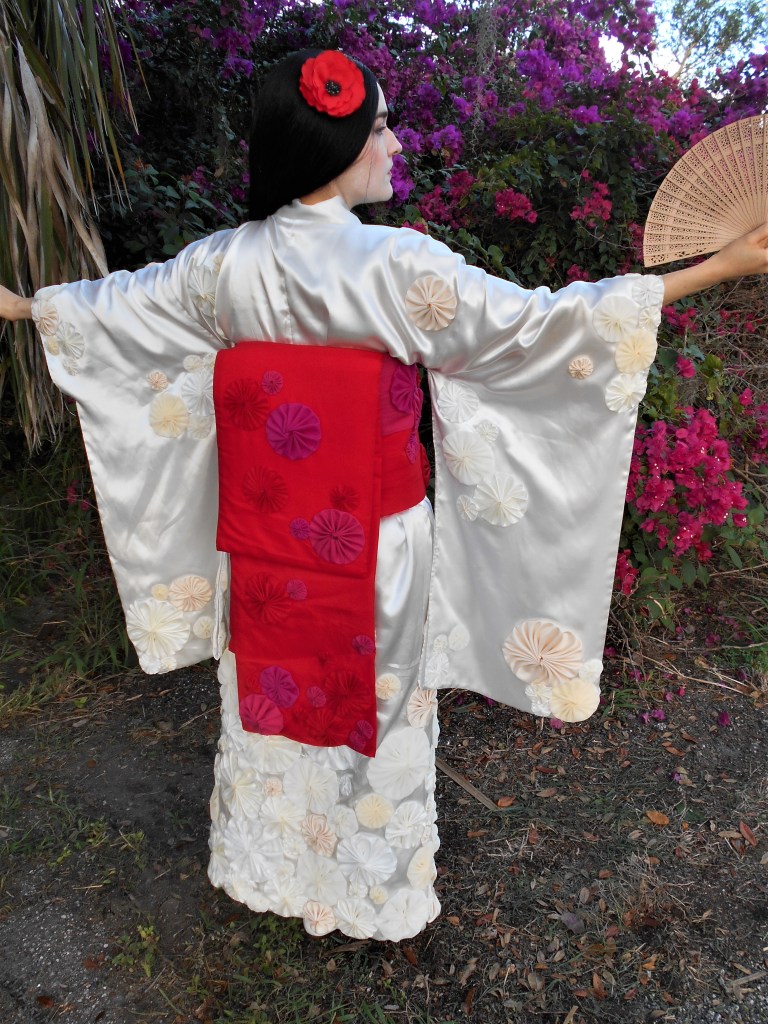
Spreading my “wings”

Who would have guessed that the simple yukata I endeavoured to sew with nothing but gumption and the will to succeed would have bloomed into a passion of sewing costumes for cinematic opera productions ? For all the memories I’ve accrued over the years, I have Madame Butterfly to thank.

Toi, Toi, Toi,

Mary Martha
Madama Butterfly (2019)

Arguably the most heartbreaking of all operas, Madama Butterfly fully represents one of the key reasons why I love opera so much: it unearths emotions in me that I rarely feel otherwise. One cannot help but be mortally affected by the tragedy of the teenaged geisha as she bestows complete faith in a foreigner she has never laid eyes upon to be her wedded husband. Characteristically of Puccini, the score sweeps with valor and brings forth some of opera’s most emblazoned moments, culminating in the painfully hopeful aria “Un bel dì”, which nearly brings tears to my eyes.

Hui He singing an excerpt from “Un bel dì” / Metropolitan Opera

Although I had seen this same Anthony Minghella production in 2016, I couldn’t resist going back a second time when it returned to theaters. In a dramatic twist, a relatively unknown tenor, Bruce Sledge, jumped into the leading role of Pinkerton with just 2 days notice and stunned ─ at least, vocally. His acting was heinous, but it was to be expected with hardly any rehearsal time. I would love to see him again when he has more time to prepare. His potential was tremendous !

Bruce Sledge as Lieutenant B.F. Pinkerton in Madama Butterfly / Metropolitan Opera

One of the fundamentals of the much-adored Minghella production is the use of traditional Japanese Bunraku puppets, most notably as Butterfly’s 3-year-old son. While it’s mesmerizing to watch three veiled men in the shadows maneuver the head, hands, and feet of the wooden child, I felt that some of the attention to detail in regards to the physicality of the puppet had diminished since seeing the 2016 performance: the child toddled not as often as before and relied more frequently on being held by his mother.

Hui He as Cio-Cio-San in Madama Butterfly / Metropolitan Opera

This was just one detail that aided in the feeling of something being amiss. Although I can’t quite put my finger on it, this particular performance lacked a chemistry and fire that is so needed for a convincing Butterfly. Still, I enjoyed the opera ─ and the visually stunning production ─ nonetheless. It is Puccini, after all.

A scene from Madama Butterfly / Metropolitan Opera

She’s a geisha, yes. But more significantly, Cio-Cio-San is Madame Butterfly─ as in, a married woman. The centrifugal moment of the opera, which triggers all the dominoes to fall, is the marriage ceremony between Butterfly and Pinkerton. Climbing up the glossy stage while accompanied by her wedding party in bright regalia and corrugated fans, the silken white figure of Cio-Cio-San is a breathtaking sight to behold. This was exactly the look I wished to emulate with my costume.

Hui He as Madame Butterfly (seen here with Roberto Armonica) / Metropolitan Opera

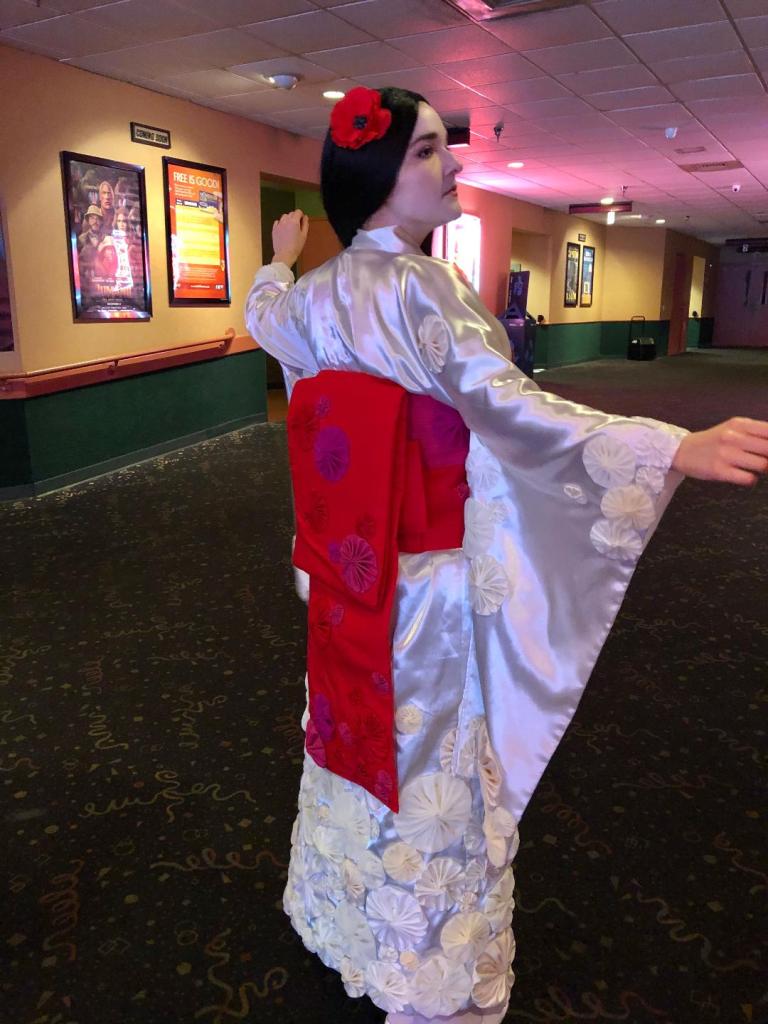
With exactly a month before the opera, I commenced work on a replica kimono that I hoped would give credence to the character. An abounding bevy of varying satin “yo-yos” were cut and hand sewn together as the key ornamentation of the robe, which was quite comfortable since it was lined in a thin cotton voile. The logistical challenge of creating the obi (sash) and faux drum knot was another story, but for now we’ll just say it was adequate for its brief stint at the theater. My lovely friend, Judy, captured a photo of the back of the outfit during intermission.

Raven black wig, red poppy affixed, and yards of silvery white satin summoned to mind the ancestral artistry of the Met’s Minghella Madame…

Hui He as Cio-Cio-San in Madama Butterfly / Metropolitan Opera

With properly applied white face, a dab of rouge, and ruby red lipstick, I felt every bit the geisha for Cio-Cio-San’s wedding day. The pantomime was complete !

While the marriage between Butterfly and Pinkerton resulted in undue catastrophe, the afternoon at the opera was a carefree delight. Should you ever be proposed with the choice of attending a heartrending performance of Madama Butterfly, there should be only one reply in return… I do !

Toi, Toi, Toi,

Mary Martha

For more information on how I created Cio-Cio-San’s signature wedding kimono, please check out my tutorial post !

Cast and Credits:

Madama Butterfly ─ Giacomo Puccini (1904)
Live in HD air date: November 9, 2019

Cast:
Cio-Cio-San ─ Hui He
Pinkerton ─ Bruce Sledge*
Suzuki ─ Elizabeth DeShong
Sharpless ─ Paulo Szot

*Replaced Andrea Carè

Credits:
Conductor ─ Pier Giorgio Morandi
Production ─ Anthony Minghella
Director/Choreographer ─ Carolyn Choa
Set Designer ─ Michael Levine
Costume Designer ─ Han Feng
Lighting Designer ─ Peter Mumford
Puppetry ─ Blind Summit Theatre
Live in HD Director ─ Habib Azar
Host ─ Christine Goerke

Manon Lescaut

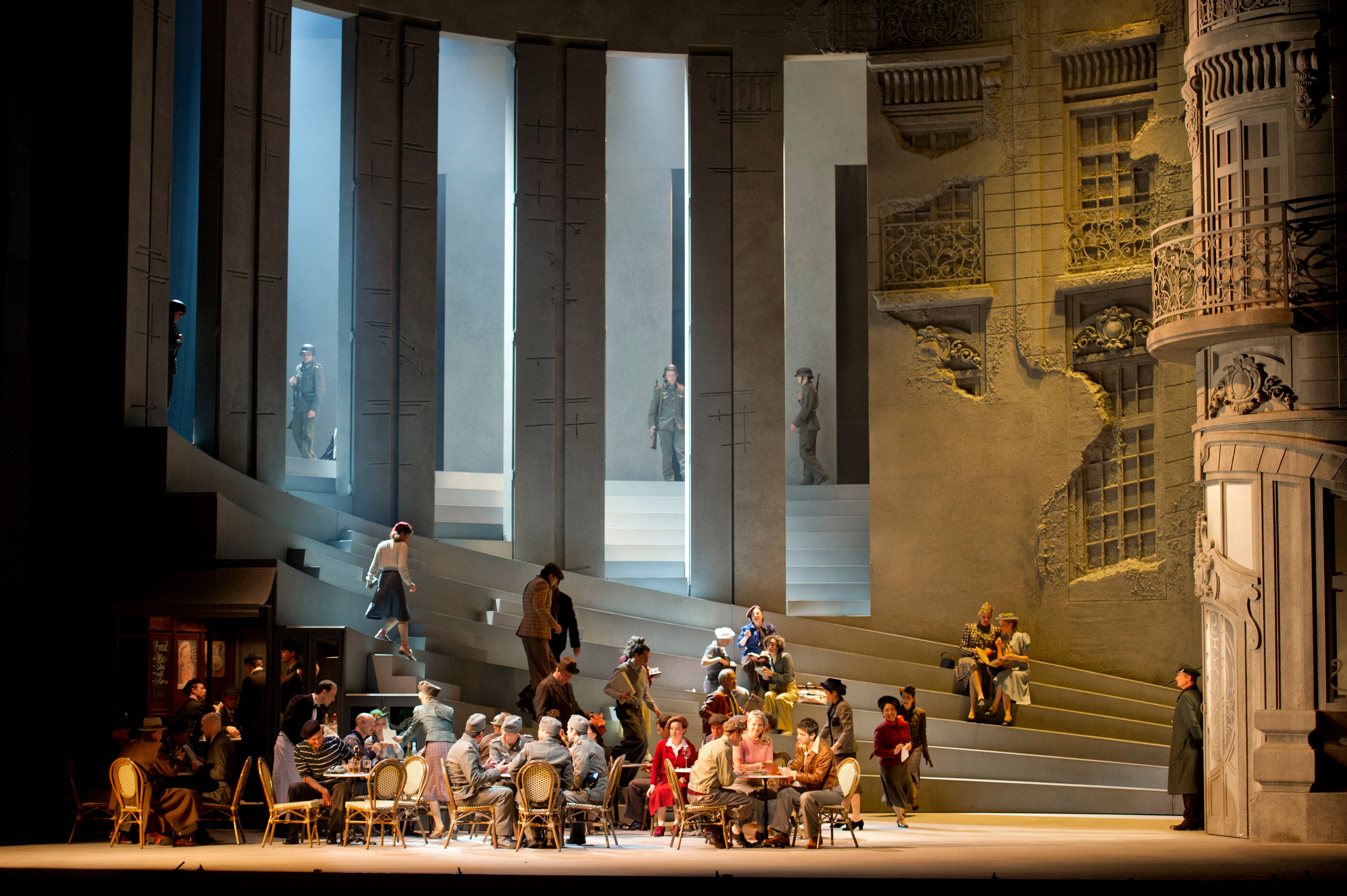
With an updated setting of occupied Paris during WWII, the Met’s volatile new production of Puccini’s Manon Lescaut brought out the glamour, darkness, and moral ambiguity of film noir. And just as with most Hollywood movies of the 1940’s, drama mottled every facet of Abbé Prevost’s salacious story.
But the most unforeseen action occurred off stage when Roberto Alagna stepped into the leading role of des Grieux with only 16 days to learn the part by memory. His alacrity paid off; he sounded terrific ! He also paired well with the statuesque Kristine Opolais, who, being of an above average height, exchanged her pumps for flats to better suit the abbreviated height of her fill-in des Grieux. How strange it felt to my eye to see a woman in flats in the 1940’s…

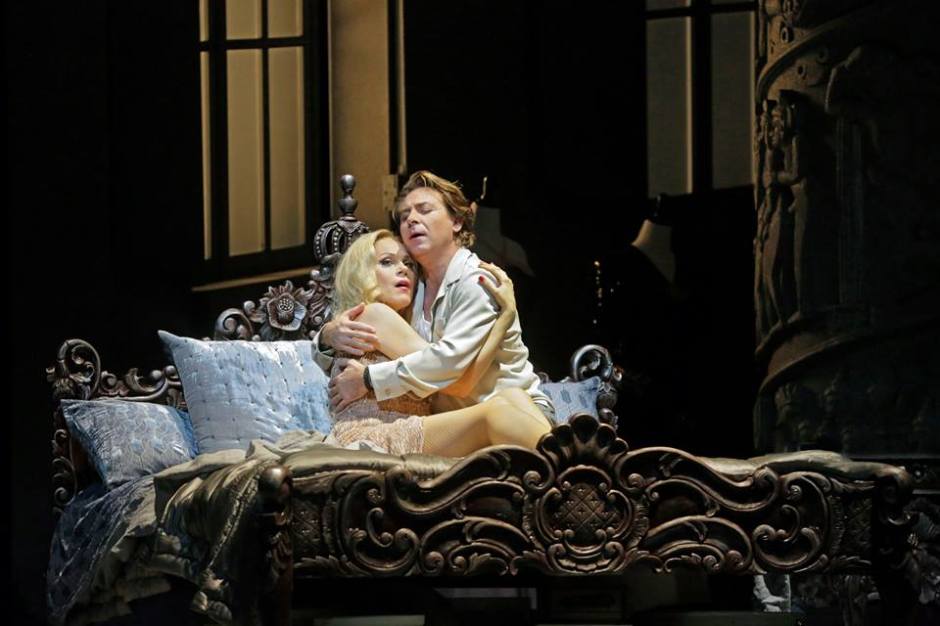
Roberto Alagna as des Grieux and Kristine Opolais as Manon Lescaut / Metropolitan Opera

Also confounding my visual perceptions were the distorted sets of Richard Eyre’s production. The swooping stairs that spanned across the stage made me fearful for the chorus members having to maneuver them. However, practice makes perfect and no false steps were made. Whew !

A scene from Sir Richard Eyre’s Manon Lescaut / Metropolitan Opera

While glamour is always a good thing, the overwhelming theme of illicit sex in Manon Lescaut was rather repugnant to me: the throngs of much older men scheming to entrap a young, innocent woman was not my idea of romance. Coupled by the dark overtones of the tumultuous setting, the feeling I had while watching Manon Lescaut was that of bitter cold and dampness ─ I wanted to crawl into a corner and wait for things to pass over ! As such, the opera ended in shambles.

The final scene of Manon Lescaut / Metropolitan Opera

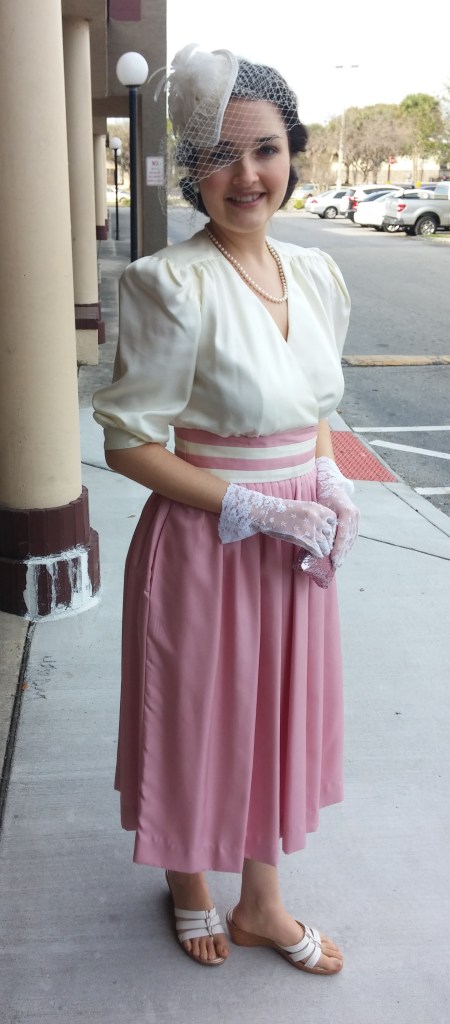
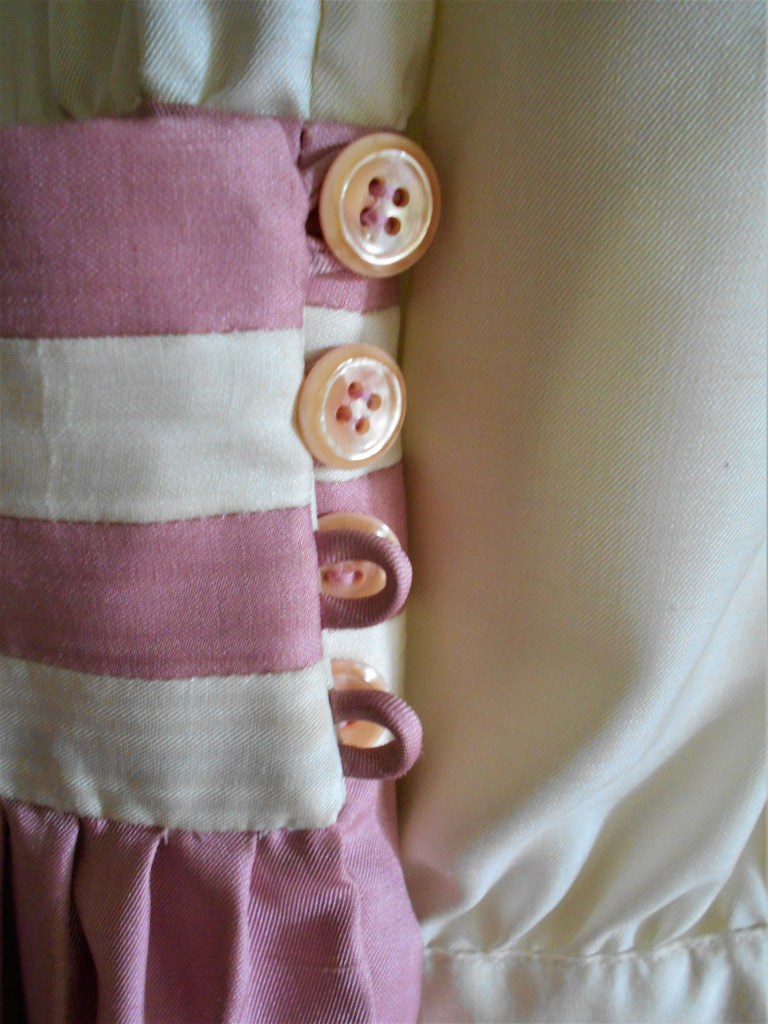
No, I didn’t care for Manon Lescaut. However, there was a silver lining to the new production and that was the swishy skirts and tilted millinery of 1940’s fashion ! If there’s one thing I enjoy more than others, it’s historical fashion and having the chance to experience a different period of clothing and mannerism. Of course, much research goes into my outfits when there’s a specific look I need to emulate, but fortunately I found just the ticket in one of my mother’s old dresses. Since I was a child, I have loved the pink and cream striped dress that has hung in the closet for years and one day when I plucked up the nerve to try it on for size, it fit ! The button loop closures at the waist are my favorite detail.

Pearls were a must as well as an elegant chignon, but I needed something more to aid in the cause… a hat was the likely choice. Thankfully, I was able to borrow a darling fascinator complete with birdcage veil ─ it was perfect for my desired look ! Without it, I wouldn’t have felt near the woman of the 40’s as I did while peeking through its tiny mesh windows. Now if only I had had a decent pair of pumps…

Thank you, Aunt Belinda !

I may not care whether I see Manon Lescaut ever again, but I do wish another occasion would arise for feminine fashion of the Forties !

Toi, Toi, Toi,

Mary Martha

Cast and Credits:

Manon Lescaut ─ Giacomo Puccini (1893)
Live in HD air date: March 5, 2016

Cast:
Manon Lescaut ─ Kristine Opolais
Des Grieux ─ Roberto Alagna
Lescaut ─ Massimo Cavalletti
Geronte ─ Brindley Sherratt

Credits:
Conductor ─ Fabio Luisi
Production ─ Sir Richard Eyre
Set Designer ─ Rob Howell
Costume Designer ─ Fotini Dimou
Lighting Designer ─ Peter Mumford
Choreographer ─ Sara Erde
Live in HD Director ─ Gary Halvorson
Host ─ Deborah Voigt

Turandot (2019)

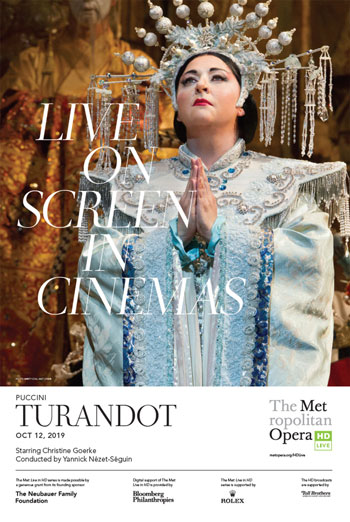
Hope. Blood. Turandot ! If my first brush with opera in 2015 hadn’t of been so life-altering, Puccini’s grandest spectacle (and final opera) would be the undisputed favorite of my heart. I remember when I first saw the opera in theaters in early 2016: it was the encore showing the following Wednesday evening since I was out of town for the live Saturday matinee broadcast. So monumental was the feeling I had while witnessing the story unfold on stage that when the Met announced that Turandot would be returning to theaters in 2019, I jumped on the affirmative decision faster than a Ferrari at top speed.

Turandot has everything. There’s drama, romance, passion, mystery, sacrifice, joy, and best of all, some of the most heart-pounding, resplendent music your ears will ever hear. The emotional power behind the fearless and triumphant aria, “Nessun dorma”, sends me to the brink of tears while elevating me from my terrestrial state. There are many renditions on the web, but I am especially moved by the English/Italian translation of the Pavarotti performance below. Divine !


Luciano Pavarotti singing “Nessun dorma” (video: MeastroPava4Ever)

As much as I adore the greatest tenor aria ever written (and that is not an exaggeration), my favorite moment in the opera comes during the high-stakes Riddle Scene showdown. Regardless of how many times I’ve seen the opera and know its plot inside and out, I can’t help but think I’ve missed something and fear a fatal slip-up by Calàf. Thankfully, my trepidation is always unfounded.

Christine Goerke and Yusif Eyvazov in Turandot / Metropolitan Opera

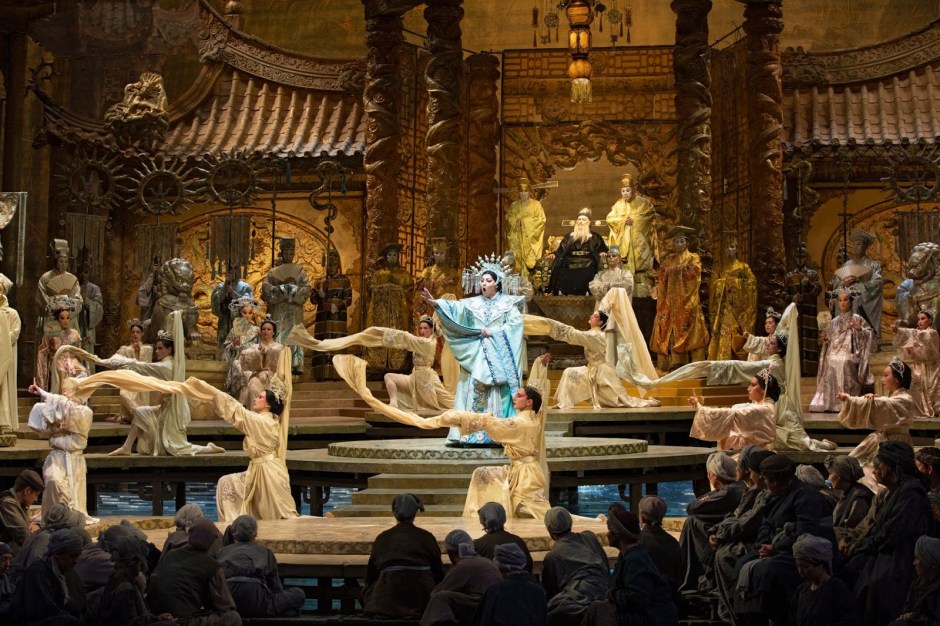
While this performance of Turandot had its plusses (Eleonora Buratto’s Liù) and minuses (an overly sensitive Calàf), the reigning winner is still Franco Zeffirelli’s magnificent production. Everything from the sets and costumes to the choreography of the chorus is perfectly enacted for an otherworldly experience. The feeling is magical. Your breath is taken away.

Yusif Eyvazov and Christine Goerke in Turandot / Metropolitan Opera

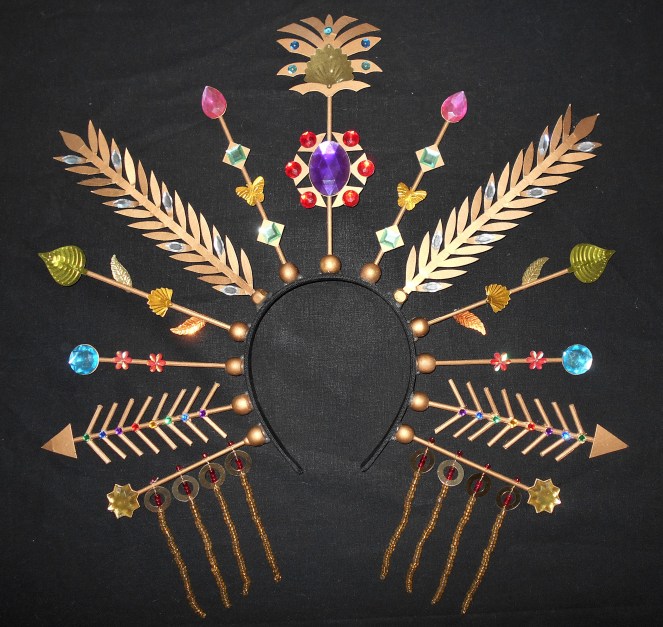
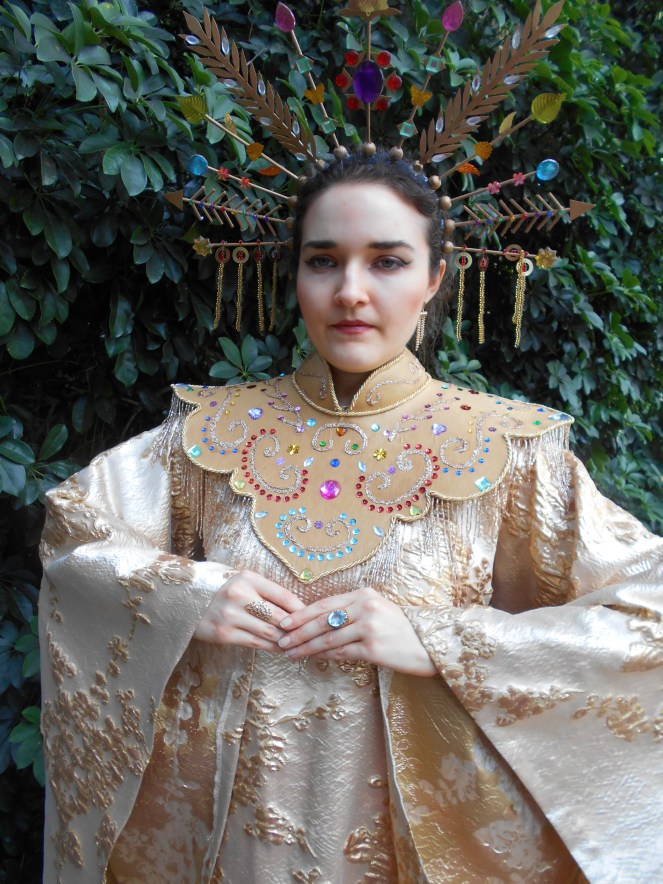
Heavily influenced by traditional Beijing Opera, the characters in Zeffirelli’s extant 1987 staging of Turandot are loaded with symbolic make-up, ornate robes, symmetrical cloud collars, and other brightly colored embellishments. As I contemplated the design of my costume for the 2019 Turandot, I had one prerequisite: whatever I wished to make HAD to coordinate with the headpiece I created for my 2016 outing since I was pressed for time (ahem, Manon) and didn’t want to fiddle with the engineering logistics of building a new headpiece from scratch.

The headpiece worn to Turandot in 2016

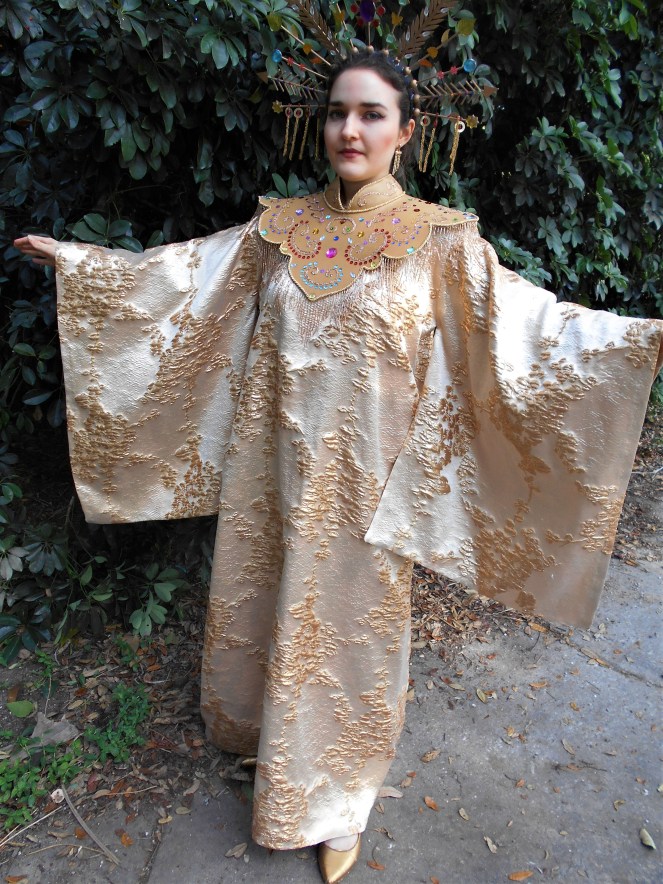
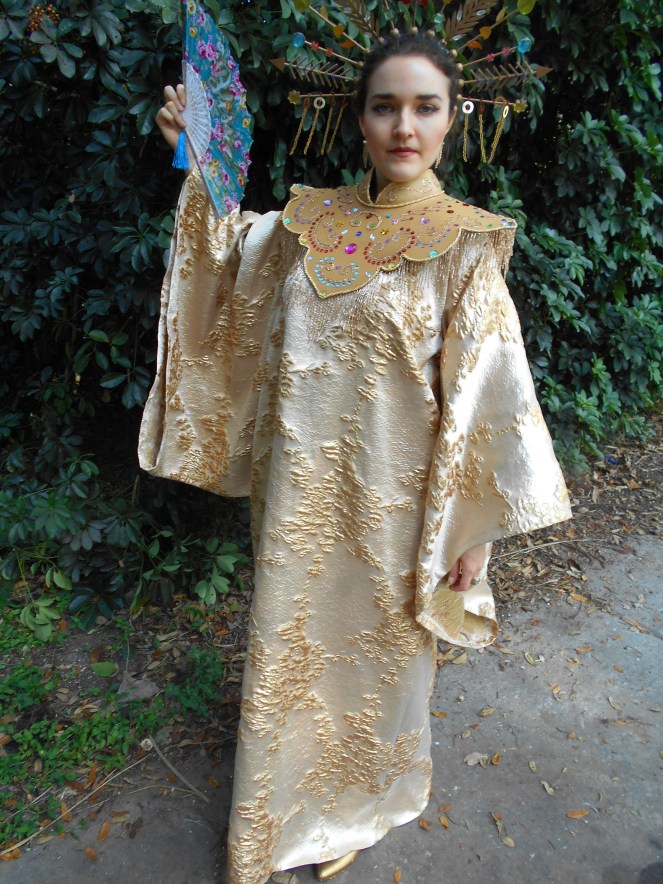
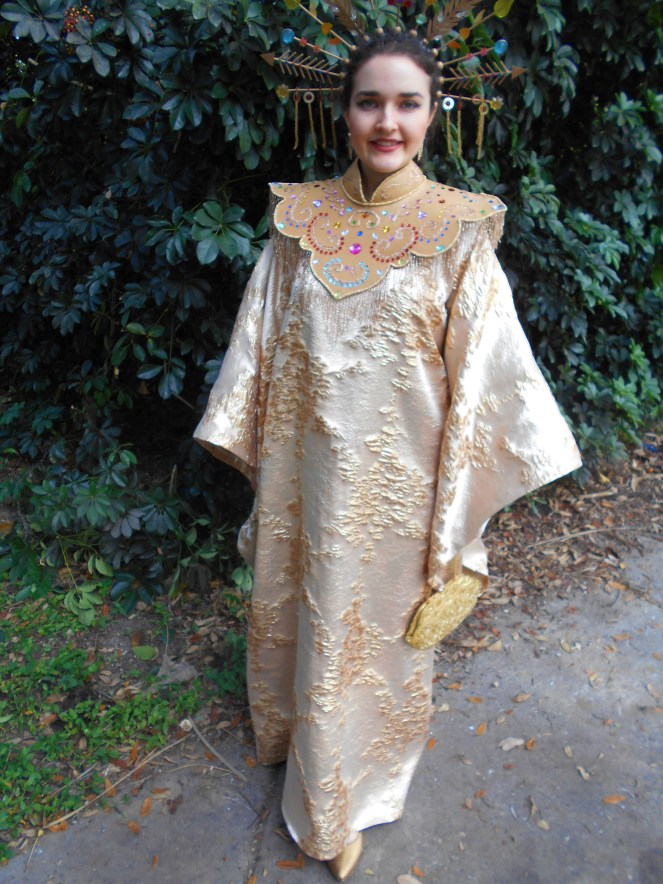
With guidelines established, I fashioned my outfit entirely around the color scheme of the headpiece: predominantly gold with LOTS of colorful jewels ! My friend, Judy, snapped this picture during the intermission at the theater:

The Turandot “death stare”… Thank you, Judy !

The brocade robe was self-drafted using only the measurements of the shoulder width and hem diameter. The sleeves were long rectangles folded in half out of the pillowy metallic material and sewn together at the bottom edge.

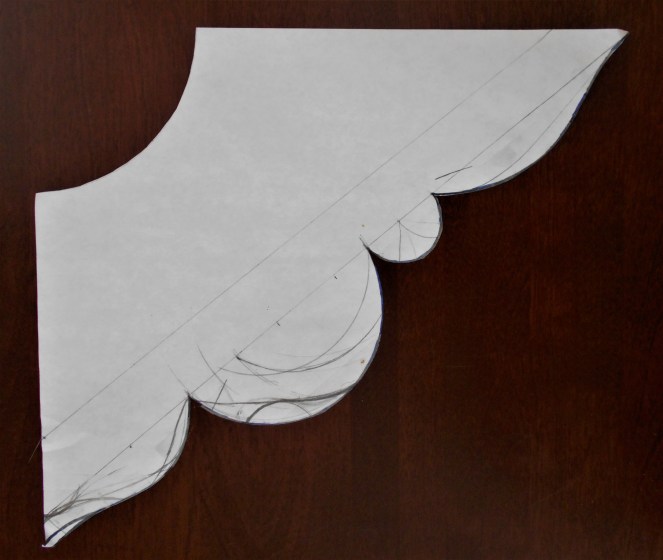
Creating the cloud collar was not as straightforward. Studying the specimen from the opera, I fiddled with drawing a quartered pattern using a compass as well as freehand curves.

Drafting the cloud collar

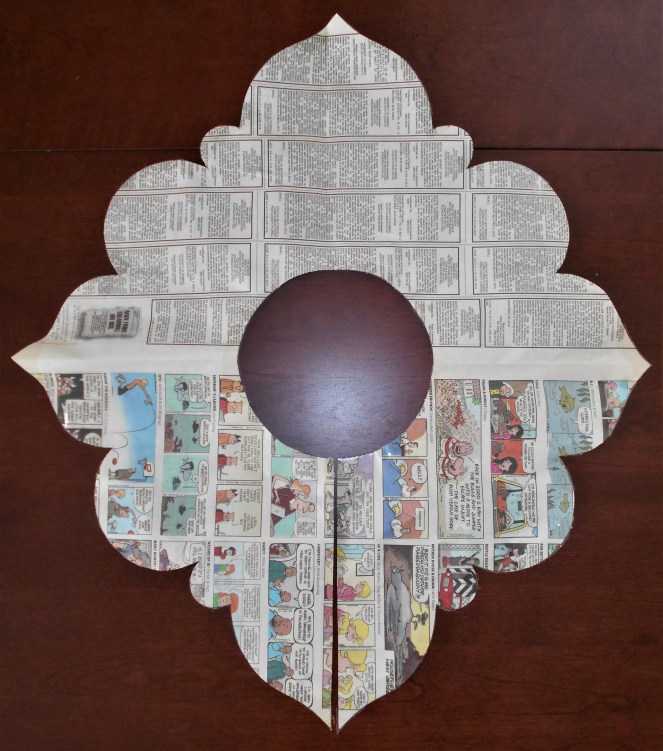
With just a few tweaks, the finalized pattern, which I copied onto newspaper, turned out great ! The full 4 quadrant newspaper replica was then taped to a sheet of thin foam, leftover from my Valkyrie days, and cut from its pliable surface as well as two layers of mustard colored stretch taffeta.

Pattern cut from newspaper

Through trial and error, the separate pattern for the pop-up mandarin collar was finally completed to my satisfaction and applied the foam and taffeta in the same manner.

Finalized Mandarin collar pattern

All that was left was the decoration ! The hot glue gun and I have an on again/off again relationship, but for Turandot, we were most definitely on !

Thank you for the fan, Faith !

My Chinese robe on the cheap made me feel like a citizen of Peking attending the riddle ceremony ! Careful, Calàf !

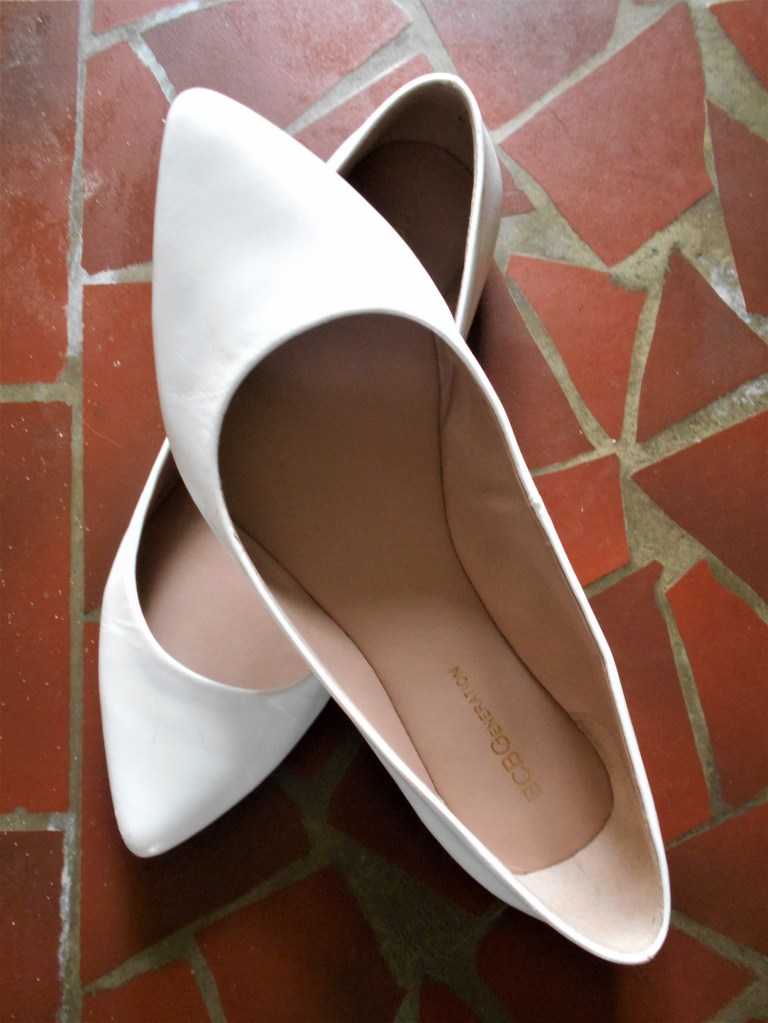
One mention of my shoes… those ballet flats ? Well, they’re not really gold. They’re white. And I bought them specifically to wear with my Empire gown to Tosca in 2018… certainly not Chinese ! But dousing dollars on new shoes for a one-time occasion is not really my style. The level of the flat was right ─ the hem of my robe wouldn’t allow for any height of heel ─ and so I changed their appearance temporarily with gold colored duct tape.

Without question, Zeffirelli’s majestic Turandot is my favorite opera in which to introduce a complete newcomer. Maybe the next time Turandot returns to the Live in HD schedule, you’ll be my first-timer and the spell of Puccini’s score will bewitch you with its undeniable magic.

Toi, Toi, Toi,

Mary Martha

Cast and Credits:

Turandot ─ Giacomo Puccini (1926)
Live in HD air date: October 12, 2019

Cast:
Turandot ─ Christine Goerke
Calàf ─ Yusif Eyvazov
Liù ─ Eleonora Buratto
Timur ─ James Morris

Credits:
Conductor ─ Yannick Nézet-Séguin
Production ─ Franco Zeffirelli
Set Designer ─ Franco Zeffirelli
Costume Designers ─ Anna Anni, Dada Saligeri
Lighting Designer ─ Gil Wechsler
Choreographer ─ Chiang Ching
Live in HD ─ Gary Halvorson
Host ─ Angel Blue

Tosca

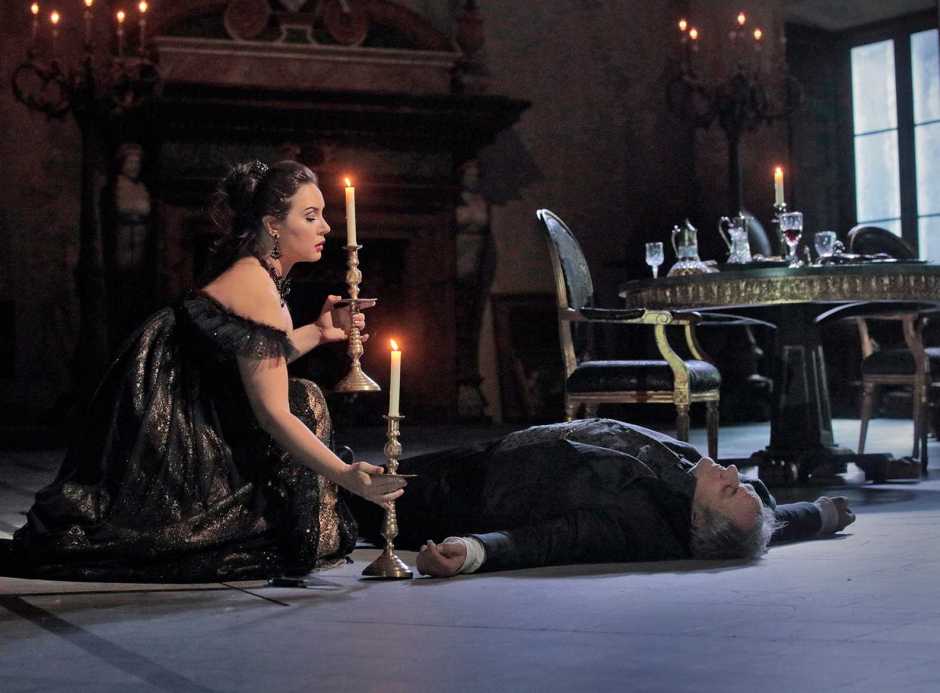
With a static setting of June 17-18, 1800, how does a stage director erect an enlivened production of Puccini’s Tosca ? When tasked to the capable hands of Sir David McVicar, the opera, no matter the setting, is bound to be a hit. That prediction held true: the Met’s enthralling new production of Tosca was bold and dramatic, pious and perilous.

A scene from Act III of Tosca / Metropolitan Opera

Although the McVicar production was a huge success, it’s almost unfathomable to believe that the entire principal cast and conductor originally slated to perform bowed out before the first curtain ever ascended. However, the new players were arguably just as effective with tempestuous Sonya Yoncheva and swarthy Vittorio Grigolo igniting passion as the lovers Floria Tosca and Mario Cavaradossi.

Vittorio Grigolo as Mario Cavaradossi and Sonya Yoncheva as Floria Tosca / Metropolitan Opera

Everyone loves a good romance. But for me, the highlight of Tosca is the riveting Te Deum, a processional of hallowed majesty and lascivious scheming. If I had to choose a small handful of favorite lines from all the operas ever written, Scarpia’s blasphemous and ironic pronouncement (“Tosca, you make me forget God !”) would be ranked in the top three. The sacrilegious statement simultaneously occurs with the conclusion of the chorus’ magnanimous hymn of praise… In the middle of a cathedral. During High Mass. Priceless.

Željko Lučić as Scarpia (far right) during the Te Deum of Tosca / Metropolitan Opera

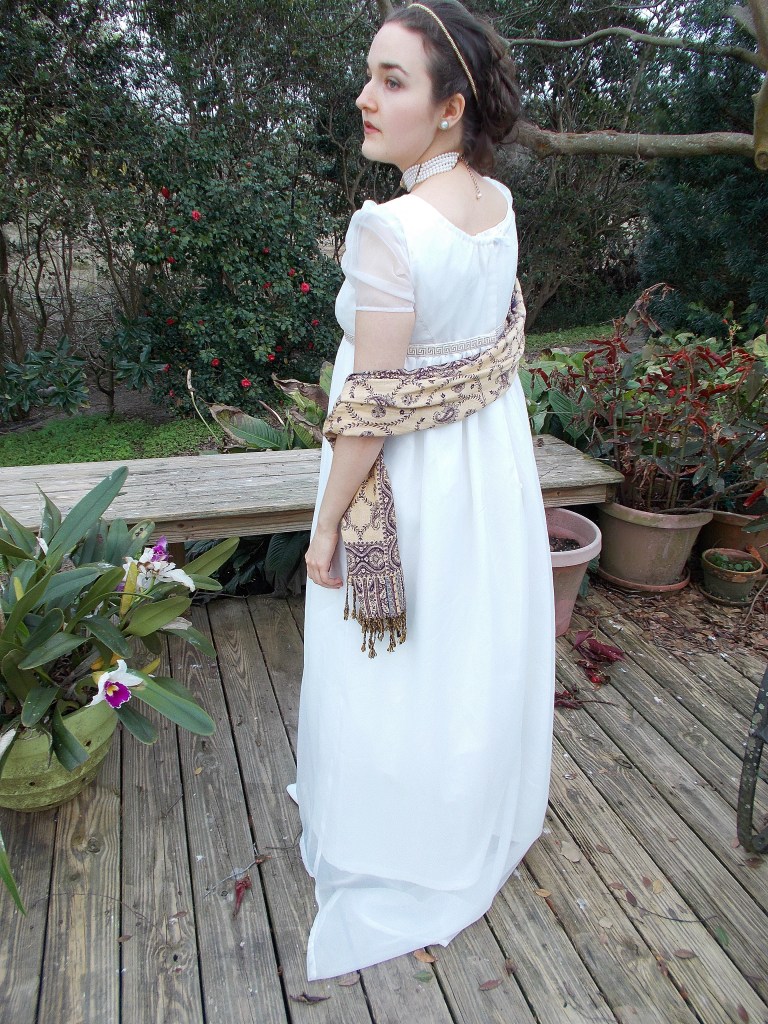
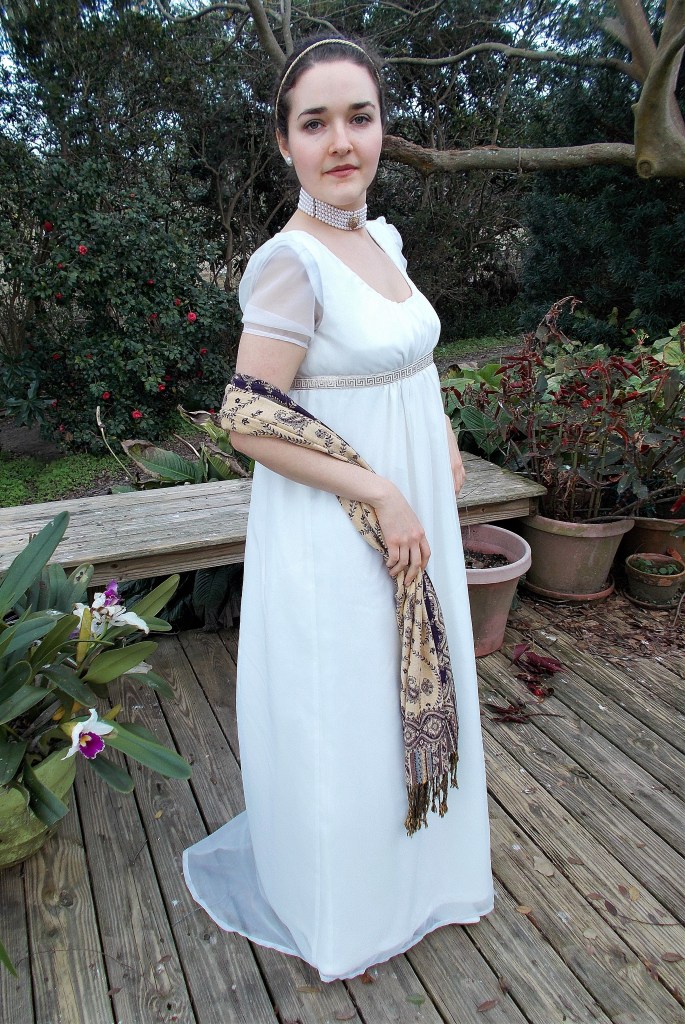
Previously mentioned, Tosca is set in 1800, often referred to as the Regency/Napoleonic era in history. I’ll be frank ─ never have I thought the extremely elevated waistlines of empire gowns to be flattering on any woman. The style invariably reminds me of two things: nightgowns and maternity clothes. But, alas ! It was the required look for the opera so I began to contemplate my own gown. While there are a multitude of commercial sewing patterns for Empire/Regency gowns on the market, I chose Butterick 6074 because it appeared more historically accurate and brought the added value of five different pattern options in one envelope. I made a variation of version A.

Butterick 6074

Nearly every detail of my Empire ensemble was modeled after the simplistic gowns (they must always be called gowns, I learned) worn during the infancy of the 19th century. The sheer train and sleeves, drawstring neckline, and accenting Greek key ribbon at the waistline were all characteristics of the most popular gowns of the day. Pearls and a hair ribbon accessorized my look as well as a shawl from the Orient.

Aiding me in my research were the very helpful articles from Fashion-Era.com and the University of Vermont. These two online resources were invaluable as I often referred to their guidance. Curiously, the gauzy whitework gown worn in Act I of the opera was fairly accurate ─ especially when speaking in terms of theatrical costumes ─ albeit, the short gathered tulle ruffles around the neckline were a mere artistic deviation.

Sonya Yoncheva as Tosca and Vittorio Grigolo as Cavaradossi / Metropolitan Opera

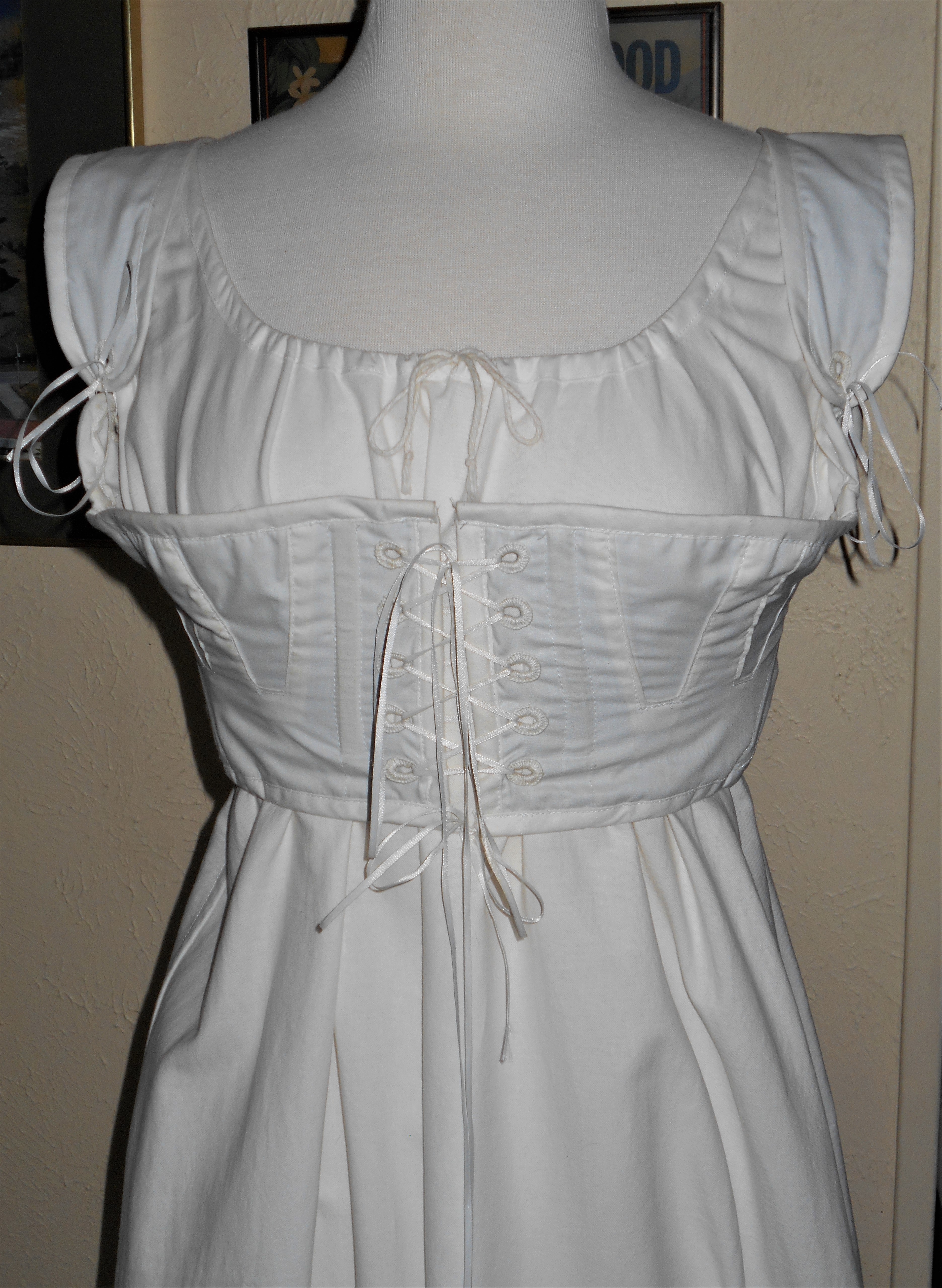
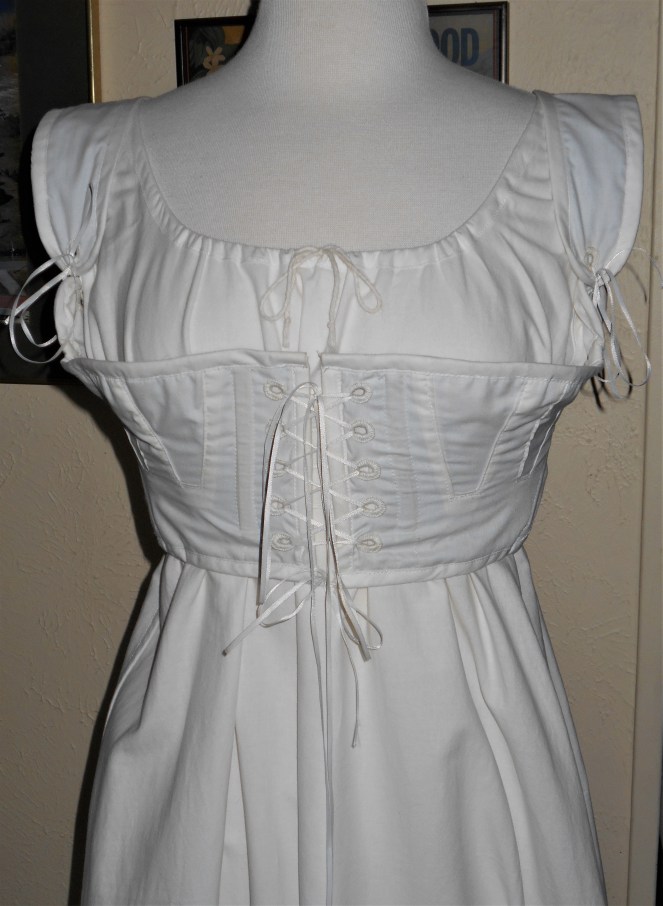
What most people wouldn’t know is that in addition to the floor length gown, I also had to sew a chemise and set of short stays (the corset of the period) to obtain the proper “column” silhouette that was so ubiquitously envied during the Napoleonic Era. In addition to shaping the figure into that of a Grecian statue, the height of the bustline was also raised by the stays. Who would have thought that a few stubby lengths of nylon cable ties and some strategic bust gores could give such heavenly lift ?

Regency chemise and short stays

Despite my general distaste for women’s clothing of the early 19th century, I gained an… appreciation… for the Empire style and learned the reasoning behind its popularity during the time. Undoubtedly, the greatest advantage to my costuming is the breadth and retention of knowledge that is acquired during my extensive research. While the gowns of early 1800’s were soft and demure, the military battles and civic rivalries during the period made for fiery reading. Perhaps drawing upon history, that same combustible drama was clearly emanated in the verismo verses of Tosca.

Toi, Toi, Toi,

Mary Martha
Cast and Credits:

Tosca ─ Giacomo Puccini (1900)
Live in HD air date: January 27, 2018

Cast:
Tosca ─ Sonya Yoncheva
Mario Cavaradossi ─ Vittorio Grigolo
Scarpia ─ Željko Lučić
Sacristan ─ Patrick Carfizzi

Credits:
Conductor ─ Emmanuel Villaume
Production ─ Sir David McVicar
Set and Costume Designer ─ John Macfarlane
Lighting Designer ─ David Finn
Movement Director ─ Leah Hausman
Live in HD Director ─ Gary Halvorson
Host ─ Isabel Leonard